Curved claw or rip claw
You are about to buy a claw hammer and the listing cannot decide whether the claw is curved or straight. A curved claw or rip claw is that choice: one rolls a nail out, the other starts a prise between boards. Head weight is a different question. This page does not re-rank star lines, and it does not pick 16 oz against 20 oz. Peter F. updated this on 22 October 2026 from twelve amazon.co.uk listings snapshotted on 19 October 2026. There is no lab test. A qualifying purchase can earn us a commission at no extra cost to you. Prices are on the [Claw hammer comparison](/hub/hand-tools/claw-hammer).
You are about to buy a claw hammer and the listing cannot decide whether the claw is curved or straight. A curved claw or rip claw is that choice: one rolls a nail out, the other starts a prise between boards.
You are about to buy a claw hammer and the listing cannot decide whether the claw is curved or straight. A curved claw or rip claw is that choice: one rolls a nail out, the other starts a prise between boards. Head weight is a different question. This page does not re-rank star lines, and it does not pick 16 oz against 20 oz. Peter F. updated this on 22 October 2026 from twelve amazon.co.uk listings snapshotted on 19 October 2026. There is no lab test. A qualifying purchase can earn us a commission at no extra cost to you. Prices are on the Claw hammer comparison.
Our top picks
| Badge | Product | Claw claim | Head weight | On a pull | Note | Price | Offer |
|---|---|---|---|---|---|---|---|
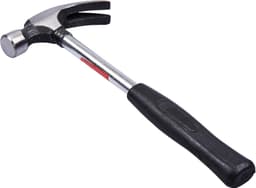
| Best overall |  HOUSERAN HOUSERAN 500 g claw hammer | Title straight rip; bullet curved | 500 g; bullet says 8 oz | No failure in the file | 6.0 | about £13.99 | View offer |
 MAXPOWER MAXPOWER 8 oz claw hammer | Title curved rip; bullet straight | 8 oz (226 g) | Shape not settled | 8.1 | about £9.78 | View offer | |
 Amtech Amtech 8 oz claw hammer | Title straight; bullet curved | 8 oz / 225 g | Bent claw and head off | 6.0 | about £6.81 | View offer |


On this page
What the curve changes
Listings that say both
When the claw is the part that breaks
Which to buy for the job you actually have
Common questions
Which claw pulls a nail more cleanly?
Which claw do I want for taking boards off?
What if the title says straight and a bullet says curved?
Why did a cheap claw bend or snap?
Should I prise with the claw at all?
Related pages
Sources
The standard identifier is BS 876:1995, with HSE guidance on work equipment and eye protection, plus a UK retailer hammer guide. Prices, stars, and review counts are amazon.co.uk captures from 19 October 2026, scored on 22 October 2026. They are not a lab test.
- BSI Knowledge: BS 876:1995, specification for hand hammers (retrieved 22 October 2026)
- ANSI webstore: BS 876:1995 (retrieved 22 October 2026)
- Intertek Inform: BS 876:1995 contents (retrieved 22 October 2026)
- HSE: PUWER overview (retrieved 22 October 2026)
- HSE L22: Safe use of work equipment (retrieved 22 October 2026)
- HSE: Using the right type of PPE (retrieved 22 October 2026)
- Toolstation: hammer buying guide (retrieved 22 October 2026)
- Sealey: hammer instructions (retrieved 22 October 2026)