Independent comparisons. We may earn from shop links. More info

Band clamp vs sash clamp: a loop or a one-line push

Updated: 22 October 2026

You already have sash cramps on the bench, and a mitred frame or a loose chair is waiting for glue. The band clamp vs sash clamp choice is about the direction of the force. A band clamp shortens a loop around the outside so the corners move together, while a sash clamp, in British workshops a sash cramp, pushes along one bar. The straps and their prices are on the [band clamp comparison](/hub/hand-tools/band-clamp). Peter F. has not glued these joints in a lab. The limits below come from UK workshop notes and single amazon.co.uk reviews read on 22 October 2026.

You already have sash cramps on the bench, and a mitred frame or a loose chair is waiting for glue. The band clamp vs sash clamp choice is about the direction of the force.

Our top picks

On this page

A loop around the outside, or a push along one line

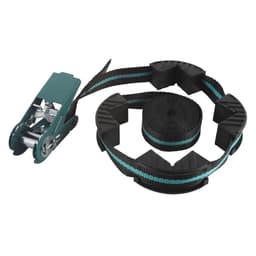
A sash cramp is a long bar, a fixed jaw and a screw jaw. You set it across one glue line and the pressure runs along that bar. A band clamp replaces the bar with webbing, a ratchet or a screw adjuster, and usually corner blocks. Tightening shortens the loop, so every side of a closed shape is drawn inwards at once. A bar across one diagonal can shorten that diagonal and leave the other long. A strap loads the whole perimeter, which is why it suits an odd shape that gives a jaw nowhere square to sit. Loop tension still leaves the faces free to skate, so a separate clamp has to hold them in one plane. A gap from a short rail is a sawing problem.

Picture frames, and the thin moulding that bows

On a four-sided mitre frame, the band closes all four corners in one pull. You seat a corner block on the outside of each mitre, lay the strap in the blocks, and take up the slack until the joints just meet. Without the blocks the band bites the arris and the moulding dents. A hard band on a thin frame bends the sides inwards and the mitres open again. UK Workshop framers describe the remedy as the strap plus a small clamp on each mitre. If the frame goes diamond-shaped, a bar across the long diagonal can pull it back towards square. V-nail sizes are on the band clamp for picture frames page, and the tightening order is on how to use a band clamp.

Drawers, chairs, and reviews that do not agree

A drawer box needs the same inward pull as a frame. On a tall box, one strap near the top and a second near the bottom stops the sides twisting. Corner blocks give the band a flat path so it does not crush a thin side. Each of these is a single amazon.co.uk review, not a measured test. A Stanley owner found a chair re-glue easier than fighting sash cramps around the legs. A Wolfcraft owner found the jaws clumsy on a drawer. A Yangfei owner bent the adjuster on a chair repair. A turned spindle gives a sash cramp nowhere flat to sit. With the jaws off, the Wolfcraft becomes a tie-down.

Which tool to pick, and when to use both

Keep the sash cramps you already own. Add a band clamp when every corner of a closed shape has to move together. An L-shaped corner clamp holds one corner and has no band, so the other three joints stay free. Strap length and how many corner blocks are in the box are set out in the band clamp buying guide. Use a strap for a closed perimeter, a sash cramp or a G-cramp for one joint, and both if the mitres close and then slip out of plane.

Common questions

When is a band clamp the better tool?
Use a band clamp when the whole perimeter has to close at once, and the parts are already cut to meet. Frames, drawers, odd shapes and a chair with several loose joints fit that case. It is the weaker choice on one glue line.
When do I stay with a sash cramp?
Stay with a sash cramp when the force belongs along one axis: a panel, a single open mitre, or a joint you need to push square. Keep it when a thin frame starts to bow under a hard strap. A G-cramp covers the same push on a shorter joint.
Can I use both on one frame?
Yes, and on a thin mitre you often should. The strap draws the four corners in. A small clamp on each mitre, or a sash cramp across the faces, stops one side skating past the other. UK Workshop framers describe that pairing after a hard band opened the mitres it had just closed.
Is a band clamp enough for a drawer?
It can be, if the jaws and corner blocks bear on the box. Two straps, one high and one low, keep a tall drawer from twisting. It falls short when the jaws will not seat, as one Wolfcraft reviewer found. A sash cramp on that corner finishes the glue-up.
What about a chair with round legs?
A strap is often the easier way to pull a chair together, because a turned leg gives a sash cramp no flat seat. One Stanley reviewer found a re-glue easier than fighting bars around the legs. Protect the rounds, and use a G-cramp if only one tenon is loose.
Is a corner clamp the same thing?
A corner clamp and a band clamp do different jobs. An L-shaped angle clamp grips one corner between two jaws. A band clamp runs a strap around the piece and pulls every corner inwards. One jaw leaves the other three free.
Will a strap replace a G-cramp for a single mitre?
A strap is a poor stand-in for a G-cramp on one mitre. The loop wants a closed shape, so on a single corner it does little. A G-cramp puts the screw on that glue line and leaves the rest of the frame alone.

Related pages

Sources

Sources for this comparison, last checked on 22 October 2026.

  1. GOV.UK, securing loads on HGVs and goods vehicles: the basics (retrieved 22 October 2026)
  2. GOV.UK, ways to secure a load, including lashing labels (retrieved 22 October 2026)
  3. Consumer Rights Act 2015 (retrieved 22 October 2026)
  4. Wolfcraft UK, ratchet belt clamp (retrieved 22 October 2026)
  5. Neilsen CT5437 4 m band-type corner clamp (retrieved 22 October 2026)
  6. Lion Picture Framing, 7 m frame band clamp (retrieved 22 October 2026)
  7. UK Picture Framing Supplies, 4 m strap and band clamp (retrieved 22 October 2026)
  8. ITS, band clamps (retrieved 22 October 2026)