How to use a 3/8 inch socket set
The 13 mm nut on the mower deck is rusty, the ratchet is in your hand, and the socket is only half on the square. That is how a fastener gets rounded before it moves. How to use a 3/8 inch socket set comes down to three checks: the square is seated and holds, the direction is proved before you load the nut, and you stop when the socket starts to slip. Our [3/8 inch socket set comparison](/hub/hand-tools/3-8-inch-socket-set) is the buying table. This page assumes you already own a 3/8 inch ratchet and sockets. What to look for in the box is on the [3/8 inch socket set buying guide](/hub/hand-tools/3-8-inch-socket-set/sub/3-8-inch-socket-set-buying-guide). There was no workshop trial. A qualifying purchase can earn a commission at no extra cost to you.
The 13 mm nut on the mower deck is rusty, the ratchet is in your hand, and the socket is only half on the square. That is how a fastener gets rounded before it moves.
The 13 mm nut on the mower deck is rusty, the ratchet is in your hand, and the socket is only half on the square. That is how a fastener gets rounded before it moves. How to use a 3/8 inch socket set comes down to three checks: the square is seated and holds, the direction is proved before you load the nut, and you stop when the socket starts to slip. Our 3/8 inch socket set comparison is the buying table. This page assumes you already own a 3/8 inch ratchet and sockets. What to look for in the box is on the 3/8 inch socket set buying guide. There was no workshop trial. A qualifying purchase can earn a commission at no extra cost to you.
Our top picks
| Badge | Product | Seating | Points | Ratchet | Note | Price | Offer |
|---|---|---|---|---|---|---|---|
| Best overall |  Draper Draper Expert 18-piece 3/8 inch socket set | Press the release button | 6-point | 72-tooth | 8.9 | about £26.47 | View offer |
 Silverline Silverline 13-piece 3/8 inch socket rail | Needs a ratchet you own | 6-point | None | 6.6 | about £10.95 | View offer | |
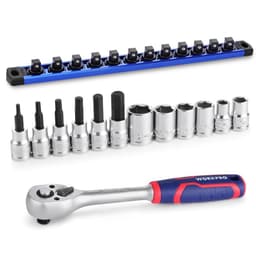
 WORKPRO WORKPRO 14-piece 3/8 inch socket set | Direction lever can be stiff | Not printed | 72-tooth | 6.3 | about £12.99 | View offer |


On this page
Seat the 3/8 inch square
Set the direction before the nut is loaded
Turn, reset, and watch the flats
When you stop
Common questions
Which end of the socket goes on the ratchet?
How do you know the square is seated?
What do you do when the handle runs out of room?
How do you choose the socket so it does not round the nut?
What should you do if the socket starts to slip?
Is the click from the ratchet the same as a torque-wrench click?
Related pages
Sources
Public UK sources from the research digest, last checked on 20 October 2026. Shelf prices and star lines are the amazon.co.uk figures in the product display for this comparison.
- HSE: PUWER overview (retrieved 20 October 2026)
- HSE: using the right type of PPE (retrieved 20 October 2026)
- Wonkee Donkee: what is an impact socket (retrieved 20 October 2026)
- Wonkee Donkee: what are sockets made of (retrieved 20 October 2026)
- Cromwell: sockets and socket sets (retrieved 20 October 2026)
- KS Tools 3/8 inch hexagon impact socket (retrieved 20 October 2026)
- PartsForMachines: mechanics and automotive socketry (retrieved 20 October 2026)
- Bradfords: socket sets (retrieved 20 October 2026)