1/4 vs 3/8 ratchet
The sockets look similar, and the squares will not click into each other’s handles. A 1/4 vs 3/8 ratchet choice is which male square the job needs: 6.3 mm or 10 mm. Use 1/4 inch when the fastener is small and already turns. Move to 3/8 inch or 1/2 inch for a wheel nut, a suspension bolt, or anything you would stand on. This page can send you away from the [1/4 inch ratchet comparison](/hub/hand-tools/1-4-ratchet). It does not rank those handles. Peter F. used ISO 1174-1 and Wonkee Donkee’s wheel-wrench sizes. Breaking torque was not measured. A qualifying purchase can earn a commission at no extra cost to you.
The sockets look similar, and the squares will not click into each other’s handles. A 1/4 vs 3/8 ratchet choice is which male square the job needs: 6.3 mm or 10 mm.
The sockets look similar, and the squares will not click into each other’s handles. A 1/4 vs 3/8 ratchet choice is which male square the job needs: 6.3 mm or 10 mm. Use 1/4 inch when the fastener is small and already turns. Move to 3/8 inch or 1/2 inch for a wheel nut, a suspension bolt, or anything you would stand on. This page can send you away from the 1/4 inch ratchet comparison. It does not rank those handles. Peter F. used ISO 1174-1 and Wonkee Donkee’s wheel-wrench sizes. Breaking torque was not measured. A qualifying purchase can earn a commission at no extra cost to you.
Our top picks
| Badge | Product | Drive | Printed swing | Grip | Note | Price | Offer |
|---|---|---|---|---|---|---|---|
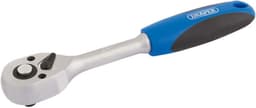
| Best overall |  Draper Draper 16427 1/4 inch soft-grip ratchet | 1/4 inch (6.3 mm) | Not printed | Soft grip | 8.5 | about £8.56 | View offer |
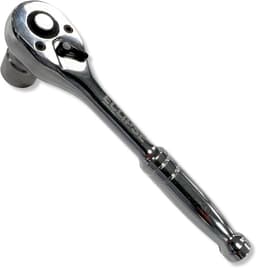
| Alternative |  Eclipse Eclipse EMRH14 1/4 inch ratchet | 1/4 inch (6.3 mm) | 5° | All metal | 8.2 | about £9.76 | View offer |
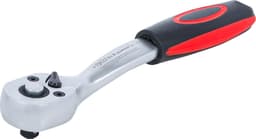
| Best value |  BGS BGS 517 1/4 inch fine-tooth ratchet | 1/4 inch (6.3 mm) | Not printed | Two-component | 8.1 | about £7.34 | View offer |
On this page
The squares are 6.3 mm and 10 mm
Stay with 1/4 inch for small fasteners that already turn
Leave this category for wheel nuts and seized bolts
A plain ratchet still does not set torque
Common questions
What is the difference between a 1/4 inch and a 3/8 inch ratchet?
Is 6.3 mm the same square as 1/4 inch?
Can I undo wheel nuts with a 1/4 inch ratchet?
When is 3/8 inch the better drive?
Will an adaptor let me use a 1/2 inch socket on this handle?
What if the bolt is seized?
Do I still need a torque wrench after I choose the square?
Related pages
Sources
Sources from the research digest, last checked on 20 October 2026.
- HSE, PUWER overview (retrieved 20.10.2026)
- HSE, maintenance of work equipment (retrieved 20.10.2026)
- Consumer Rights Act 2015, section 9 (retrieved 20.10.2026)
- Consumer Rights Act 2015, sections 22 and 23 (retrieved 20.10.2026)
- ISO 3315:2018 catalogue summary (retrieved 20.10.2026)
- ISO 1174-1:2011 (retrieved 20.10.2026)
- Mac Tools UK catalogue (retrieved 20.10.2026)
- RS Components breaker-bar guide (retrieved 20.10.2026)