Independent comparisons. We may earn from shop links. More info

How to use a 1/4 inch ratchet

Updated: 22 October 2026

The 1/4 inch sockets are already in the tin, and the fastener is a small one on a cover or a bracket. This is the sequence from fitting the socket to knowing when the click is normal and when it means stop. The square is 6.3 mm. It drives a matching socket and nothing larger. It does not rank the eight models in our [1/4 inch ratchet comparison](/hub/hand-tools/1-4-ratchet). Peter F. used UK how-to notes from Wonkee Donkee and RS Components. There was no bench test. A qualifying purchase can earn a commission at no extra cost to you.

The 1/4 inch sockets are already in the tin, and the fastener is a small one on a cover or a bracket. This is the sequence from fitting the socket to knowing when the click is normal and when it means stop.

Our top picks

On this page

Fit a socket that matches the 6.3 mm square

Start with the socket. The female square has to match the 6.3 mm male square. Push it on until the ball catches, unless that ratchet needs the button first. The socket has to sit fully over the fastener, or it rounds the corners. Test the direction before you load it. Which handle to have bought is the buying guide.

Set the lever by testing, not by guessing left or right

The lever selects which way the pawl drives and which way it freewheels. Layout is not the same on every head. FIRSTINFO’s R and L marks confused a buyer who expected the usual left-to-loosen habit. For a normal right-hand thread, looking onto the fastener, loosening is anti-clockwise. Hold the head and sweep the handle with no load. The free direction clicks back. The drive direction locks. If it locks the wrong way, flip the lever and test again. A wrong lever feels like a seized bolt.

Turn, then let the handle click back

Seat the socket and swing only as far as the space allows. You are turning a fastener whose threads already move. On the return, the pawl clicks and the fastener should stay still. If it turns backwards, the head is dragging. DURATECH reviewers hold the socket so the bolt does not follow. That is a workaround for drag, not a method for a tight bolt. If the handle hits a pipe after a few degrees, you need a printed swing or a head that changes angle, which is the tight-spaces page. A plain ratchet does not tell you the torque.

Use the button only if the handle has one

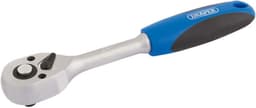
Seven of these listings state a quick-release button. Press it and pull the socket straight off. FIRSTINFO F32433B does not state a button. Do not prise the head apart. Pull the socket off by hand, and do not mark the square with pliers.

When to stop

Stop when the fastener will not turn under a firm one-hand pull. Forcing a seized fastener can break the tool, and a pipe on the handle is the wrong repair. Stop when the pawl skips. At work, damaged equipment should come out of use. A wheel nut is the wrong square, which is the versus page. If a newton-metre figure is specified, seat the fastener and use a torque wrench. Draper’s title prints no scale.

Common questions

How do I fit a 1/4 inch socket on the square?
Match the socket to the 6.3 mm square, line up the ball, and push until it snaps. The socket then has to sit fully over the fastener. A size that is slightly off rounds the head. Press a release button before fitting only if that ratchet needs the button to let the socket on. Most quick-release handles in this set let you push the socket straight on.
How do I know the lever is set to loosen?
Do not trust left and right. Hold the head and sweep the handle with no load. Loosening a normal right-hand thread, looking at the fastener, is the direction that locks when you swing anti-clockwise. If the handle freewheels that way, flip the lever and test again. A wrong setting feels like a stuck bolt.
What does the click on the return stroke mean?
The pawl is freewheeling. The handle comes back for the next stroke and the fastener should stay still. That click is not a torque setting and it is not a fault by itself. If the fastener turns backwards with the handle, the head is dragging, and you are no longer on a clean return.
How do I get the socket off if there is a quick-release button?
Press the button so the ball retracts, and pull the socket straight off the square. If it sticks, press the button fully rather than levering the socket sideways. Seven of these listings state a button. Use it when you are changing sizes often.
What if my ratchet has no button?
Pull the socket off by hand. FIRSTINFO F32433B does not state a quick release, so there is nothing to press on that listing. Do not open the head to look for a hidden control. If the socket is truly stuck, stop before you mark the square with pliers.
What do I do if the handle skips under load?
Stop. A skip means the pawl is not holding, or the load is past what this small ratchet should see. Do not add a pipe and do not keep swinging. At work, a damaged ratchet should come out of use. On a seized or rounded fastener, change tool rather than finishing the job with this one.
Can I use this ratchet when the fastener has a torque setting?
You can run the fastener down until it seats, and you cannot set the torque with the ratchet. The click you hear is the pawl, not a torque wrench. Draper’s torque socket wrench title prints no range. Use a torque wrench on the matching square when the joint specifies a figure.

Related pages

Sources

Sources from the research digest, last checked on 20 October 2026.

  1. HSE, PUWER overview (retrieved 20.10.2026)
  2. HSE, maintenance of work equipment (retrieved 20.10.2026)
  3. Consumer Rights Act 2015, section 9 (retrieved 20.10.2026)
  4. Consumer Rights Act 2015, sections 22 and 23 (retrieved 20.10.2026)
  5. ISO 3315:2018 catalogue summary (retrieved 20.10.2026)
  6. ISO 1174-1:2011 (retrieved 20.10.2026)
  7. Mac Tools UK catalogue (retrieved 20.10.2026)
  8. RS Components breaker-bar guide (retrieved 20.10.2026)