Independent comparisons. We may earn from shop links. More info

Raclette vs teppanyaki

Updated: 23 October 2026

You are setting the dining table as the cooker, people are coming for a slow supper, and the shortlist is raclette vs teppanyaki. A raclette gives each person a small pan under a shared top plate, so the meal runs on melted cheese and slow rounds. A teppanyaki is one open flat plate and a pair of spatulas, so the meal runs on batches of sliced food and steam. That split decides the pace and the washing-up. If you really want a hinged grill for Tuesday burgers, use the wider [tabletop grill comparison](/hub/grills-and-barbecues/tabletop-grill). This page stays with the party format. The rows below illustrate the format. They do not crown an overall best.

You are setting the dining table as the cooker, people are coming for a slow supper, and the shortlist is raclette vs teppanyaki.

Our top picks

BOSKA BOSKA Raclette Gourmet Party

Best overall

BOSKA BOSKA Raclette Gourmet Party
7.4/10about £69.99
On this page

What each format is for

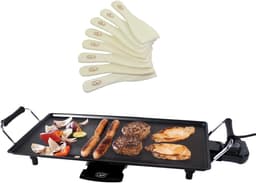
A raclette is for a supper that is allowed to drift. Each guest slides a mini pan under a shared top plate to melt cheese, while the top sears small pieces. Sold as a raclette grill 8 person, eight pans means eight small portions, not eight ribeye dinners. A teppanyaki is the other tempo: one indoor flat plate, thin steak, prawns and vegetables, moved with spatulas. One or two people usually cook for the table. Food comes off faster, though an overloaded plate cools and steams the room. Juices still cross a shared surface. Choose raclette for individual pans and melted cheese. Choose teppanyaki for one shared flat plate. Size and heat control sit in the buying guide.

Space, smoke and washing-up

Measure the table before wattage. A plate around 45–50 cm can serve a small group. A 70–90 cm teppanyaki needs that length on the table and in the cupboard. An open teppanyaki throws more steam. A raclette top plate still hazes a kitchen on fatty meat, so open a window. Use a fused BS 1363 plug, and keep either base out of the sink. The raclette’s eight pans are the heavier wash, and cheese sets if you leave it. A teppanyaki is one surface once the grease path is cool. Thin meat and veg make the single plate the lighter wash.

When a contact grill is the better buy

A hinged contact grill is the better buy when the meal is a Tuesday tea. Closed plates press a burger, cook chicken and toast a sandwich faster, and many store upright. If the real week is two people and a quick grill, leave the party sets on the shelf. Sensor models around £100–£180 in this October 2026 amazon.co.uk batch earn that spend only if you grill meat often. Poultry, pork, burgers, sausages and kebabs still need to be cooked through, about 75 °C in the thickest part, including on a teppanyaki or a raclette top plate. Preheat and cool-down sit on the how to use a tabletop grill page.

Examples in this comparison set

The Hengbo eight-pan raclette was about £60, and the BOSKA set about £70. The BOSKA row had a thin review sample, so the star line is a weak reason to call it a top pick. The Quest Large was about £28.50, and the LIVIVO Large about £33. Longer Quest plates sat about £35–£43, and only if the table takes the length. The cheaper flat plate is the stronger buy for sliced food moved with spatulas, and a weak buy when the night is cheese in separate pans. The raclette is the stronger buy when each guest wants a pan. It is a weak buy for a quick feed, because you wash eight pans afterwards. Contact-grill picks sit on the best tabletop grill page.

Common questions

Which is better for a dinner party?
For a long supper in rounds, the raclette fits, because each guest has a pan and the meal can drift. A teppanyaki still works when the group wants steak, prawns and veg cooked in view, though one or two people become the cooks. If guests expect a plated course, use the oven and save the tabletop grill for a night when a slow round is welcome.
Does an eight-person raclette feed eight adults well?
It feeds eight people sharing small portions across the evening. The 8 on the box is the pan count, not eight large steaks. Plan potatoes, bread, salad and sliced meat for the top plate, and cut anything thick so it meets the surface. Eight full dinners served at one time need a different cooker.
Which creates more smoke?
The open teppanyaki usually makes more steam and splatter, because fat stays on a wide uncovered plate. A raclette still smokes when fatty meat sears on the top plate. Ventilate either format, trim excess fat, and treat smokeless on the box as a reduction at best, never as zero smoke in a closed kitchen.
Which is easier to wash up?
The teppanyaki has fewer parts: one plate and a grease path, once it has cooled. The raclette is the heavier wash, with the top plate and every pan, and cheese bonds as it cools. A fixed coating that the manual says to wipe can still take longer than dishwasher-safe pans, so read that line before you decide.
Can I melt cheese on a teppanyaki?
You can melt cheese on the flat plate, and it tastes fine over vegetables. It spreads, catches at the edge and sticks if you leave it. A raclette pan holds one portion in the dish. When cheese is the centre of the meal, buy the pans. When cheese is only a topping, the teppanyaki is enough.
How much table space do I need?
Allow the grill plus plates, drinks and elbows on both sides. A plate around 45–50 cm is the realistic mid size for a small group. A 70–90 cm teppanyaki needs that length clear on the table and in the cupboard. An eight-pan raclette needs width for the body and a safe rest for the hot pans.

Related pages

Sources

Public UK sources on cooking temperatures, barbecue hygiene, electrical safety and portable grill standards, plus UK buyer notes on format. Prices, stars and review counts are the amazon.co.uk lines saved with this comparison in October 2026.

  1. Food Standards Agency — Cooking your food (retrieved 23.10.2026)
  2. Food Standards Agency — BBQ food safety (retrieved 23.10.2026)
  3. GOV.UK — Electrical Equipment (Safety) Regulations 2016 (retrieved 23.10.2026)
  4. GOV.UK — UKCA and CE marking in Great Britain (retrieved 23.10.2026)
  5. IEC 60335-2-9:2019 — Particular requirements for grills and toasters (retrieved 23.10.2026)
  6. Product Inspector — Raclette, teppanyaki or indoor grill (retrieved 23.10.2026)
  7. Product Inspector — Teppanyaki grills (retrieved 23.10.2026)
  8. Evening Standard — Best indoor electric grills (retrieved 23.10.2026)