Independent comparisons. We may earn from shop links. More info

How to use a spit roaster for a chicken or a joint

Updated: October 2026

The motor is on, the chicken is clamped, and ten minutes later one side is drying while the other barely colours. That is usually balance and heat, not a mysterious fault in the bird. This is how to use a spit roaster for a whole chicken or a joint on a kit you already own. It stops at poultry and pork you can lift onto a rod. The Products Compared editorial team used the Food Standards Agency’s cooking guidance and Char-Broil’s UK rotisserie method. We did not time a cook of our own. The nine listings, if you still need a kit, are in the [spit roaster comparison](/hub/grills-and-barbecues/spit-roaster).

The motor is on, the chicken is clamped, and ten minutes later one side is drying while the other barely colours. That is usually balance and heat, not a mysterious fault in the bird.

Our top picks

onlyfire onlyfire BRK-6012 114 cm

Best overall

onlyfire onlyfire BRK-6012 114 cm
9.0/10about £64.99
onlyfire onlyfire BRK-6031 90 cm

Best value

onlyfire onlyfire BRK-6031 90 cm
8.5/10about £61.99
ZENO ZENO 5078a 5 V kit

Alternative

ZENO ZENO 5078a 5 V kit
7.2/10about £59.90
On this page

Put the rod through the middle and clamp it

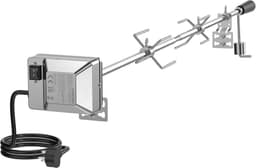
Run the rod through the centre of the chicken, along the spine, so the weight sits around the axis. Clamp the forks, then rest the rod across your palms. If one end drops, shift the bird, tighten the forks, or fit the counterbalance until the rod stays level. Char-Broil’s UK how-to makes the same point: balance the rod so the motor is not working against one heavy side. Forks set only through the thighs leave the breast swinging. Truss the legs and wings so nothing catches the burner on the way round. If the motor stalls as soon as you let go, stop and rebalance. Forcing it with a hand on the handle is how a small motor gets hot. A whole pig is on the spit roast a pig page.

Heat and time are a guide

Set the heat so the skin colours without the outside finishing before the middle. Char-Broil’s method for a chicken is about 10 minutes hotter, then about 1 to 1.5 hours toward a core of 75°C. That 75°C figure is their method, not the Food Standards Agency’s only pass mark. GrillSymbol’s chart allows about 2 to 3 hours for a 1 to 1.5 kg chicken on their grill. One UK camping-spit review described a large chicken in about three hours over a fire pit. Wind, a lid, and a small fire change the clock. Use it to decide when to start checking, not when to serve. A joint with a bone runs slower than a trimmed chicken of the same weight. Keep charcoal to the sides so one flare does not catch the breast every revolution. GrillSymbol’s 6 to 8 hours for a 10 to 12 kg lamb is their chart. It is not proof a home motor can turn that lamb.
onlyfire onlyfire BRK-6012 114 cm

Testsieger

onlyfire onlyfire BRK-6012 114 cm
9.0/10about £64.99

Probe poultry and pork

Poultry and pork need to be cooked through. The Food Standards Agency’s combination is 70°C for 2 minutes in the centre, or an equivalent that is hotter and shorter: 75°C for 30 seconds, or 80°C for 6 seconds. The Agency also lists 60°C for 45 minutes and 65°C for 10 minutes. Probe the thickest meat, away from the bone and away from the rod. Clear juices are a weak substitute. The danger zone on the same page is 8–63°C, so a half-cooked chicken should not sit on a cool table. Food Standards Scotland treats 75°C or above as fully cooked for chicken and pork. That matches Char-Broil’s chicken target. It does not cancel the 70°C for 2 minutes route. A figure around 63°C is the wrong target for pork and for poultry. Start probing about 15 to 20 minutes before you expect to finish. Rest the meat loosely covered and carve while it is still well clear of the danger zone. The Agency page does not publish a single rest time in minutes.

Stay with the fire

Stay in the garden while the rod is turning. Fat drips, a breeze lifts the embers, and a mains lead across the patio is a trip in front of a hot box. If the motor is mains, use a 30 mA RCD, and do not leave the motor in the rain. Stop if the RCD trips or the motor smells hot. A new outdoor socket is a job for an electrician. A battery or 5 V motor still needs you nearby. The ZENO listing caps the load under 5 kg, and a lopsided bird will stall it. Smoke from a normal barbecue is usually outside the cases councils treat as a statutory nuisance. If the meat is for sale, you are in food-business rules, which this Saturday chicken is not. Which kit fits the cookbox is on the buying guide.

When the cook is a carcase

When the cook is a carcase rather than a chicken, stop using this page. The times, the machine, and the point where a hired oven replaces a garden stand are on the pig guide. The rod, the forks, and the probe habit you have just used still apply. The weight does not.

Common questions

What happens if the chicken is heavier on one side?
The motor keeps lifting the heavy side and the cook slows, stops, or smells hot. Char-Broil’s UK method is to balance the rod in your hands first. The onlyfire heavy-stand listing says uneven weight above and below the rod can stop the rotation. Firepits UK gave up on motors for their pits for the same reason. Rebalance and restart. Do not hold the handle for an hour to help a motor that cannot turn a lopsided bird.
How long does a whole chicken take?
Treat the clock as a window. Char-Broil allows about 10 minutes hotter, then about 1 to 1.5 hours, toward their own 75°C core. GrillSymbol’s chart allows about 2 to 3 hours for a 1 to 1.5 kg chicken on their grill. One UK camping-spit review described a large chicken in about three hours over a fire pit. Wind, lid, and fuel change the middle of that range. Probe before you rely on any of those clocks.
What core temperature is enough for chicken and pork in the UK?
The Food Standards Agency wants poultry and pork cooked through: 70°C for 2 minutes in the centre, or a hotter shorter equivalent such as 75°C for 30 seconds or 80°C for 6 seconds. Food Standards Scotland treats 75°C or above as fully cooked for chicken and pork. Char-Broil’s 75°C is their chicken method, which fits that Scottish pass mark and the Agency’s short hot option. A rare or 63°C target is the wrong rule for these meats.
When do I use a thermometer?
Use it in the thickest meat, not in the bone and not against the rod, about 15 to 20 minutes before you think the chicken is done. That lead time is Char-Broil’s suggestion, so a low reading becomes more cooking rather than a rescue. Colour and clear juice do not replace the reading. If the probe is short of the combination you are using, keep the spit turning and check again.
Can I leave the spit while it turns?
Stay within sight of the fire. Dripping fat, a lead across the patio, and a breeze on the embers are the ordinary reasons. On mains, use a 30 mA RCD and keep the motor out of the rain. Stop if the device trips or the housing smells hot. A qualified electrician is the person to call for a new outdoor socket, not for turning the fork. A chicken does not need a professional cook standing over it. It does need you in the garden.
How do I rest the meat before carving?
Take it off the heat once the Agency’s time-and-temperature combination is met, cover it loosely, and carve while it is still well above the 8–63°C danger zone. The Agency page does not publish a single rest time in minutes. A long cool-down on the table is the mistake. If service is hours away, chill the meat and reheat it properly rather than parking a chicken over the last of the charcoal.

Related pages

Sources

Listing prices and ratings are from amazon.co.uk files dated 15 October 2026, not a live check. The public sources below cover cooking temperatures, outdoor electrics, and smoke rules.

  1. Food Standards Agency: Cooking your food (retrieved 15 October 2026)
  2. GOV.UK: Nuisance smoke (retrieved 15 October 2026)
  3. GOV.UK: Smoke control area enforcement (retrieved 15 October 2026)
  4. Electrical Safety First: Garden (retrieved 15 October 2026)
  5. IET Wiring Matters: BS 7671 regulation 411.3.3 (retrieved 15 October 2026)
  6. GOV.UK: Electrical Equipment (Safety) Regulations 2016 (retrieved 15 October 2026)
  7. GOV.UK: General Product Safety Regulations 2005 (retrieved 15 October 2026)
  8. HSE: Gas safety in catering (CAIS23) (retrieved 15 October 2026)