Indirect heat on a charcoal kettle for chicken and joints
A whole chicken over a single pile of coals goes black outside while the bone is still unsafe. Indirect heat on a charcoal kettle means banking the coals to one side, putting the food on the other, shutting the lid, and still probing the centre. Lighting and the burger check stay on the how-to page linked below. The five 57 cm listings are on the [kettle barbecue 57cm comparison](/hub/grills-and-barbecues/kettle-barbecue-57cm). This page does not re-rank them, except when a shallow compact is the wrong bowl. Sources are Weber UK, Napoleon UK, BBQ Barn and Riverside Garden Centre. We did not log grate temperatures. A purchase through our links may earn a commission.
A whole chicken over a single pile of coals goes black outside while the bone is still unsafe.
A whole chicken over a single pile of coals goes black outside while the bone is still unsafe. Indirect heat on a charcoal kettle means banking the coals to one side, putting the food on the other, shutting the lid, and still probing the centre. Lighting and the burger check stay on the how-to page linked below. The five 57 cm listings are on the kettle barbecue 57cm comparison. This page does not re-rank them, except when a shallow compact is the wrong bowl. Sources are Weber UK, Napoleon UK, BBQ Barn and Riverside Garden Centre. We did not log grate temperatures. A purchase through our links may earn a commission.
Our top picks
| Badge | Product | Bowl for a roast | Add fuel in use | Lid thermometer | Note | Price | Offer |
|---|---|---|---|---|---|---|---|
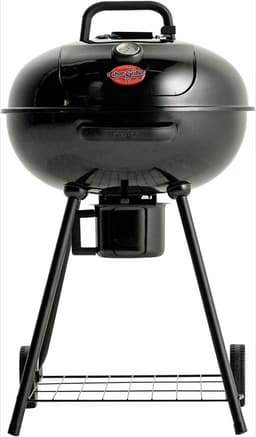
| Best overall |  Char-Griller Char-Griller 22-inch kettle | Porcelain lid and bowl | Charcoal access door | Not in the spec bullets | 6.6 | about £87.99 | View offer |
 Weber Weber Original Kettle Premium 57 cm | Deeper original bowl | Not listed; manual only in the box line | Built in, dome air | 7.5 | about £239.00 | View offer | |
| Alternative |  Weber Weber Original Kettle 57 cm | Deeper original bowl | Not listed | Built in, dome air | 7.2 | about £169.99 | View offer |


On this page
Direct heat is the wrong default for a large cut
Bank the coals to one half
Vents and a pan, not a new grill
What a shallow 57 cm compact will not do well
Food is not finished because the lid was shut
Common questions
How do you set up two zones on a round grate?
Does the lid have to be shut?
Where does a drip pan go?
Can you do this on the Weber Compact 57 cm?
How do you add charcoal mid-cook?
Is a kettle a smoker?
What still has to be checked with a food probe?
Related pages
Sources
Public UK and maker sources used for this comparison. Listing prices, stars and review counts are the saved amazon.co.uk figures for these ASINs. Retrieved 22 October 2026.
- Weber UK: Original Kettle 57 cm, model 1502202 (retrieved 22 October 2026)
- Weber UK: warranty information (retrieved 22 October 2026)
- Weber UK: Original Kettle size guide (retrieved 22 October 2026)
- Weber UK: Compact 57 cm, model 1502061 (retrieved 22 October 2026)
- London Fire Brigade: BBQ safety (retrieved 22 October 2026)
- BSI: BS EN 1860-1:2024 solid-fuel barbecues (retrieved 22 October 2026)
- GOV.UK: nuisance smoke, how councils deal with complaints (retrieved 22 October 2026)
- Food Standards Agency: cooking your food (retrieved 22 October 2026)