How to use a kettle barbecue safely in a UK garden
How to use a kettle barbecue is outdoor air, no petrol, grey ash before the food goes on, and a probe for anything minced or poultry, not a guess from the colour of the crust. The five 57 cm listings on the [kettle barbecue 57cm comparison](/hub/grills-and-barbecues/kettle-barbecue-57cm) differ on thermometers and ash systems. The lighting order does not. Banking coals for a whole chicken belongs on the indirect page linked below. We wrote this in October 2026 from Weber UK, GOV.UK, London Fire Brigade and Food Standards Agency pages, without lighting these ASINs. A purchase through our links may earn a commission.
How to use a kettle barbecue is outdoor air, no petrol, grey ash before the food goes on, and a probe for anything minced or poultry, not a guess from the colour of the crust.
How to use a kettle barbecue is outdoor air, no petrol, grey ash before the food goes on, and a probe for anything minced or poultry, not a guess from the colour of the crust. The five 57 cm listings on the kettle barbecue 57cm comparison differ on thermometers and ash systems. The lighting order does not. Banking coals for a whole chicken belongs on the indirect page linked below. We wrote this in October 2026 from Weber UK, GOV.UK, London Fire Brigade and Food Standards Agency pages, without lighting these ASINs. A purchase through our links may earn a commission.
Our top picks
| Badge | Product | Lid thermometer | Ash system | Vents | Note | Price | Offer |
|---|---|---|---|---|---|---|---|
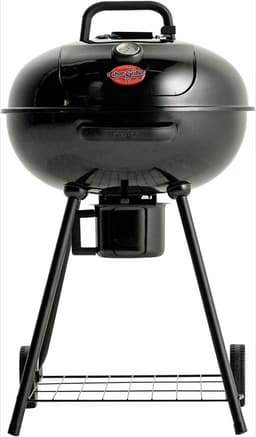
| Best overall |  Char-Griller Char-Griller 22-inch kettle | Not in the spec bullets | Removable pan and bucket | Top and bottom dampers | 6.6 | about £87.99 | View offer |
 Weber Weber Original Kettle Premium 57 cm | Built in, dome air | One-Touch into a catcher | Lid and bowl dampers | 7.5 | about £239.00 | View offer | |
| Alternative |  Weber Weber Original Kettle 57 cm | Built in, dome air | One-Touch | Lid and bowl dampers | 7.2 | about £169.99 | View offer |


On this page
Set the kettle before you strike a light
Light the charcoal
Hold the heat with the vents
Know the food is cooked
Put it out and leave it outside
Common questions
How do you light it without lighter fluid?
When are the coals ready?
How much charcoal is a starting point?
What temperature should a burger reach?
Can a steak be pink?
How do you put it out, and where does the ash go?
Can you finish the cook in the garage if it rains?
Related pages
Sources
Public UK and maker sources used for this comparison. Listing prices, stars and review counts are the saved amazon.co.uk figures for these ASINs. Retrieved 22 October 2026.
- Weber UK: Original Kettle 57 cm, model 1502202 (retrieved 22 October 2026)
- Weber UK: warranty information (retrieved 22 October 2026)
- Weber UK: Original Kettle size guide (retrieved 22 October 2026)
- Weber UK: Compact 57 cm, model 1502061 (retrieved 22 October 2026)
- London Fire Brigade: BBQ safety (retrieved 22 October 2026)
- BSI: BS EN 1860-1:2024 solid-fuel barbecues (retrieved 22 October 2026)
- GOV.UK: nuisance smoke, how councils deal with complaints (retrieved 22 October 2026)
- Food Standards Agency: cooking your food (retrieved 22 October 2026)