Independent comparisons. We may earn from shop links. More info

27 mm clip-on vs POL regulator

Updated: 23 October 2026

Both regulators in the basket say propane, both are sold for a barbecue, and only one of them will lock onto the cylinder you carried home. A 27 mm clip-on vs POL regulator is a valve question, not a pressure contest. Patio gas and a standard UK screw propane cylinder are both normally 37 mbar. The metal that meets the bottle is not shared. The [Gas regulator](/hub/grills-and-barbecues/gas-regulator) table shows which listings print which fitting. This page is the split. We did not test an adaptor, and this comparison does not recommend one.

Both regulators in the basket say propane, both are sold for a barbecue, and only one of them will lock onto the cylinder you carried home. A 27 mm clip-on vs POL regulator is a valve question, not a pressure contest.

Our top picks

On this page

When it is 27 mm

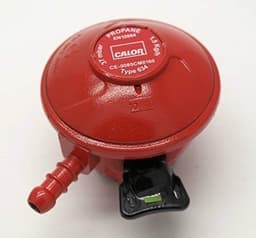
It is 27 mm when the cylinder is the green patio-gas type with a clip-on cup. You push, and it clicks. Calor's specification is 27 mm, 37 mbar, 1.5 kg/h, an 8 mm nozzle, and EN 16129. The Calor page, part 601228, is about £13.77. It prints 37 mbar, 27 mm, and an 8 mm nozzle, and names Calor 5 kg and 13 kg green patio cylinders plus specified Flogas and BP 27 mm bottles. Kilograms per hour are not on that listing. It is 4.7 from 1,114 ratings. Adventure AOS0036 at about £13.95 prints 27 mm, 37 mbar, 1.5 kg/h, and an 8 mm tail, at 4.7 from 34 ratings. One switch would not click. Neither page includes a hose. The HowseHold listings are also 27 mm clip-ons. They print 1.5 kg/h and a 16 bar inlet, not millibar. Low pressure is not a measurement. A green finish on a screw cylinder would still be POL. Plate before brand is the gas regulator buying guide.

When it is POL

It is POL when the propane cylinder has a screwed outlet and the nut, or a handwheel, threads onto it. Screwed LPG connections are usually left-hand, so the nut tightens anticlockwise. Calor puts the screw-on regulator on standard UK propane and the 27 mm clip on patio gas. Same gas family, different outlet. Cavagna's trade table, relevant because the Calor listing names Cavagna, keeps a 27 mm line at 37 mbar and a separate POL line at 37 mbar. The PGR01 screw listing at about £9.99 prints 37 mbar and 1.5 kg/h, and it states that it does not fit 27 mm patio bottles. It is 4.8 from 62 ratings. It prints no hose-tail size, includes no clips, and claims UK safety standards without a number. A spanner is not ruled out. The HWR01 handwheel at about £8.99 prints 37 mbar and says no spanner. It does not claim 27 mm. Capacity is absent. It is 4.6 from 143 ratings. Reviews include a year-old date, a unit that stopped passing gas, and a collar with no room to turn the wheel. Clearance is a POL problem, not a reason to clip it onto patio gas. Choose POL when the bottle screws. Who should buy which row is best BBQ gas regulator.

Hose tail and colour do not decide it

An 8 mm hose tail does not decide it. Calor and Adventure print 8 mm, and many propane hoses use that tail on POL regulators too. These two POL listings do not print a tail size, so the tail is not a clue in this basket. A new 8 mm hose on the wrong regulator still will not seat, and it will not turn a 27 mm clip into a left-hand nut. A red body does not decide it either. The Calor patio regulator is described as red, and so are the HowseHold 27 mm pages. POL regulators elsewhere are often black or red. Paint is branding.

Stars, rank, and adaptors

Stars do not decide it. The 4.8 POL screw refuses patio gas, and the 4.7 Calor sample is the patio clip. The handwheel sat at rank 2 and the Calor at rank 9. Garden rank mixes the fittings. An adaptor is not a third way. This page does not support forcing a POL regulator onto a 27 mm cup or a clip onto a screw. If the fitting does not start cleanly, stop. Once the correct regulator is on, the two sequences stay apart on how to fit a BBQ gas regulator. A blue butane clip is a different page. Twenty-seven millimetres and POL are both propane stories at 37 mbar.

Common questions

Is a green patio cylinder POL?
No. The green patio cylinder takes the 27 mm clip-on. Standard screw propane takes POL. Both are propane, normally at 37 mbar. Paint without the cup is not enough if the outlet is threaded.
Can I use a POL regulator with an adaptor on patio gas?
Do not. The JD Brands screw listing says it does not fit 27 mm patio bottles. This comparison has no tested adaptor. If it will not click or will not start on the thread, it is the wrong valve.
Which listings in this set are 27 mm?
Calor, Adventure AOS0036, the HowseHold regulator-only page, and the HowseHold hose kit. Only Calor and Adventure print 37 mbar as well. The HowseHold pages leave millibar blank. The valve match is not the whole specification.
Which say they are not 27 mm?
The JD Brands POL screw listing says POL only, not for 27 mm patio bottles. The handwheel does not claim 27 mm either. Absence of a claim is weaker than that exclusion. Neither should be pushed onto a patio cup.
Why does one 27 mm listing not print millibar?
Because the seller did not print it. The HowseHold pages say low pressure, 1.5 kg/h, and 16 bar at the inlet. Inlet pressure is not the 37 mbar the barbecue expects at the outlet. If you need 37 mbar on the page, use a row that prints it.

Related pages

Sources

Public UK sources used for this comparison. Listing prices, stars and review counts are the amazon.co.uk figures for these ASINs. Retrieved 22 October 2026.

  1. Liquid Gas UK: Consumer Guidance Sheet 39 (August 2020) (retrieved 22 October 2026)
  2. GOV.UK: types of gas and supply pressures in the UK (retrieved 22 October 2026)
  3. Gas Safety (Installation and Use) Regulations 1998, regulation 2 (retrieved 22 October 2026)
  4. Gas Safe Register: BBQ safety (retrieved 22 October 2026)
  5. Calor: which hose and regulator (retrieved 22 October 2026)
  6. Calor: propane patio regulator, 27 mm clip-on (retrieved 22 October 2026)
  7. Calor: connecting a gas bottle (retrieved 22 October 2026)
  8. Flogas: regulator safety (retrieved 22 October 2026)