Independent comparisons. We may earn from shop links. More info

Water pump for a rainwater tank

Updated: 22 October 2026

A butt by the downpipe, or an IBC beside the shed, looks like a free supply for the washing machine and the garden tap. A water pump for a rainwater tank can move that water. It does not make the water drinkable, and a check valve does not separate it from the mains. Which pump on the [domestic water pump comparison](/hub/garden-watering/domestic-water-pump) states a lift from a tank below it is the next question. Peter F., editor for DIY & tools, read those listings on 21 October 2026. There is no laboratory test. A qualifying purchase can earn a commission at no extra cost to you.

A butt by the downpipe, or an IBC beside the shed, looks like a free supply for the washing machine and the garden tap. A water pump for a rainwater tank can move that water.

Our top picks

On this page

What rainwater is allowed to do

The UK Water Reuse Association describes untreated harvested rainwater for toilet flushing, washing machines and outside taps, in pipes kept separate from drinking water. A mains top-up is described only through an air gap. Water Regs UK class rainwater as fluid category 5. A high butt with its own tap often needs no pump. You add one when you want pressure that gravity will not push. The first fill is on how to prime a water pump.

Which pump in this set can reach a tank below it

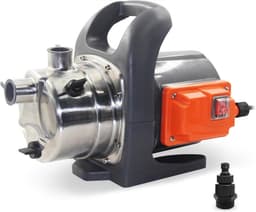
Submersible butt pumps sold elsewhere are outside this comparison. The KATSU 151434, at £76.99, is the listing that both names rainwater tanks and states self-priming. The power-source field says battery powered and the voltage field says 220 V. The KATSU 260 W says it is not self-priming. A butt on the ground is not its job. The VEATON names rain barrels. It is manual, you prime it, and the suction hose is kit FPC3-4. Threads are on the domestic water pump buying guide.

Keeping the intake clean

These listings are clean-water pumps. A butt collects leaves and sludge, and that load stops a small impeller before the litre claim matters. Lift the intake off the tank floor and fit a strainer on a reinforced suction hose. The VEATON does not include that hose. A soft hose collapses on the suction side and the pump runs on air. A filter reduces debris and does not make the water mains quality.

Where the mains must stay out

Water Regs UK do not treat a non-return valve as the separation between rainwater and the mains. Their stated method is a break tank with a Type AA or Type AB air gap of at least 20 mm or twice the bore, whichever is greater. If the butt runs dry, the top-up is that air gap, not a tee on the machine. The country lines are on the booster pump water regulations page. A dual-fed machine is the point a plumber takes over.

Common questions

Can rainwater go to a washing machine?
The UK Water Reuse Association and the Environment Agency guide both describe untreated rainwater for washing machines, on pipes kept separate from drinking water. UK reviews of the KATSU 151434 describe that layout from butts or an IBC. The Agency guide also warns about colour and odour in the wash. The live KATSU listing says the pump is not for drinking water. A filter is debris control, not drinking-water treatment.
Can it go to a kitchen tap?
A kitchen tap you drink from sits outside the uses those bodies describe. The Environment Agency guide does not cover drinking or personal hygiene, and Water Regs UK class rainwater as fluid category 5. The KATSU page that names rainwater tanks also says the pump is not suitable for drinking water. An outside tap on its own labelled pipe is the kind of outlet the reuse notes are written for.
Do I need a pump if the butt has a tap?
Often you do not. Waterpump.co.uk points out that a butt already high enough for a watering can is a gravity supply. A pump is for pressure that height will not give you, such as a washing machine or a distant hose. Adding a surface pump to a butt that already works adds a prime, a hose and a frost routine.
Is a check valve enough if I also have mains?
A check valve holds prime in a hose. Water Regs UK require a Type AA or AB air gap on a break tank before mains water and rainwater share an installation. The gap is at least 20 mm or twice the bore, whichever is greater, and it is vertical. A non-return valve is not that device. If a top-up exists, tell the undertaker. The rules page has the three UK regimes.
Will the 150 W KATSU suck from a butt on the ground?
It is the listing that states the job: self-priming, 8 metres of suction, and rainwater tanks by name, at £76.99. Eight metres is the vertical claim. A practical rule of thumb from Flood & Water Pumps sits nearer 6 metres. One UK review describes a flood when this pump started unattended, and the listing clashes between battery and 220 V. Measure the drop and stay with the first runs.
Can the washing machine stay plumbed to both?
Water Regs UK say a domestic washing machine must not be fed by mains and rainwater at once, because the machine is not category 5 protection. Two hoses and a valve you remember to turn is the arrangement they refuse. If you want mains when the butt is empty, the mains enters through an air gap at the tank, not through a second hose on the machine.
Will the pump survive winter outside?
Drain it and store it dry and frost-free. The VEATON already tells you to drain after use, and Waterpump.co.uk gives the same storage note for a seasonal butt pump. A casing left full on a patio can split. The KATSU 150 W’s dry-run timer does not protect a frozen body. Bring the pump in before the first hard frost.

Related pages

Sources

Public UK sources for fittings rules, pump notification, rainwater and plugs. Listing prices, stars and review counts are the saved amazon.co.uk lines. This is not a lab test. One digest source URL for a manufacturer course was truncated and is not listed here.

  1. Water Supply (Water Fittings) Regulations 1999 (retrieved 22.10.2026)
  2. Water Regs UK — pump notification (retrieved 22.10.2026)
  3. Scottish Water — water byelaws (retrieved 22.10.2026)
  4. Water Supply (Water Fittings) Regulations (Northern Ireland) 2009 (retrieved 22.10.2026)
  5. Waterpump.co.uk — increasing house pressure (retrieved 22.10.2026)
  6. Environment Agency — harvesting rainwater for domestic uses (retrieved 22.10.2026)
  7. Electrical Safety First — plugs and fuses (retrieved 22.10.2026)