Independent comparisons. We may earn from shop links. More info

Centrifugal vs peripheral pump

Updated: 22 October 2026

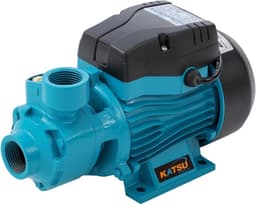
You are looking at a KATSU title that says centrifugal and peripheral in the same line, and a Clarke ECP15A1 that says centrifugal with a different pair of numbers. Centrifugal vs peripheral pump is not a brand fight. It is a hydraulic split: volume at low head against pressure at modest flow. The seven amazon.co.uk listings sit on the [centrifugal pump comparison](/hub/garden-watering/centrifugal-pump). How to size the duty is the [centrifugal pump buying guide](/hub/garden-watering/centrifugal-pump/sub/centrifugal-pump-buying-guide). Who each listing is for is on the [best centrifugal pump](/hub/garden-watering/centrifugal-pump/sub/centrifugal-pump-best) page. Peter F., editor for DIY & tools, updated this on 22 October 2026. This is not a bench test. A qualifying purchase can earn a commission at no extra cost to you.

You are looking at a KATSU title that says centrifugal and peripheral in the same line, and a Clarke ECP15A1 that says centrifugal with a different pair of numbers. Centrifugal vs peripheral pump is not a brand fight.

Our top picks

KATSU Tools KATSU 151116

Best overall

KATSU Tools KATSU 151116
8.8/10about £69.99
KATSU Tools KATSU 151112

Best value

KATSU Tools KATSU 151112
8.0/10about £49.99
Clarke Clarke ECP15A1

Alternative

Clarke Clarke ECP15A1
7.0/10about £125.92
On this page

Same word, two duties

Peripheral pumps are often sold under the centrifugal umbrella because the impeller still throws water outward. The geometry differs. A peripheral, sometimes called a regenerative turbine, builds higher pressure at a relatively low flow and wants clean water. A single-stage high-flow centrifugal moves a large volume over a short distance and drops away when the head climbs. Irrigation guides put peripheral on pressure, single-stage centrifugal on emptying or transferring, and jet on deeper suction. A KATSU listing can print both words without lying about the family name. High head on the title is not high flow at that head. Read the pair, then match it to the bed, the tank, or the slope.

What the kept listings actually state

Put the saved figures side by side. The Clarke ECP15A1 states 239 L/min and a head band of 2–14 m, with a 1.5 inch BSP outlet. That is the volume pattern. The KATSU 151112 states 35 L/min and 35 m; the KATSU 151116 states 45 L/min and 45 m. That is the peripheral pattern. The Clarke CEB103 states 35 L/min and 35 m on a brass body: the duty pair looks like the peripheral job even though the title says centrifugal and never uses the word peripheral. Pedrollo rows in this set claim higher mixed figures on stainless bodies; they still obey a curve, and their self-priming answer is blank. One sentence decides the shortlist. If the job is litres over a short run, emptying a tank or moving rainwater a few metres, leave the KATSU and look at the ECP15A1 pattern. If the job is head on clean water and 35–45 L/min is enough for a hose, the peripheral pattern is the match, and it still has to be primed. Both KATSU models say they are not self-priming and clean-water only. The ECP15A1 extract does not answer those questions. Geometry comes first, then the listing limits.
KATSU Tools KATSU 151116

Testsieger

KATSU Tools KATSU 151116
8.8/10about £69.99

When a peripheral is the wrong buy

A peripheral is the wrong buy when you need to empty a tank quickly. Forty-ish litres per minute will not feel like 239 L/min on a wide outlet. It is also the wrong buy in grit, shredded leaves, or sewage. Clean-water limits on the KATSU and Pedrollo rows are not optional. Forcing a peripheral through silt wrecks the tight clearances that make the pressure. Reading 45 m of head as a fire-hose volume is the same mistake: friction eats head, and the flow at that head is the low peripheral figure, not the Clarke’s 239 L/min. It is the right buy when one hose needs pressure on clean water and you will fill the casing. Rust and a thermal cut-out on the cheaper KATSU are ownership limits, not proof the geometry is wrong. Swap geometry when the duty is wrong. Swap model when the review file is the problem.

The jet, only if the water is below the pump

A jet pump is the other tool, not a third column here. Jet designs use a nozzle and venturi to help lift from a well or a sunken tank. Grundfos UK’s basic types course talks about jet suction often discussed around about 6 m and notes that jet pumps can be noisy. If the water sits well below the pump and a primed surface centrifugal keeps failing inside a sensible suction figure, a jet or a submersible may be the next conversation. That is not a reason to skip priming on the KATSU you already own. Fill, seal, and check the foot valve first. The steps are on how to prime a centrifugal pump. Volume and short head point at the ECP15A1 shape. Pressure and modest flow on clean water point at the peripheral shape. Titles that say centrifugal for both name a family, not the same hose.

Common questions

Is a peripheral pump a kind of centrifugal pump?
It is often sold in the centrifugal family. The impeller geometry and the duty differ. Treat the flow and head pair as the truth, not the shared word alone.
Which one fills a tank faster?
The high-flow centrifugal pattern, such as the ECP15A1’s 239 L/min at low head, moves volume faster. A peripheral at 35–45 L/min is slower on purpose because it is building pressure.
Which one is more likely to run a hose up a slope?
The peripheral pattern, if the water is clean and the stated head covers the slope plus losses. You still will not get the high-flow figure at that head.
Why does the KATSU title use both words?
Peripheral describes the geometry; centrifugal is the broader family label on many marketplaces. The numbers show which job it does.
Does high head mean I also get high flow?
No. Maximum head and maximum flow are opposite ends of the curve.
Where does the Clarke CEB103 sit?
Its stated 35 L/min and 35 m look like the peripheral duty. The title says centrifugal and does not say peripheral. Judge it by the pair, not by the missing word.
When would I leave both and buy a jet?
When the water sits below the pump beyond what a primed surface centrifugal can hold, and a jet or submersible is the proper lift tool. Check priming and hose collapse before you escalate.

Related pages

Sources

Public UK sources for abstraction, water fittings, hose taps and garden electrics. Maker and pump-trade pages for duty, priming and the CP family head. Listing prices, stars and review counts are the amazon.co.uk lines saved on 21 October 2026. This is not a lab test.

  1. GOV.UK — check if you need a licence to abstract water (retrieved 21.10.2026)
  2. Water Supply (Water Fittings) Regulations 1999 (retrieved 21.10.2026)
  3. Water Regs UK — hose union taps (retrieved 21.10.2026)
  4. Electrical Safety First — garden electrics (retrieved 21.10.2026)
  5. IET Wiring Matters — BS 7671 regulation 411.3.3 (retrieved 21.10.2026)
  6. Pedrollo — single-impeller centrifugal pumps (retrieved 21.10.2026)
  7. UK Flow Centre — which pump do I need (retrieved 21.10.2026)
  8. Michael Smith Engineers — self-priming pumps (retrieved 21.10.2026)