Independent comparisons. We may earn from shop links. More info

Bypass vs anvil secateurs

Updated: 22 October 2026

You have two words on an amazon.co.uk title and a rose, or a dead shrub stem, in the other hand. Bypass vs anvil secateurs is a rule about the wood, not a league table of brands. If the stem is alive, use a bypass. If it is dead or hard and a clean heal does not matter, an anvil can do the job. Peter F. applied that rule to the twelve listings in the [secateurs comparison](/hub/garden-tree-and-hedge-shears/secateurs) on 21 October 2026. We did not cut a rose bed for this page. A listing that prints both words is not a third type of blade. A qualifying purchase can earn a commission at no extra cost to you.

You have two words on an amazon.co.uk title and a rose, or a dead shrub stem, in the other hand. Bypass vs anvil secateurs is a rule about the wood, not a league table of brands. If the stem is alive, use a bypass.

Our top picks

Kynup Kynup V-11

Best overall

Kynup Kynup V-11
9.0/10about £9.99
WORKPRO WORKPRO 200 mm

Best value

WORKPRO WORKPRO 200 mm
8.6/10about £7.99
Spear & Jackson Spear & Jackson set

Alternative

Spear & Jackson Spear & Jackson set
7.4/10about £12.71
On this page

What the two cuts do

Bypass secateurs work like scissors. A sharp blade passes a hooked counter-blade and slices the stem. On live green wood that slice can heal, provided the edge is sharp and you do not twist. Anvil secateurs close a blade onto a flat block. The block supports hard or dead wood, and it also crushes the cells on the far side. Burgon & Ball put it in those terms: alive means bypass, and dead wood, where plant health is not the point, means anvil. Kent & Stowe say keen gardeners often keep both, because the jobs are different. The crush is the reason an anvil is a poor rose tool. Style Roses, a UK nursery, tells growers to keep an anvil for very thick dead stems, because the crushed end invites die-back. You can still force an anvil through a green shoot. The shoot may come off. The stub is the part you have to live with. A bypass can struggle on dry, brittle wood and can twist if you exceed the printed cut. Neither action is more professional. A rose grower still wants the scissor cut on living wood. Match the jaw to the stem in your hand. The place of that cut, 5 mm from a rose bud or about 0.5 cm above a tree bud, is the how to use secateurs page.

Roses and other live stems

For roses, bypass is the tool. The Royal Horticultural Society’s rose page does not use the words bypass and anvil. It does require a clean cut within 5 mm of a bud, sloping away from the bud, to an outward bud, and to white pith when you are removing older wood. A crushed anvil face makes that clean cut harder to achieve. Deadheading a floribunda, taking a soft side shoot off a shrub, and shortening a live climber cane all sit on the bypass side of the rule. Most of this amazon.co.uk set is already a bypass. The Kynup V-11, the WORKPRO 200 mm, the Spear & Jackson 7159BS, VOTREK C800, and DECERK DDGJ-JD are titled as bypass tools. The 7159BS stops at 12 mm on the table, which is enough for many rose stems and short for a thicker cane. Kynup’s bullets say 25 mm and the table says 1 inch. Stay inside the smaller figure you are willing to quote. A bypass used past its width tears bark even though the action was the right one. You can nibble thin dead wood with a bypass. You should not make that the reason to own only a bypass if half your winter job is hard, dead stems. If the grip, rather than the rose, is the problem, go to secateurs for weak hands after you have chosen the action.
Kynup Kynup V-11

Testsieger

Kynup Kynup V-11
9.0/10about £9.99

Dead wood, and the set in this comparison

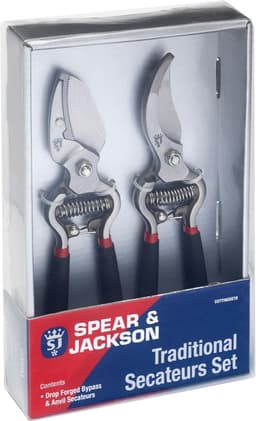
Dead, dry, or hard wood is where an anvil earns its place. The block stops the stem sliding, and you are not asking the plant to callus over a show cut. Spear & Jackson CUTTINGSET8, at £12.71, is the box in this folder that claims both jobs. The title and the bullets say a bypass pruner for live stems and an anvil pruner for dead wood, with a stated 15 mm cut. The pack weighs 572 g because two tools are listed. The amazon.co.uk line is 4.5 from 3,164 reviews. One reviewer uses the anvil on woody shrubs and the other tool on roses, which is the split the bullets describe. The blade-type attribute on that same page says Anvil only. The title and the table disagree. If you order the set, look in the box. Two tools means the title was right. One anvil means the attribute was the stock you received. UK reviews also say the blades rust if you put them away wet, and one says the bypass nut loosens. The WORKPRO £9.99 set is not this solution. It is a bypass plus 160 mm shears, with a stated 19 mm cut on the pruner. Shears tidy soft growth. They do not replace an anvil on dead wood. tazoueoo’s four-pack is stainless snips around 14.5 to 21 cm long, and the length is not a cutting capacity. If you only ever cut live roses, you do not need the anvil half. If winter means a pile of dead stems as well, a real second tool is the clearer buy.

When the listing says both

Some pages print bypass and anvil because the box holds two tools. CUTTINGSET8 is that kind of clash, if the attribute line is simply incomplete. The DECERK ratchet at £23.99 is a different clash. The title says ratchet anvil. The bullets say S mode for a direct cut on fresh stems and R mode for a ratchet cut on tougher wood. The attribute blade type says Anvil, Bypass. Printing the word bypass in a table does not turn the jaw into a scissor blade. The weight is 167 g, the stated cut is 19 mm, and the star line is 4.8 from eight reviews. Seven UK texts praise the switch on woody cuts. That is a small sample, and the tool remains an anvil ratchet until the blade itself is shown to pass another blade. A ratchet lowers the force of each squeeze. It does not change what the jaw does to a green stem. Burgon & Ball’s own ratchet, a different product at £29.99 on their page, is an anvil rated to about 2 cm and not sold for green wood. Use R mode on hard or dead wood inside 19 mm if you buy the DECERK and the jaw matches the title. Do not use it as your rose pruner because a mode is labelled for fresh stems. Cut width, lock, and hand, once you know the action, sit on the secateurs buying guide. One bypass is enough if you deadhead live shrubs and you deal with thick dead wood some other way. Add an anvil, or buy CUTTINGSET8 and check that both tools arrived, if dead wood is part of the same afternoon.

Common questions

Which is better for roses, bypass or anvil?
Bypass. A rose needs a clean cut within 5 mm of a bud, sloping away from the bud, which is the Royal Horticultural Society’s rose method. An anvil closes on a block and crushes green tissue, and a UK rose nursery warns that the crush invites die-back. Use the anvil on very thick dead stems, not on the living cane you want to flower. Sharpness still matters. A blunt bypass tears even though the action was right.
Can I use anvil secateurs on green wood?
You can remove the shoot, and you will bruise the stub. Burgon & Ball reserve the anvil for dead wood, where healing is not the point. On a rose or a live shrub that bruise is the part that has to callus. If green wood is most of your pruning, buy a bypass. Keep an anvil for the dead stems, or use a set only after you have seen both tools in the box.
Can bypass secateurs cut dead wood?
Thin dead twigs, yes, if you stay inside the printed cut and you accept more effort than an anvil would ask. Thick, hard, or brittle wood is where a bypass twists and where an anvil or a saw is the better tool. Do not increase the squeeze until the handles meet on a stem the page never claimed. The 7159BS, for example, prints 12 mm. Past that, change tool even if the blades are bypass.
What is in the Spear & Jackson set?
CUTTINGSET8 at £12.71 claims a bypass and an anvil, a 15 mm cut, and a pack weight of 572 g. The blade-type attribute says Anvil only. The amazon.co.uk line is 4.5 from 3,164 reviews. One reviewer splits the tools between woody shrubs and roses. Check the parcel. UK reviews also mention rust if the blades are stored wet and a bypass nut that loosens. The set is two jobs only if two tools arrive.
Is a ratchet a bypass or an anvil?
In this folder the DECERK ratchet is titled as an anvil. S mode is a direct cut and R mode is the staged cut. The attribute line also says Bypass, which conflicts with the title and does not prove a scissor blade. Burgon & Ball’s separate ratchet is an anvil and is not for green wood. A ratchet changes how hard you squeeze. It does not automatically change the jaw. Treat it as an anvil unless you can see the blades pass each other.
Why do some pages say both?
Either the box is meant to hold two tools, as CUTTINGSET8’s title claims, or one field has been filled with every blade word the catalogue knows, as on the DECERK ratchet attribute line. Read the title, the bullets, and the blade-type field as three sentences that may disagree. Do not average them into hybrid secateurs. Order only when you know which sentence you are paying for, and look in the box when it arrives.
Do I need two pairs?
You need two actions if you cut both live green wood and dead or hard wood. One bypass covers roses and living shrubs. An anvil, or a checked two-tool set, covers the dead stems. If you never cut dead wood, one sharp bypass is enough. If the second problem is a weak grip rather than a second kind of wood, a ratchet anvil is still the wrong rose tool. Match the jaw first, then the force.

Related pages

Sources

Public UK sources for cut size, rose cuts, sharpening, grip, and consumer-goods rules. Listing prices, stars, and review counts are the amazon.co.uk lines saved for this comparison.

  1. RHS — how to prune a tree (retrieved 22.10.2026)
  2. RHS — rose pruning (retrieved 22.10.2026)
  3. RHS — sharpening tools (retrieved 22.10.2026)
  4. Arthritis UK — gardening (retrieved 22.10.2026)
  5. Consumer Rights Act 2015, section 9 (retrieved 22.10.2026)
  6. GOV.UK — General Product Safety Regulations 2005 (retrieved 22.10.2026)
  7. BBC Gardeners' World — best secateurs (retrieved 22.10.2026)
  8. Burgon & Ball — bypass, anvil or scissor (retrieved 22.10.2026)