Independent comparisons. We may earn from shop links. More info

How to prune with secateurs

Updated: 22 October 2026

The last cut on a rose or a shrub left a stub that died back. How to prune with secateurs, for a UK garden, is a place on the stem, a season the Royal Horticultural Society gives for that plant, and a point where the tool is the wrong size. The pair may already be one of the five in the [Löwe secateurs comparison](/hub/garden-tree-and-hedge-shears/loewe-secateurs). This page does not rank those models. It follows the RHS rose guidance, the RHS shrub calendar, and the bad-cut list from Gardens Illustrated. Peter F. did not prune a trial border. A qualifying purchase through our links can earn a commission at no extra cost to you.

The last cut on a rose or a shrub left a stub that died back.

Our top picks

On this page

The cut above the bud

The RHS rose page asks for a cut no more than 5 mm above a bud, sloping away from that bud, on an outward-facing bud if you want an open centre. Leave more than 5 mm and you keep a peg the plant does not use. Cut into the bud and you damage the shoot you meant to keep. Gardens Illustrated names five cuts to avoid: a long stub, a flat cut, a cut into the bud, a torn cut, and a slope toward the bud. A torn cut is what a blunt blade or a twisting squeeze leaves. The RHS rose advice sends dieback back to white pith. If the blade is chewing, sharpen or replace it.

When, for a UK shrub

The RHS splits shrubs by when they flower, not by the brand of the secateurs. Plants that flower from July to October are pruned in spring: Buddleja, hardy fuchsia, Hibiscus, and Hydrangea paniculata. Plants that flower from November to June are pruned just after flowering: Kerria, Philadelphus, Ribes, and Weigela. Forsythia belongs with that second habit. Cut it after flowering, not in a hard spring chop that takes the buds. Evergreens are pruned after flowering, and not in autumn or winter if you can avoid it. A late cut can push soft growth into frost. Roses follow the rose page: the 5 mm slope, the outward bud, and a return to white pith where the stem has died back. If you are unsure which month a plant flowers, watch it for one season before you cut hard.

Which blade, in one decision

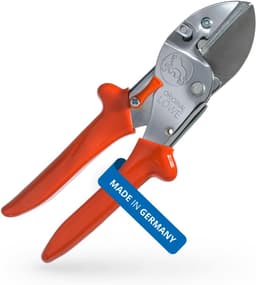
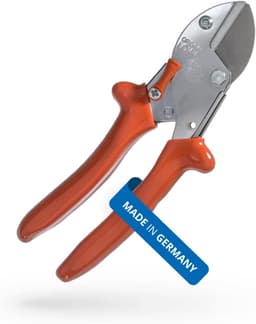
Use a bypass blade on live green wood and an anvil on dead or hard wood. Burgon & Ball put it the same way: bypass for living tissue, anvil when crushing is acceptable. The English Garden says an anvil tends to crush live green growth. A live rose stem is the bypass case. In this set the 11.107 and the 14.104 are the right-hand bypass listings, and the 1.104 is the anvil whose fields agree. The 5.107 bullets say anvil while its blade-type field says bypass, and the 15.107 mixes both. Those conflicts are not a pruning method. The full argument is anvil or bypass secateurs. Stop at the stated cut on the listing you hold.

When to stop

Stop when the stem is past the diameter printed on the secateur. The 5.107 states 16 mm. The 1.104, 11.107, 14.104, and 15.107 state 22 mm. Those are listing claims, not a trial we cut. A stem of 25 mm does not become a secateur job because you are already holding the tool. Fetch a lopper or a pruning saw. Forcing the close tears bark and notches the blade. Stop and call a professional for ladder work, a saw in a crown, a protected tree, or a disease you cannot name. Latch the blade before the tool goes in a pocket or a trug. The 11.107 and the 14.104 do not name a latch. The cut above the bud does not change with the handle length.

Common questions

Which way should the slope face?
Away from the bud, so the cut sheds water off the bud rather than onto it. The RHS rose page asks for that slope. Gardens Illustrated treats a slope toward the bud as one of the cuts to reject, along with a flat cut. Set the blade on the far side of the stem from the bud. If the slope lands on the bud, you have turned the cut over.
When do you prune a Buddleja, and when a forsythia?
Buddleja flowers from summer into autumn, so the RHS puts it with the spring-pruned group, alongside hardy fuchsia, Hibiscus, and Hydrangea paniculata. Forsythia flowers before summer, so you prune it just after flowering, with Weigela, Kerria, Philadelphus, and Ribes. A hard spring cut on forsythia removes the flowering wood.
What does a torn cut do?
It leaves a ragged wound instead of a clean face, which is how dieback starts down the stem. The RHS rose advice is to follow dead wood back until you see white pith. A blunt blade, a twist as you squeeze, or a stem thicker than the stated cut will tear rather than slice. Sharpen or change the tool before you repeat the wound.
Anvil or bypass for a live rose stem?
Bypass. A live rose stem is green wood, and an anvil tends to crush it. The English Garden and Burgon & Ball both keep the anvil for dead wood, where a crush is acceptable. In this set that points you at the 11.107 or the 14.104 if you cut with your right hand. The 1.104 is the anvil for the dead wood in the same plant.
Should you prune evergreens in winter?
Avoid autumn and winter if you can. The RHS says evergreens are pruned after flowering, and a winter cut can leave soft growth exposed to frost. That is a different calendar from a July-flowering shrub, which you prune in spring. If the evergreen has a dead branch, you can still remove dead wood, and you still stop at the stated diameter.
What if the wood is dead and the bypass will not go through?
Switch to an anvil if the stem is still inside the stated cut, or move to a lopper or a saw if it is not. A bypass that stalls on dead wood is doing the job the maker’s FAQ gives to the anvil. Forcing it through twists the blade and tears the bark. The 1.104 is the anvil in this set whose listing fields agree. It still stops at 22 mm.

Related pages

Sources

Public sources used for the anvil and bypass split, UK shop prices, pruning season, and the 30-day rejection right. Listing prices, stars, and review counts are the amazon.co.uk lines saved for this comparison. Last checked 22 October 2026.

  1. Original LÖWE, Flintbek (retrieved 22.10.2026)
  2. Original LÖWE FAQ (retrieved 22.10.2026)
  3. Dan Cooper Garden, Original Löwe 1.104 (retrieved 22.10.2026)
  4. Dan Cooper Garden, Original Löwe 5.107 (retrieved 22.10.2026)
  5. BBC Gardeners' World, best secateurs (retrieved 22.10.2026)
  6. Burgon & Ball, anvil, bypass, or scissor (retrieved 22.10.2026)
  7. RHS, pruning shrubs (retrieved 22.10.2026)
  8. Consumer Rights Act 2015, section 22 (retrieved 22.10.2026)