Independent comparisons. We may earn from shop links. More info

How to use bonsai shears

Updated: 22 October 2026

You already have the shears. The next cut is a leaf, a bud, a shoot, or a thin twig, and the blade stays honest only if you wipe it before the drawer. Dirty or blunt edges crush tissue. Carbon steel rusts if you store it wet. This is how to use bonsai shears on that growth, then clean, oil, and store them the same day. Which shape to buy is on [how to choose bonsai shears](/hub/garden-tree-and-hedge-shears/bonsai-shears/sub/bonsai-shears-buying-guide). Limits come from the amazon.co.uk listings in our [bonsai shears comparison](/hub/garden-tree-and-hedge-shears/bonsai-shears), captured on 19 October 2026. Peter F. did not run a lab test. A qualifying purchase can earn a commission at no extra cost to you.

You already have the shears. The next cut is a leaf, a bud, a shoot, or a thin twig, and the blade stays honest only if you wipe it before the drawer. Dirty or blunt edges crush tissue.

Our top picks

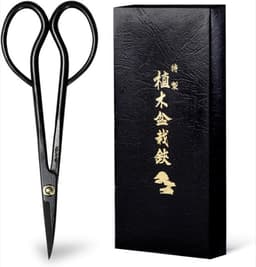
Wazakura Wazakura satsuki shears

Alternative

Wazakura Wazakura satsuki shears
7.6/10about £39.99
Saboten Saboten PT-16F

Alternative

Saboten Saboten PT-16F
7.1/10about £21.59
On this page

Cut leaves, buds, and thin twigs only

A bonsai shear is a small bypass scissor for leaves, buds, shoots, and thin twigs. It is the wrong tool for wire, a trunk cut, or a garden tree. Treat a printed ceiling as a maximum. In this set the satsuki shear is about 4 mm, the ashinaga about 6 mm, the twig shear is not for thick branches, and the Saboten PT-16F is for delicate stems. If no millimetre line is printed, do not invent one. The Spear & Jackson 4453KEW has pointed tips and no thickness stated. One UK review on the ashinaga says the edge marked above about 0.5 mm, far below the seller’s 6 mm. If the blades stall, stop. Twisting a stuck stem bruises the bark. Wazakura’s satsuki sheet says no wire.

Place the cut and stop forcing it

Set the stem where the edges meet, not on the last millimetre of a fine point. The point picks a leaf out of a crowd. Close the handles in one squeeze. If you have to saw or twist, the stem is too thick. Do not cut bonsai wire, training wire, or a cable tie. Wire notches the steel. Keep the tips away from children. A lock only helps if it holds. UK reviews on the PT-16F call the clip fiddly or say it does not close properly, so test it over a bench. On an ordinary bleeding cut, the RHS says leave the wound alone: do not paint it and do not bind it. The steel changes the wipe, which is why carbon steel vs stainless bonsai shears is a buying page.

Clean, dry, and oil before you put them away

Sap gums a bypass edge whether the steel is S58C or stainless. The RHS cleaning note says: take dried sap off with a nylon scourer or wire wool, loosen grime with a penetrating oil such as WD-40 and wipe it off, oil the pivot, and store the tool dry. Wear gloves. A fluorine coat on the PT-16F helps sap let go. It is not permission to skip the wipe. A 3Cr13 description did not stop one UK rust report on the vouiu kit after a few days. After diseased wood, do not move straight to a healthy plant. The RHS names Jeyes Fluid, Citrox, or Propellar, left on for 15 to 20 minutes, then wiped, dried, and oiled. Carbon steel, including Wazakura S58C and the Spear & Jackson, wants a light oil after each session. Oil does not restore a rounded edge.

Sharpen the bevel, then know when to stop

Sharpen the bevel and leave the flat face alone. The RHS says grinding the flat opens the gap so the blades no longer meet. If the shears will not come apart, or you cannot keep a safe home edge, that is a professional sharpener’s job. Do not invent a grit number. None of these listings states one. Stop for a branch at the trunk, deadwood carving, a ladder, heavy bleeding, a disease you cannot name, or paid work on someone else’s trees. A 180 mm bonsai shear is the wrong tool on a ladder. Wound paint is their exception for silver leaf on plum and cherry, not a coating for every bonsai cut.

Common questions

How do you clean sap off the blade?
Wipe fresh sap before it dries. For dried sap, the RHS suggests a nylon scourer or wire wool, then a penetrating oil such as WD-40 to loosen grime, then a wipe. Oil the pivot afterwards and store the shear dry. Wear gloves for the oil and the wire wool. A fluorine coat helps sap release on the PT-16F. It does not replace the wipe.
Do you oil stainless as well as carbon steel?
Oil carbon steel, including S58C, after every session, and dry it first. Stainless resists rust better and still gums with sap, so you still wipe it, and the RHS says occasional oiling may still be required because quality varies. Do not treat a stainless label as rust-proof. One UK review reported rust after a few days on a 3Cr13 kit.
How do you sharpen without opening the gap?
Work the bevel only. Do not grind the flat face, or the blades stop meeting. If the shear will not take a safe home edge, or it does not come apart, a professional sharpener is the RHS fallback. No grit is specified on these listings. A heavy hand on a short bonsai blade removes steel you cannot put back.
Should you paint or tape the cut?
Not on an ordinary bleeding cut. The RHS says to let it heal, and not to paint or bind it. They state an exception for silver leaf on plum and cherry. That exception is not a reason to dress every bonsai wound. Nothing here claims a painted cut closes faster.
When should you put the shears down?
Stop for a trunk cut, deadwood carving, a ladder, heavy bleeding, a disease you cannot name, or paid work on someone else’s trees. Also stop when the stem is past the seller’s ceiling, or when the blades are notching on wire. Clean between a diseased cut and the next healthy plant, then dry and oil before the shear goes away.

Related pages

Sources

Public UK and maker sources used for this comparison. Listing prices, stars, and review counts are from amazon.co.uk on 19 October 2026.

  1. RHS — cleaning hand tools (retrieved 19.10.2026)
  2. RHS — sharpening hand tools (retrieved 19.10.2026)
  3. RHS — how to prune a tree (retrieved 19.10.2026)
  4. RHS — bleeding from pruning cuts (retrieved 19.10.2026)
  5. Consumer Rights Act 2015 (retrieved 19.10.2026)
  6. Wazakura — types of bonsai scissors (retrieved 19.10.2026)
  7. Bonsai Shop (UK) — bonsai tools (retrieved 19.10.2026)
  8. Suwada UK — essential bonsai tools (retrieved 19.10.2026)