Independent comparisons. We may earn from shop links. More info

How to use a pond de-icer

Updated: 22 October 2026

The pond has a skin of ice, or it will by Friday, and the de-icer is still in the box with a bare cable. You need a small open patch so gases can leave. This is how to use a pond de-icer you already own, or one you are about to lower in. It draws on public UK sources and the listings on the [pond de-icer comparison](/hub/garden-ponds/pond-de-icer). Peter F. did not watch a unit run at your pond. A qualifying purchase can earn a commission at no extra cost to you. Voltage and the job come before the water. What follows is the check, where the unit sits, the cable with no plug, and the night the ice is already there.

The pond has a skin of ice, or it will by Friday, and the de-icer is still in the box with a bare cable. You need a small open patch so gases can leave.

Our top picks

On this page

Before it goes near the water

Read the voltage on the listing and on the hardware before the unit gets wet. UK mains are 230 V. The K&H stock-tank de-icer states 110/120 V only, so it does not go on a garden socket. Several other rows never state volts. If you cannot see 230 V, stop. Look for cuts in the cable and a connector that has lived in a puddle. IET guidance wants socket outlets on a 30 mA RCD. All Pond Solutions and Swell UK say the same, which matches the Blagdon brand FAQ. Use a supply that already has that protection. Do not trail a lead from an indoor socket across wet grass. If the RCD trips on test, do not bypass it. Isolate the supply before your hands enter the water, then follow the booklet or ask an electrician. In England, an existing RCD socket is not, by itself, a new circuit. A new garden circuit is notifiable.

Where it sits

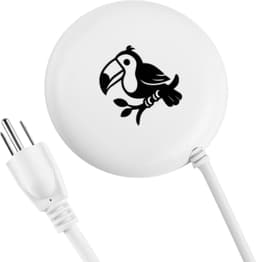
The Blagdon Affinity Ice Vent is a floating vent. The polystyrene piece is the float, not packaging. UK reviews say people nearly threw it away. Seat it so the vent can hold a small opening. It will not clear 5,000 litres from edge to edge. One UK review still saw ice around a tube that had warmed at about −6 °C. Submersible cages and tubes must stay fully immersed. The VIHOSE bullets say unplug the element and wait 10 to 20 minutes before you lift it out. The vassillias disc only heats while it stays covered, which is why birdbath reviews talk about topping up. A heater on a liner edge or a pile of leaves is a dry element. The Blagdon has no warning lamp, so after the first hard night you look at the hole. If it has closed and the cable is sound, treat the unit as failed until you know otherwise.

A cable with no plug

The Blagdon listing supplies about 5 m of cable and no plug. The brand page says 10 m, so measure the cable in your hand. The brand FAQ says use an outdoor connector and an RCD: a weatherproof joint on that supply, fitted with the power isolated. If you are not confident, call an electrician. This page will not invent terminal colours from another brand’s manual. Keep the cable off the deck as a trip line and out of the pond. Test the RCD with its own button. If it will not trip and reset, the heater waits. A tripped consumer unit is a reason to leave the unit unplugged and find the fault. When the ice is already a lid, a saucepan can open a patch tonight. It does not replace the RCD.

If the pond is already frozen

Do not smash the ice. The RHS, Practical Fishkeeping and the RSPCA say a shock through the water stresses fish. Do not tip boiling water in. Sit a saucepan of hot water on the ice until you can see water. Lower the de-icer into that patch only if the cable and the RCD socket are already in place. Otherwise the pan is tonight’s hole and the wiring waits for daylight. Keep the element submerged. Brush snow off if you want light in the water. If fish die after a hole is already open, that is water quality or depth. Call an electrician if the RCD will not reset, the earth is damaged, the voltage is unknown, or you are adding a garden circuit. A heater versus a low-watt air pump is on the pond de-icer versus air pump page. Run the de-icer when a freeze is likely. A 50 W vent left on is about 30 p a day at an illustrative 25 p per kWh, and these listings publish no duty cycle.

Common questions

Where do I put it?
Put a floating vent, such as the Blagdon, in the water with its float fitted, where it can hold a small opening. Put a submersible element fully under the water, not on the liner in air and not balanced on the ice. The VIHOSE text wants you to unplug and wait 10 to 20 minutes before you lift the element out. A birdbath disc only works while it stays covered, which means you top the bath up. The pond edge is the wrong shelf for any of them.
What if the cable has no plug?
Fit an outdoor connector on an RCD-protected supply, with the power isolated, or ask an electrician to do it. The Blagdon is sold that way on purpose, with a 5 m cable in the listing and 10 m on the brand page, so check the length in your hand. Do not improvise a wet domestic plug back at an indoor socket. This page does not give a terminal diagram. The booklet or the electrician does.
Do I need an electrician?
You need one if you are adding a new garden circuit, if the RCD will not reset, if the cable or earth is damaged, or if you cannot confirm the voltage. In England, using an RCD socket that is already there is not, by itself, notifiable new work. Fitting a connector you understand, with the supply off, is ordinary for this kit. Guessing at terminals because a different brand’s PDF shows colours is the point where you stop.
The pond is already frozen. What now?
Set a saucepan of hot water on the ice until a patch melts. Do not hit the ice, and do not pour boiling water in. The RHS, Practical Fishkeeping and the RSPCA fish guidance all reject the hammer. When the patch is open, place the de-icer only if the RCD supply is already safe. If it is not, the saucepan is tonight’s hole and the wiring waits until daylight.
How do I know it is on?
The Blagdon has no warning lamp, so the hole is the indicator. Look after the first hard night. UK reviews include people who only noticed a dead unit when the pond froze again. A warm cable or a warm tube with ice still sealed around it, as in the review at about −6 °C, means you still do not have the opening the fish need. A silent box is not proof that the unit is working.
Should I run it all winter?
Run it when a freeze is forecast, and check that a hole remains after cold nights. A 50 W vent left on continuously is about 30 p a day at an illustrative 25 p per kWh, before any thermostat idle time, which these pages do not publish. A mild week does not need a 1,000 W tube held at a warm setpoint. If the RCD trips, leave the unit off until the fault is found. Do not bypass the RCD to keep it running.

Related pages

Sources

Public UK and maker sources from the research digest, used for this page in October 2026. Prices, stars and review counts are from the nine amazon.co.uk listings captured on 19 October 2026. A missing voltage is not 230 V. No score is a laboratory freeze test or a claim that the whole pond stays ice-free.

  1. Blagdon Affinity Ice Vent (retrieved 20 October 2026)
  2. Blagdon Affinity Ice Vent FAQ (retrieved 20 October 2026)
  3. RHS, ponds in January (retrieved 20 October 2026)
  4. Practical Fishkeeping, fish and the pond in winter (retrieved 20 October 2026)
  5. ARC Trust, frogs and ice (retrieved 20 October 2026)
  6. IET Wiring Matters, Regulation 411.3.3 (retrieved 20 October 2026)
  7. Voltimum, electrical installations in the garden (retrieved 20 October 2026)
  8. GOV.UK, Approved Document P (retrieved 20 October 2026)