Independent comparisons. We may earn from shop links. More info

Barley straw vs blanketweed treatment

Updated: 22 October 2026

You are choosing a mesh pad of barley straw or a tub, and both are sold as the way to clear the green hair. Barley straw vs blanketweed treatment is not a tie. Straw is a suppressant you put in before the mat peaks. A dose is what people buy when the hair is already in the pump. Straw is not one of the twelve ASINs on the [blanketweed treatment comparison](/hub/garden-ponds/blanketweed-treatment), so this page does not invent a pad price. Peter F. used the saved listings on 21 October 2026. This is not a laboratory test. A qualifying purchase can earn a commission if you later buy a tub.

You are choosing a mesh pad of barley straw or a tub, and both are sold as the way to clear the green hair. Barley straw vs blanketweed treatment is not a tie. Straw is a suppressant you put in before the mat peaks.

Our top picks

On this page

What straw does and does not do

Barley straw does not eat the blanketweed you can lift today. The Centre for Ecology & Hydrology sheet says green unicellular algae often fade over six to eight weeks, while filamentous blanketweed can persist all season if the straw goes in late onto a dense mat. Add it early in spring. BBC Gardeners’ World treats straw as a suppressant. Barley works better than wheat or hay. Hay releases nutrients and can strip oxygen. Overdosing straw is an oxygen risk. The sheet describes a peroxide-like effect as the straw rots in open water. If the pump is already choked, the mat will still be there next weekend.

How much, and when

The Royal Horticultural Society rate is about 50 g of barley straw per square metre of surface, in a loose mesh bag, added in spring and removed when it turns black, around six months. A pond 2 m by 3 m is about 300 g. The March note says straw is generally less effective than shade and rainwater. Do not rewrite that rate as 50 g per 1,000 litres. A deep pond and a shallow pond with the same surface take the same straw weight and very different tub doses. Extract bottles are not in this comparison. A packed brick is not the open rotting straw the research sheet describes.

When a treatment is the other answer

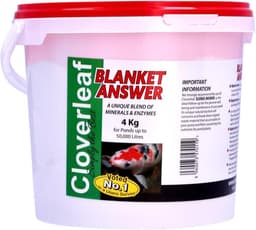
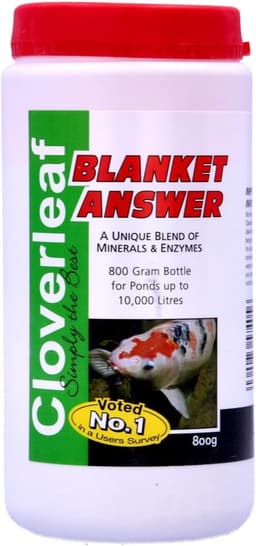
A tub is the other answer when hair is already in the pump. Cloverleaf Blanket Answer 800 g is about £19.47 to £19.49 for a stated 10,000 litres, at 10 g per 125 litres, with milky water and sludge afterwards. Stop Blanketweed is 30 g per 900 litres weekly for about three weeks, so the 4 kg price is not one Saturday. envii lists copper sulfate and is a poor match for a wildlife pond. Dying weed and rotting straw both draw on oxygen. Do not double the powder because a net is also in the pond. A 1,500 litre pond is 120 g of Cloverleaf, not the whole 800 g tub. Once you have decided to dose, follow how to use blanketweed treatment.

A conditional choice

Where the pump is not already stopped, use shade and straw first. Shade a third to a half of the surface, add about 50 g per square metre in early spring, and take the straw out when it blackens. A mat still visible in week one is not proof the straw failed. The bank-pile method is on the blanketweed treatment wildlife pond page. If the pump is choking on hair now, straw will not clear this week. Size a powder or a course to the real litres and plan to clean the filter. Use straw plus shade before growth peaks, and a measured tub when the mat is already in the equipment.

Common questions

Will barley straw clear the mat I can see today?
It is a suppressant for algae that has not peaked. The Centre for Ecology & Hydrology sheet says filamentous blanketweed can persist all season if straw is added late onto a dense mat. Green water algae more often fade in six to eight weeks. If the pump is blocked this week, straw is the slow tool.
How much straw should I use?
About 50 g per square metre of water surface, the Royal Horticultural Society rate, in a mesh bag. A 2 m by 3 m pond is about 300 g. That is a different figure from 50 g per 1,000 litres, which some garden sites use. A deep pond and a shallow pond with the same surface take the same straw weight.
When do I put it in, and when do I take it out?
Add it in early spring, before the hair thickens. Remove it when it turns black, often around six months on the RHS blanketweed page. The March note talks about replacement every three to four months, and says shade and rainwater do more. Hay can feed algae and strip oxygen. Overfilling the pond with straw is the oxygen risk the research sheet flags.
Is a barley extract the same thing?
The RHS and the CEH sheet are about straw rotting in a mesh bag, added early and removed when black. A bottled extract is a different product, and this comparison does not include one or a price for one. If a label claims the same job in a day, read it as its own dose.
My pump is blocked now. Is straw the wrong tool this week?
Straw will not clear a choked pump before the next weekend. The research sheet’s timing is early spring, and late straw on a thick mat may not work that season. A measured blanketweed treatment is the other answer, with milky water or a weekly course and sludge in the filter. Size it to litres.
Can I use straw and a powder together?
You can have straw in the pond and still decide to dose. Straw is not the other chemical Cloverleaf tells you to wait 10 days for. Do not double the powder because the pad is also there. Rotting straw and dying weed both use oxygen. If fish are at the surface, aerate and do not add a heavier dose.
Is straw safer in a wildlife pond?
It is the RHS-aligned first step, at about 50 g per square metre, ahead of a shop dose. It is not automatically harmless if you overfill the pond, because the research sheet flags oxygen. Leave spawn and great crested newt larvae in the weed. The wildlife page covers the cane, the bank pile, and when not to dose.

Related pages

Sources

Public UK and maker sources from the research digest, used for this page in October 2026. Prices, stars and review counts are from the twelve amazon.co.uk listings captured on 21 October 2026. HSE No. 9647 is Evolution Aqua's own statement for Stop Blanketweed, not a certificate for this set. A safe-for-fish bullet is a listing claim.

  1. RHS, Pond algae and blanket weed (retrieved 21 October 2026)
  2. RHS, June ponds (retrieved 21 October 2026)
  3. HSE, COPR product types (retrieved 21 October 2026)
  4. HSE, product authorisation (retrieved 21 October 2026)
  5. GOV.UK, manage water on land (retrieved 21 October 2026)
  6. Cloverleaf Blanket Answer (retrieved 21 October 2026)
  7. Evolution Aqua Stop Blanketweed (retrieved 21 October 2026)
  8. envii Algae Klear Xtra (retrieved 21 October 2026)
  9. NT Labs Blanketweed Balance (retrieved 21 October 2026)