Independent comparisons. We may earn from shop links. More info

Obelisk for climbing roses

Updated: 22 October 2026

You have a climbing rose, or you are about to buy one, and you want to know whether a plant pyramid in this amazon.co.uk set is tall enough. Vigour comes first, centimetres second. This page matches rose type to a real climbing frame, not to a faux cone. The full table sits on the [plant pyramid comparison](/hub/garden-decor/plant-pyramid). Height and material checks sit on the [plant pyramid buying guide](/hub/garden-decor/plant-pyramid/sub/plant-pyramid-buying-guide). Peter F. read those listings with RHS and nursery guidance on 21 October 2026 and did not load-test a cane. A qualifying purchase can earn a commission at no extra cost to you.

You have a climbing rose, or you are about to buy one, and you want to know whether a plant pyramid in this amazon.co.uk set is tall enough. Vigour comes first, centimetres second.

Our top picks

On this page

Which roses belong on an obelisk

The RHS points less vigorous climbing roses and shrub roses grown as climbers toward obelisks, pillars, and arches. Vigorous climbers belong on walls, fences, and pergolas. David Austin's guidance highlights roses in roughly the 6–8 ft band (about 1.8–2.4 m), with spiral training while young shoots are pliable. Many shrub roses reach a 3–4 m class, which exceeds a 1.9 m budget frame, so pruning still matters. A rampant wall climber is the wrong bet for an obelisk in this set. A less vigorous climber, or a shrub trained as a short pillar, can start on about 1.9 m of metal. Match catalogue vigour to the structure. This page does not invent a variety guarantee for a thin tube.

Heights in this set that are plausible for roses

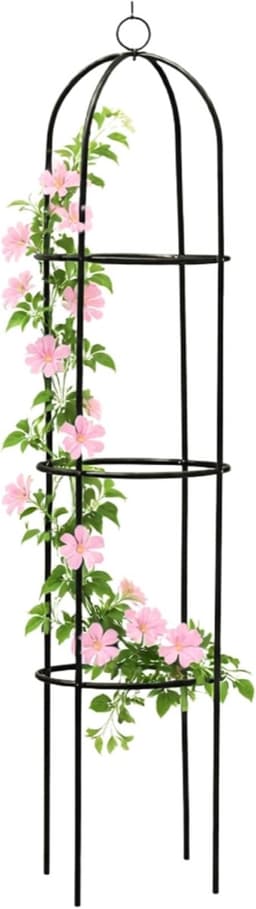
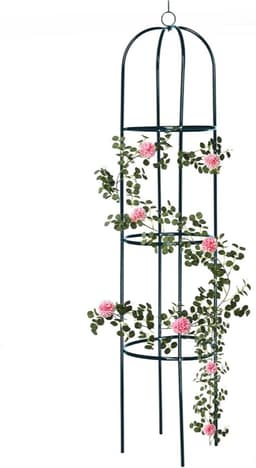
Three metal listings sit at about 1.9 m: Ram at £8.95 (4.0 from 2,300), DIVCHI at £10.99 (4.2 from 2,725), and Garden Mile at £15.99 (4.1 from 1,085). Bases are about 39–43 cm. That height band overlaps the lower end of the 6–8 ft nursery advice and the less-vigorous RHS obelisk role. Reviews on these rows cite roses among other climbers. They also cite thin metal, missing bolts, and fiddly screws. Treat them as budget towers for a trained, less vigorous plant, not as welded galvanised pillars with a kilogram rating. ONEANU's title says 1.6 m and the model line says 150 cm, with a disputed metal line in one UK review and only 46 ratings. Use it only with caution for roses. Height fields and material should agree before you trust it as a rose pillar. The 90 cm towers, Pologmase and B2C plastic, suit a small shrub rose or an annual scale, not a 3 m climber. Skip them as a primary climbing-rose support. Roles across the set sit on the best plant pyramid page.
DIVCHI DIVCHI steel obelisk 1.9 m

Testsieger

DIVCHI DIVCHI steel obelisk 1.9 m
8.4/10about £10.99

Train in a spiral with soft ties

Roses do not cling like ivy. You will tie. David Austin-style advice is to spiral young canes while they bend, and to train side shoots rather than letting everything shoot straight up the tip. Soft twine that does not cut stems beats wire against powder-coated tube. Smooth metal often needs those ties because there is little for a cane to grip. Put the frame in before you plant. The RHS wants the support in place first, a gap of about 20–30 cm so the base is not a rain shadow, and ties that stay kind to bark. Weekly guidance through the first season beats buying a taller title and never tying.

What is not a rose pyramid

Artificial cones in this set — BPIL, Leaf, and Momoplant — are doorway décor. They do not support a climbing rose. Titles that say boxwood or bay do not create a training frame. If search results offered you a faux pyramid while you typed rose support, that is the wrong fork. The living-versus-faux decision sits on the obelisk or artificial plant pyramid page. A 90 cm plastic spiral is also not a rose pyramid for a vigorous climber. Low climbing roses named on a short-tower listing still need honest height for the plant you actually bought. Measure the rose's expected height against the frame, not against the hope that pyramid means enough.

When to leave this set

Choose a wall, fence, or pergola when the rose is vigorous and needs horizontal run the RHS assigns away from obelisks. Leave for specialist UK-made galvanised frames from about £130 when you want heavier construction than the £9–£16 powder-coated band. Ask for help when the house is listed or you will concrete a permanent structure. Trading Standards contact for goods not as described is through Citizens Advice.

Common questions

Can I grow a climbing rose on a plant pyramid?
Yes, if the pyramid is a real climbing support and the rose is less vigorous or a shrub trained as a short climber. A faux cone is not a rose support. Match vigour before you match brand.
How tall should the obelisk be for my rose?
In this set the plausible rose heights are the about-1.9 m metal frames. Nursery guidance often cites roughly 1.8–2.4 m for obelisk and pillar roses. A 90 cm tower is for a small plant, not a tall climber.
Is a 90 cm tower enough?
Rarely for a climbing rose with any real vigour. Use 90 cm only for a small shrub rose or a deliberately low plant. Skip Pologmase and B2C as primary supports for a 3 m climber.
Do I need to tie roses, or will they cling?
You need to tie. Roses are not self-clinging on smooth metal. Soft twine and spiral training while canes are young are the usual method.
When should I use a wall or pergola instead?
When the rose is vigorous and the RHS would point it at a wall, fence, or pergola rather than an obelisk. Also when you need stronger construction than a budget screw-together frame.

Related pages

Sources

Public UK sources for climber training, box blight, product safety and the Consumer Rights Act. amazon.co.uk prices, stars and review counts were taken from the listings on 21 October 2026. The digest lists these URLs without a separate retrieval date for each page, so the shelf date on the score note is used.

  1. RHS, pruning and training climbers on planting (retrieved 21 October 2026)
  2. RHS, climbing roses (retrieved 21 October 2026)
  3. RHS, box blight (retrieved 21 October 2026)
  4. RHS, box alternatives (retrieved 21 October 2026)
  5. Consumer Rights Act 2015, section 9 (retrieved 21 October 2026)
  6. GOV.UK, General Product Safety Regulations 2005: Great Britain (retrieved 21 October 2026)
  7. GOV.UK, permitted development rights for householders: technical guidance (retrieved 21 October 2026)
  8. Harrod Horticultural, garden obelisks (retrieved 21 October 2026)