Heavy duty rubber matting: what the thickness actually means
Heavy duty rubber matting is the phrase on a 3 mm checker roll and on a 22 mm door mat, and both turn up in the same amazon.co.uk search. The words do not say whether water falls through, whether the edge is a ramp, or whether you can carry the parcel. This page is the specification, not a ranking. Prices, stars, and the lines that disagree sit in the [rubber mats comparison](/hub/flooring/rubber-mats). The Products Compared editorial team updated this on 19 October 2026 from the captured amazon.co.uk listings. We did not measure the mats in a lab. A qualifying purchase through our links can earn a commission at no extra cost to you.
Heavy duty rubber matting is the phrase on a 3 mm checker roll and on a 22 mm door mat, and both turn up in the same amazon.co.uk search.
Heavy duty rubber matting is the phrase on a 3 mm checker roll and on a 22 mm door mat, and both turn up in the same amazon.co.uk search. The words do not say whether water falls through, whether the edge is a ramp, or whether you can carry the parcel. This page is the specification, not a ranking. Prices, stars, and the lines that disagree sit in the rubber mats comparison. The Products Compared editorial team updated this on 19 October 2026 from the captured amazon.co.uk listings. We did not measure the mats in a lab. A qualifying purchase through our links can earn a commission at no extra cost to you.
Our top picks
| Badge | Product | Thickness | Drainage | Edge | Note | Price | Offer |
|---|---|---|---|---|---|---|---|
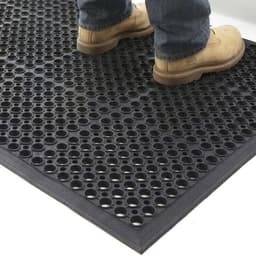
| Best overall |  Ark Mat Ark Mat entrance mat, 150 × 90 cm | 14 mm / 1.2 cm | Holes stated | Bevel stated | 9.6 | about £24.95 | View offer |
| Best value |  Ark Mat Ark Mat honeycomb mat, 120 × 80 cm | 22 mm | Holes stated | Square | 9.2 | about £17.95 | View offer |
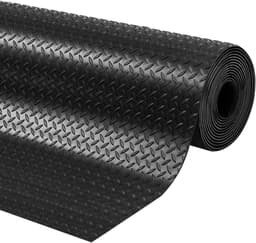
| Alternative |  tonchean tonchean checker roll, 1 × 5 m | 3 mm | No holes stated | Not stated | 9.0 | about £53 | View offer |

On this page
What heavy duty rubber matting means in this set
Size the mat to the opening
Holes, a closed plate, or finger nubs
Read the material line and the conflicting numbers
What you still cannot know from the title
Common questions
What size rubber mat fits a normal UK front door?
How thick should heavy duty rubber matting be?
Do I need holes or a solid top?
Is a PVC drainage sheet a rubber mat?
Why do two lines on one listing give two weights?
Is non-slip a BS 7976 result?
Related pages
Sources
Public UK sources from the research digest. Listing prices, stars, and review counts are the amazon.co.uk figures captured on 19 October 2026. Nothing was lab tested.
- Workplace (Health, Safety and Welfare) Regulations 1992, regulation 12 (retrieved 19 October 2026)
- HSE INDG225, workplace health, safety and welfare (retrieved 19 October 2026)
- HSE GEIS2, assessing the slip resistance of flooring (retrieved 19 October 2026)
- HSE slips and trips, flooring (retrieved 19 October 2026)
- Approved Document M, volume 2, with 2024 amendments (retrieved 19 October 2026)
- Consumer Rights Act 2015, section 9 (retrieved 19 October 2026)
- GOV.UK, General Product Safety Regulations 2005 (retrieved 19 October 2026)
- GOV.UK, construction products regulation in Great Britain (retrieved 19 October 2026)