Independent comparisons. We may earn from shop links. More info

Decking tiles vs boards

Updated: 21 October 2026

Decking tiles vs boards is a choice of structure, not of colour. Click tiles in this amazon.co.uk set sit on a slab you already have. Boards sit on a frame that has to carry people over soil, a drop, or open air. The [decking comparison](/hub/flooring/decking) only ranks the tile packs and one small platform. The Products Compared editorial team set this against TDCA and Wood Protection Association guidance, and the listings, on 19 October 2026. We did not price a timber-board run, so there is no £-per-metre for boards here. A qualifying purchase through our links can earn a commission at no extra cost to you.

Decking tiles vs boards is a choice of structure, not of colour. Click tiles in this amazon.co.uk set sit on a slab you already have. Boards sit on a frame that has to carry people over soil, a drop, or open air.

Our top picks

On this page

What each system is

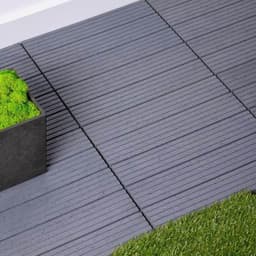
A click tile is a loose cover. The Nicoman packs are rubber squares listed at 300 mm, with a click the bullets call easy. The Airsell pack is nine plastic squares, 0.81 m² in the colour name. You lay them on concrete, paving, or old boards that are already sound, and you can lift them. A board deck is a frame first. The TDCA’s specification puts joists, posts, and beams in Use Class 4, and cites strength class C16 as a minimum where the deck is more than 600 mm above ground. The Wood Protection Association’s September 2025 buyer guide, around BS 8417, puts the deck boards in Use Class 3 and the structural members in Use Class 4.

Ground, height, and load

Tiles lose as soon as the ground is soil. Seller notes say loose soil, gravel, and bare grass move, and the listings never answer their own grass question. A Nicoman clip broke on uneven earth. A click tile on a slab does not create a raised platform. A board deck that climbs can cross the Planning Portal’s 30 cm line for houses in England and, separately, the 600 mm fall where Approved Document K expects guarding. That planning height is in the decking buying guide. Foot traffic on a solid base is the tile case. A hot tub is named in Nicoman’s titles and refused by the heavy-load bullet. No tile here states a design load in kilograms.

Upkeep and slip

Neither surface is maintenance-free. Rubber reviews describe a tyre smell when the carton is new, a light grey that missed a later box, and a patch that paled after rain and sun. The TDCA’s slip article treats a wet pendulum value of 36 or above as low slip potential. None of these tiles publishes a PTV, so we cannot say they meet that band. The same association says composite boards fade, can grow mould where water sits, and vary by recipe. Use Class 4 is what keeps the joists from failing first in the wet. Use Class 3, in the WPA guide, is the treatment class for the boards, not a promise that they never need a wash.

Which to choose

Choose click tiles when the base is already solid, the use is light foot traffic, and you want to lift the surface later. Obey Nicoman’s heavy-load line. The 10-pack is how you check colour. The 40-pack is area of the same light-grey tile. The click sequence is how to lay decking tiles. Choose boards on a Use Class 4 frame when the deck is raised, open underneath, standing over soil, or asked to carry a heavy load. If the ground is a firm slab and a chair, tiles. If it is soil, a drop, or a spa, boards and a frame. Do not bridge the two with the £361 platform unless you have accepted one 80 cm module. Which carton to open, once you stay with tiles, is on best decking tiles.

Common questions

Do click tiles need joists?
No. The Nicoman and Airsell packs are interlocking tiles for a solid surface. They do not include joists. Joists belong to a board deck. Tiles on joists with nothing but the click between them are not the system either pack describes.
Can I lay tiles on soil?
Not usefully. The listings leave the grass question unanswered, and a Nicoman clip failed on uneven earth. If the area is lawn or bare ground, build a base that is actually firm, or switch to boards on a frame.
When do I need Use Class 4?
Use Class 4 is the TDCA requirement for the joists, posts, and beams, and the WPA September 2025 guide says the same for those members under BS 8417. You need it on a framed deck, especially where the timber stays damp. You do not need that stamp on a rubber click tile. The boards themselves are Use Class 3 in that guide.
What strength class is cited for a raised timber deck?
The TDCA cites C16 as a minimum for the timber frame where the deck is more than 600 mm above ground. That is a strength class for the joists and beams, not a grade on these amazon.co.uk tiles. Below that height you still need a sound, treated frame.
Can tiles replace boards over a drop?
No. A rubber or plastic tile does not guard a fall and does not span a gap. If people could fall more than 600 mm, Approved Document K for England is the guarding question. Tiles cover a surface that is already there.
Which is cheaper per square metre?
Inside this tile set, the Nicoman 40-pack is about £33 a square metre for about 3.6 m², and the small packs are about £29 to £36 for under 1 m². We did not capture a merchant price for boards, so a joisted-deck figure would be a guess. Compare systems only after both quotes include the frame.
Are composite boards better than rubber tiles?
Only when you needed boards. Composite still goes on a timber frame, and the TDCA says it can fade, soften in heat, and grow mould if water sits. Rubber tiles suit a liftable cover on a slab, inside the heavy-load line. Neither wins as a general surface.

Related pages

Sources

Public UK sources used for this comparison. Listing prices, stars and review counts are the amazon.co.uk figures saved for this set on 19 October 2026.

  1. Planning Portal — decking planning permission (retrieved 19 October 2026)
  2. GOV.UK — permitted development rights for householders (retrieved 19 October 2026)
  3. Approved Document K — protection from falling (retrieved 19 October 2026)
  4. TDCA — specification for timber decking (retrieved 19 October 2026)
  5. WPA buyer guide to preservative-treated wood, September 2025 (retrieved 19 October 2026)
  6. TDCA — is composite decking all it is cracked up to be? (retrieved 19 October 2026)
  7. TDCA — preventing slips on timber decks (retrieved 19 October 2026)
  8. Hastings Borough Council — balcony and decking (retrieved 19 October 2026)