Independent comparisons. We may earn from shop links. More info

How to use carpet tape so the rug stays where you put it

Updated: October 2026

You have a roll in the hallway, or you are about to, and the rug still walks by the weekend. How to use carpet tape is mostly preparation: the listing has to allow the floor, both faces have to be clean and dry, and the tape has to cover more than four corners. The sticky failures in this set are a liner that will not start, scissors that gum up, and edges-only strips that roll into a tube. This page is the sequence and the point where you stop. It is not a ranking. Prices stay on the [carpet tape comparison](/hub/flooring/carpet-tape). The Products Compared editorial team wrote this from those listings and from UK sources on 19 October 2026. We did not tape a floor in a lab. Links to amazon.co.uk can earn a commission at no extra cost to you.

You have a roll in the hallway, or you are about to, and the rug still walks by the weekend.

Our top picks

On this page

Check the listing, then clean

Read the surface bullet before you cut anything. DIY Doctor’s 20 m mesh and Target Control’s 15 m roll both tell you not to use them on top of a carpet. If that is your floor, put the roll back and use a product whose listing says rug to carpet, or use a fleece. Laying a forbidden tape to see is how reviewers end up with adhesive in a pile the page told them not to touch. The cases for that split are on rug tape for carpet. If the floor is allowed, vacuum the rug back and the floor, and let both dry. Ideal Home’s UK decor piece, drawing on rug retailers, makes the same point: clean and dry, then tape. Dust is why a very sticky roll still lets go. Reviewers of the short XFasten describe grip that dies once fluff is on the tape. A damp hallway from wet shoes is the same problem. Wipe a hard floor and wait. Do not lay tape over grit and hope the pressure will push through it. Cut a short piece and press it in a corner you can afford to mark. Leave it, then peel it. Wickes’ carpet-tape notes say a hardwood floor can be marked, so the test is the point of the corner, not a formality. On carpet, you are checking whether the adhesive keys to that pile and whether it will come back off. If the corner fails, more of the same roll will fail. Stop there.

Lay the perimeter and a grid

Tape the floor or the lower carpet first, not the rug. XFasten’s own instructions say that, and they are the maker’s method for their tape, not a British Standard you must follow with every brand. Run a continuous strip around the perimeter, a few centimetres in from the edge so it does not show. A rule of thumb for the length is twice the rug’s length plus twice its width. A 2 m by 1.5 m rug is about 7 m of edge before you add anything in the middle. Four corners are not a perimeter. Reviews of the 30-yard XFasten rolls describe tape that rucks into a tube, and lounge rugs that still walk when only the edges were taped. On a rug you walk across, add a grid: a strip every half metre or so in both directions. XFasten suggests that grid once a rug is larger than about 5 by 8 feet, roughly 1.5 by 2.4 metres. A hall runner sees more sideways force than a bedroom rug, so the ends and a centre line matter more than they do under a bed. Press each strip down before you think about the liner. If you are doing a large rug alone, the free end will stick to the pile while you fetch scissors. A second person, or weights on the rolled rug, saves that mess.

The liner and the first contact

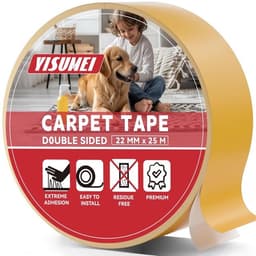
The second face gets one chance. Peel the liner back a little at a time as you lower the rug, rather than stripping a whole length and then dragging the rug across it. Reviewers of YISUMEI say it is manageable if you peel as you go, and that it sticks to your feet if you do not. DIY Doctor’s mesh grabs immediately, so reviewers say you need a sharp knife and you cannot slide the rug afterwards. Target Control’s highlight says easy tear by hand, and reviewers say the backing is hard to start. One person gave up. If the liner will not lift, nick a corner with a fingernail or slide a plastic card under it, which is the XFasten tip. Do not attack it with scissors you care about. Scotch and DIY Doctor both draw the same complaint: the tape sticks to the blades and then to itself. Wipe the blades as you go, or cut the lengths before the adhesive is exposed. Once the rug is down, press from the centre outwards so you are not trapping a bulge. Walk the middle, then the edges. XFasten’s question page says to let pressure-sensitive tape set for at least 12 hours. That is the maker’s instruction, not a British Standard, and it is a reasonable pause before you drag a sofa back. Keep traffic off the rug while it sets, including the dog that one reviewer was trying to stop from digging.

Lifting it, and when not to start

When you do lift the rug, peel slowly, folding the tape back on itself rather than ripping upwards. If residue remains, Wickes’ advice is to warm it with a hairdryer and wipe with soapy water. That is the UK note to follow. Do not import a solvent recipe from an American removal blog. One YISUMEI reviewer did need a hairdryer because the tape had gummed into the carpet. Hardwood can still mark, which is why the corner test came first. A listing that says residue-free for six months is a claim. Reviews in this set include both clean lifts and adhesive that would not come off. Stop before you start if the job is a fitted seam, a gripper that has let go at the skirting, or a worn stair carpet. A consumer roll will not rebuild those. Guy’s and St Thomas’ NHS falls sheet says not to leave rugs at the top or bottom of the stairs. RoSPA’s guidance for over-65s is to repair worn stair carpet, and to tape a loose corner or remove the rug, not to treat tape as a stair safety system. Also stop if you cannot lift the furniture safely, or if the rug is large and you are working alone on a pile the tape is already grabbing. If the real problem is that you must take the rug up every time you vacuum, fleece is the better tool, which is the comparison on carpet tape vs rug gripper.

Common questions

Do you stick the tape to the rug or to the floor first?
Stick the first face to the floor, or to the fitted carpet if the listing allows that, and leave the liner on. Then peel the liner in short lengths and lower the rug onto it. Sticking the tape to the rug first leaves you trying to land a sticky underside in the right place, which is how strips fold and stick to themselves. XFasten’s instructions use the floor-first order. On a hard floor, that also lets you see the grid before the rug hides it.
How do you start a liner that will not peel?
Nick a corner and lift it with a fingernail or a plastic card. Do not cover the tape with more tape to get a grip, and do not use the good scissors as a lever. Target Control, the super-strong XFasten and one Double Dragon review all include a liner that was hard or impossible to start. If you cannot start it after a nick and a card, that roll is not going to become easy halfway across the room. Peel only as much as you can cover in the next few seconds.
Are four corners enough?
No, not on a rug you walk on. Corners stop a little curl and they do not stop the middle from rucking. Reviews of the wide XFasten rolls include rugs that moved again when only the edges were taped, and tape that rolled into a tube. Use a full perimeter, then a grid on anything larger than a small mat. A runner can get away with the two ends and a centre line if the listing’s adhesive actually keys to that back. Check it after a week.
How long before you walk on it?
Press it firmly at once, and keep heavy traffic off it while the adhesive sets. XFasten says at least 12 hours for their pressure-sensitive tape. Treat that as the maker’s figure, not a standard that every roll in this comparison has published. A hallway that is used all evening is a poor first night for a new runner. If the rug walks the next morning, more corners will not fix a dusty bond or a forbidden surface.
What if it sticks to the scissors?
Cut the lengths you need before you expose the adhesive, and wipe the blades as soon as they pick up glue. Scotch and DIY Doctor reviewers both describe a mess on scissors, fingers and the roll itself, and DIY Doctor’s grab is why people reach for a sharp knife. Once the tape has stuck to itself, that piece is waste. Work in short sections, with the liner still on the part you are not laying.
How do you lift it later without a solvent guide?
Peel slowly, back on itself. If a film of adhesive remains, warm it with a hairdryer and wipe with soapy water, which is the Wickes note, and test that on hardwood because the same source says wood can mark. Do not soak the pile in white spirit because a US blog suggested it. Some rolls in this set leave more than a film: reviewers describe glue in the carpet that would not come up. If the corner test already showed that, do not tape the rest of the room.
When do you stop and call a fitter?
Call a fitter when two pieces of carpet need seaming, when the gripper at the edge of a fitted carpet has failed, or when stair carpet is worn, loose or fraying. Also stop if you cannot move the furniture without trapping the tape, or if the only way to make it safe is a rug at the top of the stairs. Tape is for a rug or a loose corner on a surface the listing allows. It is not a repair for the structure of a fitted floor.

Related pages

Sources

Public UK sources and the eight amazon.co.uk listings, checked on 19 October 2026. DIY Doctor was rechecked that day at £6.90. Shelf prices move. This is not a lab test, and none of these rolls is claimed to stop falls or to be BS 5325 certified.

  1. BSI: BS 5325:2021 installation of textile floor coverings (retrieved 19 October 2026)
  2. The Carpet Council: installation (retrieved 19 October 2026)
  3. RoSPA: Safe at Home tips for the over-65s (retrieved 19 October 2026)
  4. Guy's and St Thomas' NHS: Preventing falls at home (retrieved 19 October 2026)
  5. HSE: flooring and slips (retrieved 19 October 2026)
  6. Consumer Rights Act 2015, section 9 (retrieved 19 October 2026)
  7. Flooring Tools Online: heat seaming irons (retrieved 19 October 2026)
  8. amazon.co.uk: DIY Doctor carpet tape listing (retrieved 19 October 2026)