Independent comparisons. We may earn from shop links. More info

Underlay for click vinyl

Updated: 20 October 2026

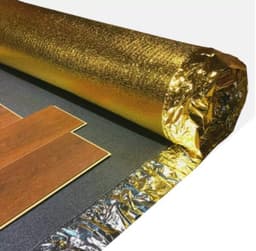
You have click luxury vinyl in the hallway and a 5 mm gold roll in the basket because it felt soft and the price was about £30 for 15 m². Underlay for click vinyl is a different product from underlay for a stiffer laminate. The joint on a thin vinyl plank is a small plastic lock. Soft foam lets that lock rock until it opens. Laminate can sometimes carry the same foam, and only when the plank maker allows the thickness and the floor is flat. This page is that choice. It is not a laying sequence. Prices and review counts are on the [5mm acoustic underlay comparison](/hub/flooring/5mm-acoustic-underlay). If you buy through our amazon.co.uk links, we may earn a commission at no extra cost to you. We used the listings, UK review notes, and maker guidance. We did not run a joint test.

You have click luxury vinyl in the hallway and a 5 mm gold roll in the basket because it felt soft and the price was about £30 for 15 m².

Our top picks

On this page

Why the joint fails

A click floor is only as stable as the layer under the lock. Press a thin plank on a sponge and the edges tilt. The click takes that tilt on every step, especially in a doorway. Contract Flooring Journal puts it as a trade problem: click joints need a firm support, laminate foam and luxury-vinyl underlay are not interchangeable, and underlay does not level hollows. Density keeps the joint shut. Thickness is what makes a bare foot feel warmer. Those two wants fight each other on a 5 mm sponge. Luxury vinyl click is the clearer failure here. One UK review on the AcuStick 15 m² roll says the foam was too thick and spongy, the boards unclipped, and the reviewer points people at 1 mm or 2 mm instead. Quick-Step’s own floating vinyl underlays sit around 1–2 mm, and the brand still caps floor plus underlay at 0.15 m²K/W where there is underfloor heating. MacBlair’s note says click LVT wants a high-density vinyl underlay, not a laminate foam. A comfortable kneel on the bare roll is the wrong test. Laminate is usually stiffer, so it can bridge a slightly softer bed. Usually is not permission. Floor Depot discourages Sonic Gold 5 mm under 7 mm laminate for the same reason: the thin board cannot span the give. A 12 mm laminate on a flat floor, with the maker’s sheet allowing about 5 mm, is a plausible use. A 7 mm click in a kitchen is the case to refuse.

What these listings promise

Five of the six listings say wood or laminate. They do not say click vinyl. AcuStick’s 15 m² roll is explicit about wood and laminate, and it is the roll with the unclipping review. Royale’s bullets say wood or laminate and do not state a foil or a decibel figure. The XPS boards say wood and laminate, claim up to 2.2 tog, and state no foil. Reviewers have put those boards under vinyl anyway. That is an off-label use, not a specification. Smoothfit says wood or laminate. The exception is the Network roll, B0DRDDMG3C, at £29.50 for 15 m². The bullets say laminate and vinyl, 25 dB, a gold foil, and 0.9 tog. The amazon.co.uk line is 5.0 from one rating, and there is no review text. The part string matches the AcuStick roll. A sentence that says vinyl does not print a compressive strength, and it does not answer the unclipping report on the similar foam. Compressive strength and the 10 kPa floor in BS EN 16354:2018 are on the buying guide. None of these listings show that number. If your vinyl maker names a maximum of 1.5 mm or 2 mm, the Network bullet does not overrule it. Crinkle is a separate complaint. Gold-foam reviews describe a crisp-packet noise in the room you are standing in. That can happen under laminate that has not unclipped. It is not the impact figure for the flat below.

When 5 mm foam can still be the layer

Use it under laminate or engineered wood when three things are true at once. The plank maker allows this thickness. The floor is flat enough that you are not asking the foam to fill a dip. The boards are stiff enough to bridge a soft spot, which in the Floor Depot warning means you should be wary of 7 mm laminate on this sonic gold foam. A bedroom of 8 mm or 12 mm laminate over a dry, flat screed is the ordinary case these rolls were bought for. Reviewers on Royale and AcuStick describe warmth and less foot noise than bare boards. That is a comfort result, not a certificate. Engineered wood with a click, if the maker allows a resilient underlay of this depth, can sit with laminate. Glue-down wood is a different system and is outside these listings. Carpet on the foam is also outside the bullets. If you are choosing inside the six, take the reviewed wood-or-laminate rolls, not the one-rating vinyl sentence. Both still carry the spongy-vinyl limit. The XPS boards are a board lay for wood or laminate. Firmer than sponge is not a high-density vinyl underlay tested at 1–2 mm. Heating adds a second refusal. Add the underlay to the floor and compare with 0.15 m²K/W before you put it over underfloor heating. The Network 0.9 tog is the only gold-roll figure in the set that might leave room, and only if you do the sum. The vinyl problem remains even when the tog is acceptable.

If the floor is already gapping

Gaps along the clicks, or boards that unclip when you heel them, are a support failure. Walking softer will not close the lock. A second layer of foam makes the movement worse. The usual repair is to lift the floor, discard the soft underlay, and relay on the underlay the plank maker names, once the subfloor is flat. If more than a couple of rows have opened, a fitter is the sensible call, because a broken click is a new plank. If the floor only crinkles and the joints are tight, you still cannot silence it without lifting. The noise is the foam against the plank or against itself. Do the laying details, if you do relay, on the how to lay page: butt joints, tape, and the expansion gap. None of that rescues a 5 mm sponge under a vinyl click the maker never allowed.

Common questions

Can you use this 5 mm foam under click vinyl?
Not on the evidence here. Five listings say wood or laminate. The one that says vinyl has a single rating and no review text. An AcuStick review describes luxury vinyl click unclipping on this thickness and points to 1 mm or 2 mm. Quick-Step’s own vinyl underlays are in that thinner range. Follow the plank maker if their limit is stricter still.
Why do boards unclip if the underlay feels comfortable?
The comfort is compression. Each step lets the lock twist by a fraction, and the lock is not designed to hinge. Doorways and the first metre inside a room show it first. A firm, thin underlay keeps the two planks in one plane. A deep sponge does the opposite, which is why density beats thickness for click floors.
Is laminate stiffer than vinyl?
Often, yes, which is why a maker may allow 5 mm under a thicker laminate and refuse it under click vinyl. Thin laminate, around 7 mm, is the in-between case. Floor Depot warns against sonic gold 5 mm under that thickness. Read the sheet for your packs. Stiffness you guess from the weight of the box is not a specification.
What should you do if the floor is already down and gapping?
Plan to lift it. The underlay has to come out, and a firmer layer that the maker allows has to go down. A rug, a heavier sideboard, or another sheet of foam will not close an open click. If many boards have separated, or the clicks are breaking as you lift them, ask a fitter before you wreck the rest of the pack.
Does suitable for vinyl on one listing override the plank maker?
No. B0DRDDMG3C states vinyl, at 5.0 from one rating, with no review text and no compressive strength. Your warranty follows the flooring instructions. If those cap underlay at about 1–2 mm, a 5 mm foam is outside the system, whatever the underlay bullet says.
Is a crinkle the same fault as an open joint?
No. Unclipping is the joint opening. Crinkle is noise in the room, reported on gold foam even when the floor stays locked. Both can push you to lift the floor. Only the open joint is a structural fail of the click. Neither is fixed by a different pair of shoes.

Related pages

Sources

Public UK sources listed in the research digest. Listing prices, stars, and review counts are from amazon.co.uk on 19 October 2026.

  1. Approved Document E, GOV.UK (retrieved 19 October 2026)
  2. East Lindsey Guidance Note 53, resistance to the passage of sound (retrieved 19 October 2026)
  3. Scottish Technical Handbook 2022, section 5.1, noise separation (retrieved 19 October 2026)
  4. Technical Booklet G 2012, Northern Ireland (retrieved 19 October 2026)
  5. SITMA, sub-floor testing requirements under Approved Document E (retrieved 19 October 2026)
  6. BSI, BS EN 16354:2018 laminate floor underlays (retrieved 19 October 2026)
  7. EPLF underlay materials bulletin, December 2022 (retrieved 19 October 2026)
  8. Quick-Step UK, vinyl with underfloor heating or cooling (retrieved 19 October 2026)