Independent comparisons. We may earn from shop links. More info

How to use a sealant finishing tool

Updated: 21 October 2026

The bead looked fine for a minute, then a second pass tore a groove through it and the silicone stuck to the tool. You already have a gun, a tube, and a profiler. How to use a sealant finishing tool is mostly what you do before the paddle touches the bead: a dry joint, a nozzle cut to the profile, and one pass. This page is the sequence. It does not rank kits. The [joint smoother comparison](/hub/flooring-tools-and-accessories/joint-smoother) does that. Peter F. did not film a demonstration. A qualifying amazon.co.uk purchase can earn a commission at no extra cost to you. If the joint is a bath that still holds water, the loaded-bath step is on [silicone around a bath](/hub/flooring-tools-and-accessories/joint-smoother/sub/joint-smoother-bathroom).

The bead looked fine for a minute, then a second pass tore a groove through it and the silicone stuck to the tool. You already have a gun, a tube, and a profiler.

Our top picks

On this page

Prepare the joint and the nozzle

The joint has to be clean, dry, and free of grease before any sealant goes down. Old silicone left in the corner becomes the line the new bead peels along. Soap and the film from a previous soapy finger sit on the face the silicone is supposed to grab. Bathrooms and Plumbing's UK guide rejects washing-up liquid on the joint. Cramer's Profiling Kit 7 method says no release agent on the faces. Metex allows a light spray on the tool only. Checkatrade still shows a damp finger or soapy water. For a sanitary bead, follow the makers who keep the joint dry. Cut the nozzle on a bench, not in your hand, and hold the paddle in the empty joint before you gun so you can see which edge fits. iLitLuk's listing says 40 to 60 degrees for its pad. That angle is that maker's instruction, not a rule for every brand.

One pass with the profiler

Gun a length you can finish while the silicone is still wet, then start the next length slightly behind the stop so you do not leave a step. Both edges of the tool sit on the two faces, and the pressure stays light. Hard pressure scrapes the bead out and leaves a hungry line. Bathrooms and Plumbing's guide says one continuous pass. A pause is where the paddle digs in. Wipe the tool on a paper towel before the next stroke. A dirty edge prints the last lump back into the bead. Do not go back over a section that has already skinned. If the first pass is lumpy and the silicone is still wet, lift the worst and tool once more immediately. If a skin has formed, cut that length out, dry the faces, and gun again. Keep any release agent on the paddle, not on the tile or the bath rim. The finger argument is on smooth silicone with a finger or a tool.

Tape, corners, and crossing grout

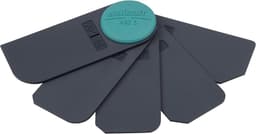
Masking tape gives a straight edge only if you pull it while the bead is wet. UniBond's sanitary datasheet says to pull the tape before the skin forms. Finish into the corner, wipe the tool, and start the next face from that corner. Grout lines are where a flat smoother drops and cuts a groove. Seat a guide before you reach the grout and keep both contact edges on the faces. If your set has no guide, slow down and use a smaller radius, not more pressure. A 16 mm chamfer on a 4 mm crack piles silicone onto the tile. Window boards follow the same pass, without a loaded bath. The choice between a fan, a five-piece set and a guided kit is on the silicone profiling kit guide.

When the tool cannot save the joint

Stop if the bead has skinned and you are about to neaten it. Cut it out, dry the joint, and start again. Stop if the surface is acrylic and the next tool is a metal blade. Cramer's method keeps the knife off acrylic. Call a fitter if the joint has already leaked into the floor, if the ceiling below is stained, or if mould runs well beyond one bead into the plaster or the tray. A new fillet will not dry a joist. Uttlesford's mould advice is goggles, gloves and a mask, and it tells you not to brush mould around the room. UniBond's about 24 hours is the cure note for that sanitary tube. Read the cartridge you opened.

Common questions

Do I wet the tool?
Keep the joint dry. Metex allows a light spray on the tool only, then you wipe the excess so it does not transfer onto the faces. Cramer's kit method uses no release agent. Washing-up liquid on the tile or the bath rim is the step UK plumbing guides blame when a fillet peels. A damp tool is not the same thing as a soapy joint.
What angle do I hold it at?
Use the angle that maker prints, if it prints one. iLitLuk's listing says 40 to 60 degrees for its pad. Checkatrade's silicone article uses a 45 degree nozzle cut, which is the gun, not the paddle. Other tools are held at a slight angle so both edges stay on the faces. There is no single degree that fits every brand in this set.
How far do I gun before I tool?
About 60 to 120 cm if you are following Cramer's Kit 7 sequence, then tool that length before you continue. Shorter is safer on a first bath, because the bead skins while you look for the right edge. Restart the next length slightly behind the stop so the join does not stand proud. Do not gun the whole room and tool it at the end.
Can I go back over a lumpy bit?
You can, while the silicone is still wet: lift the lump, wipe the tool, and make one more pass immediately. Once a skin has formed, a second pass tears it. Cut that section out, dry the faces, and gun again. Pressing harder does not repair a skinned bead.
When should I stop and call a fitter?
Call one if water has already reached the ceiling below, if the floor beside the bath is soft, or if mould extends past the bead into the wall. Also stop using a metal blade on acrylic. A skinned, torn bead is still a DIY repair if the structure is dry. A leak path into joists is not.

Related pages

Sources

Public UK sources from the research digest. Listing prices, stars and review counts are the amazon.co.uk lines used for this comparison, retrieved 19 October 2026.

  1. GOV.UK — General Product Safety Regulations 2005: Great Britain (retrieved 19 October 2026)
  2. legislation.gov.uk — General Product Safety Regulations 2005 (retrieved 19 October 2026)
  3. GOV.UK — Consumer Rights Act 2015 (retrieved 19 October 2026)
  4. BSI Knowledge — BS EN ISO 11600:2003+A1:2011 (retrieved 19 October 2026)
  5. Cramer UK — Profiling Kit 7 (retrieved 19 October 2026)
  6. wolfcraft — Joint smoother fan set 4332000 (retrieved 19 October 2026)
  7. Henkel — UniBond sanitary sealant UK datasheet (retrieved 19 October 2026)
  8. Uttlesford District Council — Removing mould (retrieved 19 October 2026)