Independent comparisons. We may earn from shop links. More info

Cement mixer buying guide

Updated: 21 October 2026

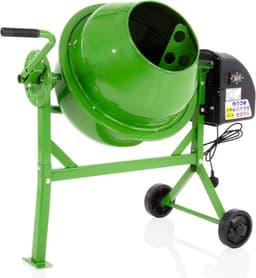
You have a run of fence posts, or a small garden slab, and a 13 A socket on the outside wall. A cement mixer buying guide for that job starts with the mix the listing actually prints, and with the supply you can plug into, rather than the largest litre number in the title. The four electric drums in the [cement mixer comparison](/hub/flooring-tools-and-accessories/cement-mixer) were about £144.99 to about £188.99 on amazon.co.uk on 19 October 2026, all at 220 W. Peter F. compared those listings and public UK sources. He did not run a lab mix. A qualifying purchase can earn a commission at no extra cost to you.

You have a run of fence posts, or a small garden slab, and a 13 A socket on the outside wall.

Our top picks

On this page

Drum litres and stated mix

The number on the box is the shell. The number you can tip is the mix. Hyundai states a 63 litre drum and a 47 litre mix. Garden Universe states a 63 litre drum and a 40 litre working capacity. Both KATSU listings, the 63 litre 167340 and the 80 litre 167341, state the drum only. Treating that shell as concrete overfills a 220 W motor that reviewers already stall on a heavy batch. Where the page prints 40 or 47 litres, use that figure. Drum class is on 63 litre or a larger cement mixer.

230 V at home, 110 V on site

Buy 230 V with a BS 1363 plug for a house. Buy 110 V, centre-tapped to earth, only for a site that already uses it. The Health and Safety Executive says domestic plugs are not for site conditions, and that voltage to earth on a 110 V centre-tapped system should not exceed 55 V. A 110 V mixer at home needs a transformer. Only the Hyundai states 230 V and plug format G, on a 3 metre cable. Garden Universe states 240 V AC and does not state a plug type. Both KATSU pages omit voltage. Watts are not volts. The supply choice is on 230 V or 110 V.

Wheels, tip, and barrow height

Wheels and a tip do not mean the spout meets a builder's barrow. Hyundai's mouth is 260 mm and Garden Universe's opening is 24 cm. Reviews of both say a standard barrow does not fit unless you raise the mixer or lean the barrow. Discharge height is not printed. The KATSU package sizes are parcels, not the stand. Garden Universe's overall height is about 92 cm including the handle, and reviewers still call the frame short. Empty weights run from 24 kg to 27 kg. Raising a short frame is a two-person job. Do not lift a full drum.

What this set can and cannot do

These four are tip-up drums for posts, stepping stones, a small slab or a tile bed. One Hyundai reviewer mixed a 6 by 4 slab in about an hour. A Belle Minimix 150, outside this set, states a 130 litre drum and a 90 litre mix at £637.77 including VAT. Wet cement is about pH 12 to 13. It can burn trapped skin, irritate lungs as dust, and cause dermatitis. A 2 ppm chromium VI limit, while the bag is in date, does not replace alkali-rated gloves, eye protection, or washing. A pick inside the set is on best cement mixer.

Common questions

What size cement mixer do I need for posts and a small slab?
For posts, stepping stones, or a small slab in batches, a stated mix around 40 to 47 litres is what these listings describe. Hyundai prints 47 litres and Garden Universe prints 40. A patio that must be finished in one pour needs a larger drum or ready-mix. If each tip has to fill a builder's barrow, look for a stated mix near 90 litres.
Is drum capacity the amount of concrete I get?
No. Drum capacity is the shell. Hyundai states 63 litres of drum and 47 litres of mix. Garden Universe states 63 litres and 40 litres working capacity. The KATSU 63 litre and 80 litre pages do not state a mix at all, so an 80 litre shell is not evidence of a larger batch. Speedy's figure of about 80 percent is a rule of thumb for drums that do not print a working capacity. Do not apply it on top of a 40 or 47 litre line.
Should the stand reach a wheelbarrow?
It should if you want to tip straight into a builder's barrow. None of these four listings states a discharge height. Hyundai and Garden Universe reviewers say the spout is too low unless the mixer is raised or the barrow is leaned. DIY Garden's 100 cm stand is their suggestion, not a spec for these frames. Garden Universe's approximate overall height is 92 cm including the handle. A low tub still works. A full barrow on every mix does not.
Is 220 W enough?
It is the motor class of every drum kept here, and it is enough for the small batches reviewers describe: post mix, stepping stones, one large tile, a modest slab. It is not the 0.55 kW of a Minimix 150 or the 550 W of a 140 litre drum. Hyundai reviewers report stalling and a thermal trip when the drum is tipped heavy. If the job needs a barrow-sized mix, 220 W is the wrong class.
Do I need 110 V at home?
Not for a garden on a 13 A socket. At home you want 230 V and a BS 1363 plug. A 110 V mixer needs a transformer, because it will not run from that socket. On a construction site, the Health and Safety Executive expects 110 V centre-tapped to earth so the voltage to earth stays at or below 55 V, and domestic plugs are not the site supply. In this set, only Hyundai states 230 V and plug type G. If a listing omits voltage, do not assume it.

Related pages

Sources

Public sources used for this comparison, with the amazon.co.uk listings read on 19 October 2026.

  1. HSE: cement and health risks (retrieved 19 October 2026)
  2. HSE: electricity on construction sites (retrieved 19 October 2026)
  3. HSE: noise at work for employers (retrieved 19 October 2026)
  4. HSE: manual handling (retrieved 19 October 2026)
  5. BS EN 12151:2007 via NBS (retrieved 19 October 2026)
  6. MPA Cement: chromium VI and cement (retrieved 19 October 2026)
  7. Speedy Hire: cement mixer buying guide (retrieved 19 October 2026)
  8. Seddon Plant: Belle Minimix 150 110 V (retrieved 19 October 2026)
  9. Hire MK: 110 V tip-up cement mixer (retrieved 19 October 2026)