What size flag for a flagpole: one third, then area

Match a garden flag to the pole you will install. One third of the height is the look. In England a projecting flag must stay at or under 2 square metres.
On this page

The pole in the lawn is shorter than the kit photograph, and the other tab is a 3 by 5 ft flag or a hoist cloth four metres long. What size flag for a flagpole is two sums, not one. The Flag Institute’s custom, for a pole on the ground, is that the longer side should be no more than one third of the height. In England a projecting flag has a separate cap of 2 square metres.
The figures come from the Flag Institute, Hampshire Flag’s chart, Harrison Flagpoles’ quarter-to-one-third band, the Planning Portal’s 4.6 metre garden case, and GOV.UK’s guide to the advertisement classes. Sizes and GBP prices are amazon.co.uk listings in the Borussia Dortmund flag set. These flags were not flown in a lab. A qualifying purchase can earn a commission at no extra cost to you.
In short
On a ground-level pole, one third of the 4.6 metre English garden height is about 1.53 metres. That is a look, not the same rule as England’s 2 square metre cap on a projecting flag. A 3 by 5 ft flag or a 150 by 100 cm flag can meet both. A 150 by 400 cm flag meets neither.
- Look: longer side no more than one third of a ground-level pole.
- England, projecting flag: stay at or under 2 square metres.
One third of the pole is a look, not a law
The Flag Institute states the length rule as a custom, not a planning condition. British land flags are 3:5 and ensigns are customarily 1:2. When national flags fly together, the protocol asks for equal sizes on poles of equal height.
A council does not come out with a tape because the fly is a few centimetres past one third. If you treat the sentence as a bylaw, you will argue with a rule that was never written that way.
Maker charts are not the same rule
Hampshire Flag’s rough guide, which still depends on pole strength, puts about 1,370 by 680 mm on a pole under 5 metres and about 1,830 by 910 mm on a 6 metre pole. Harrison Flagpoles runs from one quarter to one third and places a 1.5 to 2 yard flag on poles of about 4 to 6 metres. Do not average them.
Do the sum for 4.6 metres
The Planning Portal’s usual English garden case is one flagpole up to 4.6 metres without an application. One third is about 1.53 metres. That is the Flag Institute applied to a planning height, not the planning rule. A longer flag can still be lawful on a grounds staff and look large.
Hampshire’s under-5-metre row is about 1.37 by 0.68 metres, close to 1:2, not 3:5. The 6 metre row is a 2 yard flag, about 1.83 by 0.91 metres, already past 1.53 metres. Harrison’s home size is that same 2 yard flag, about 183 by 91 cm, for poles around 5 to 6 metres. On a 4.6 metre pole, 1.83 metres is past one third.
A 20 ft kit is about 6.1 metres. Tall kits in the flagpole comparison can stand above 4.6 metres. Whether that height is allowed is in the flagpole height rules. Measure the height left above the ground after the sleeve or base.
A short wall pole is a different sum
Wall kits in that flagpole set are about 1.5 to 1.8 metres, often without a flag, at about £11 to £22. One third is 0.5 to 0.6 metres. A 3 by 5 ft fly of about 1.52 metres is about three times that, so it can be lawful and still drown a six-foot house pole. Harrison’s 2 yard flag belongs on poles around 5 to 6 metres, where one third is about 1.7 to 2 metres. Do not move it onto a short house bracket because both are called wall poles.
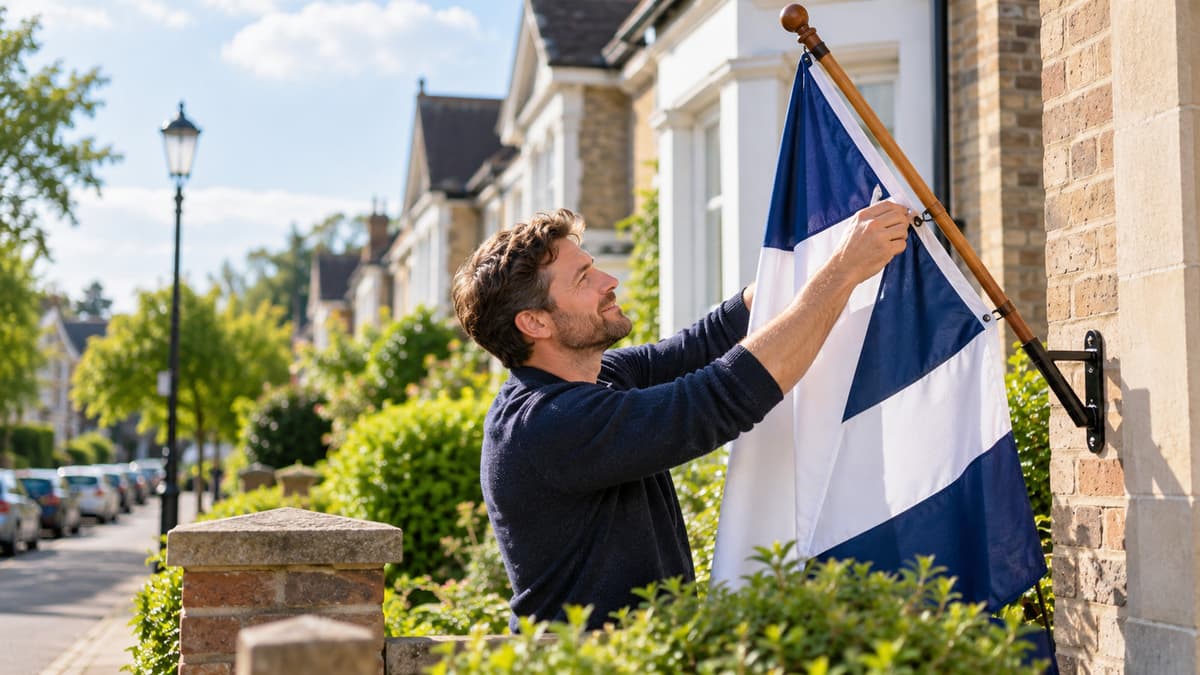
A projecting flag in England must stay at or under 2 square metres if you rely on that deemed-consent class. Multiply the sides, and divide the bracket height by three. Bracket, sleeve or spike is a separate choice on the wall or in-ground flagpole page.
Two square metres is the projecting-flag cap
Class 7AA covers a flag projecting from a building, not a vertical roof staff. GOV.UK’s guide to the Town and Country Planning (Control of Advertisements) (England) Regulations 2007 caps that flag at 2 square metres. The class steps aside on conservation areas, National Parks, National Landscapes, the Broads and areas of special control. A sponsor mark can also take consent away. Those conditions are in flying a flag in a UK garden.
Class 7AB is a grounds flagstaff, limited to 4.6 metres, with no flag-area cap in the GOV.UK guide. Amenity and safety still apply. A bracket off the wall is the projecting case. A pole in the lawn is the grounds-staff case. The planning-permission guide sets them beside the height. The 2 square metre figure is English, not UK-wide and not the building regulations. Scotland and Wales differ, and the Flags Regulations (Northern Ireland) 2000 cover specified government buildings.
At 3:5, a 1.53 metre fly gives a short side of about 0.92 metres and about 1.4 square metres. A flag of 1.5 by 1.4 metres is about 2.1 square metres, so it fails Class 7AA even though each side is near one third of a 4.6 metre pole.
Three flags people actually buy
A 3 by 5 ft flag in the Borussia Dortmund set is about 0.91 by 1.52 metres, on the one-third line for 4.6 metres, and about 1.39 square metres. The printed polyester cloths are about £35.80 to £37.86, with one to three reviews or none. The size can be right while that sample is too thin to rank one print above another.
The official polyester hoist flag, B074W9G7JC, is 150 by 100 cm, 1.5 square metres, £10.97 and about 100 g. It is listed double-sided, for indoor use, with a pole mount and no pole. The listing is 4.6 from 162 reviews. Reviewers describe a flagpole and a garden, and one buyer expected a rod a photo seemed to show. It is the top pick for a small official club flag. It is the wrong parcel if the page must say outdoor, or if the pole must be in the box.
The portrait flag, B008Y2XMVK, is 150 by 400 cm, 6 square metres, with a 4 metre side. On a 4.6 metre pole it fails the look, and on a projecting staff it fails the 2 square metre cap. It is the outdoor viscose listing at £63.21, 4.6 from 234 reviews, with notes of torn seams and a torn top hanger. Outdoor on the page is not a sizing pass.
Shape, a roof pole, and the order to buy in
Land flags at the Flag Institute are 3:5. Ensigns are customarily 1:2, also called 2:1. Harrison says the Union Flag, St George’s Cross and the Saltire are traditionally 2:1, which is the ensign proportion, not the Institute’s land flag. The one-third check still uses the longer side.
On a roof the Institute allows a larger flag, because the building adds height. That is a look, not permission for a second flag, a sponsor mark, or a taller staff. A vertical roof staff is not the Class 7AA projecting flag.
- Measure the pole you will install, from the ground or the bracket to the top, not the tallest picture.
- Take one third of that height as the longest side on a ground-level pole if you follow the Flag Institute.
- Multiply the two sides. In England a projecting flag stays at or under 2 square metres.
- Leave a 4 metre portrait flag off a short pole, and do not size the flag to a 20 ft carton until the height rules allow it.
Failing the one-third look can still be lawful on an English grounds staff. Passing it can still fail the area cap on a house bracket. Passing both can still be too much cloth for a light pole. There is no wind-load number here.
Common questions
What size flag fits a normal garden pole?
Is the flag supposed to be one third of the pole?
Is a 3 by 5 ft flag too big?
What about a 4 metre hoist flag?
Are UK flags 3:5 or 2:1?
Does a legal size also look right?
What size flag for a short wall bracket?
Do I use the same size for a flag on the roof?

Heinrich W. is the editor for Leisure & sport at productscompared.co.uk. Comparisons in this category are checked against amazon.co.uk listings, review evidence and public UK sources.
Related articles

Flagpole height rules in the UK
The 4.6 metre figure is the ordinary English garden pole. A 20 ft kit can stand above it.
Flying a flag in a UK garden
England’s flag rules are not a free pass, and they are not the same in every nation.

Sports club flag consent in England
A club flag can lose deemed consent if it shows a sponsor, or if a projecting flag exceeds 2 square metres.