Flagpole height rules UK: measuring the 4.6 metre line

The 4.6 metre line is an English advertisement limit for a garden flagpole. See how a 20 ft kit compares, and when a listed building changes the answer.
On this page
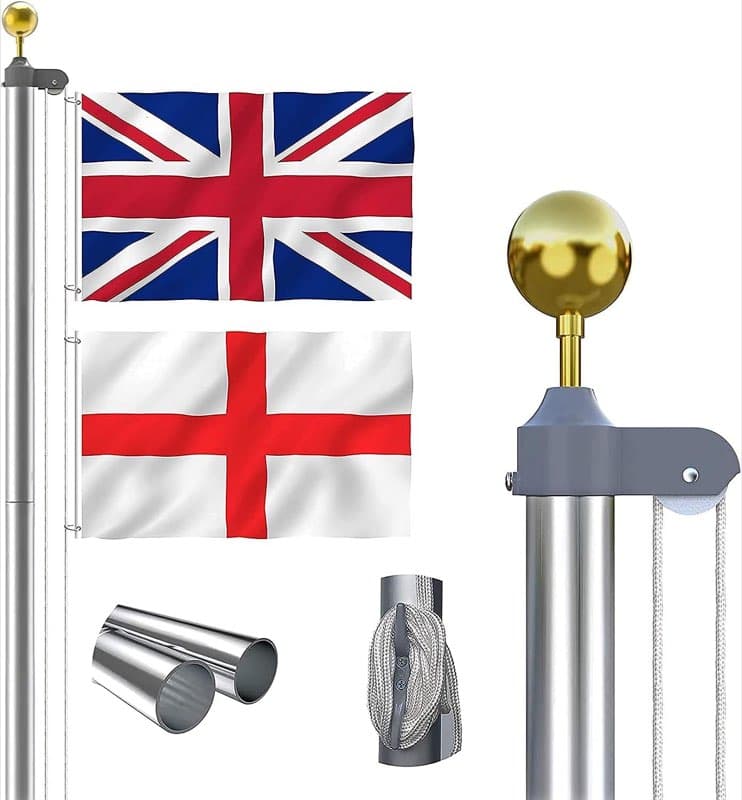
The carton says 20 ft, the Planning Portal says 4.6 metres, and you are standing in the garden with both numbers in your head. Flagpole height rules in the UK are easy to flatten into one maximum. The 4.6 metre line is a real English figure for a flagpole in the grounds. It lives in advertisement control and in a short planning FAQ. It is a poor substitute for a UK-wide building regulation, and a 20 ft title is about 6.1 metres if you assemble every section.
Measure the pole you will stand up, from the ground to the top, before you treat the longest number on the box as the height you are allowed. Heinrich W. checked the Planning Portal FAQ, the GOV.UK flag guide, Class 7 of the England advertisement regulations, and amazon.co.uk shelf prices in our flagpole comparison, in October 2026. This is not a lab test, and no listing states a tested wind speed. A qualifying purchase through our links can earn us a commission at no extra cost to you.
In short
In the ordinary English case, one garden flagpole up to 4.6 metres can go up without an application. A full 20 ft kit is about 6.1 metres, so the title height sits above that line. Conservation areas, listed buildings, and the other protected designations change the answer even when the pole is short. Scotland does not inherit Class 7AB by being in the UK.
The 4.6 metre figure is English advertisement control
People meet 4.6 metres in two public places and then treat it as a national building rule. The Planning Portal answers a householder who wants a pole in the garden. GOV.UK's plain-English flag guide puts the same figure inside the section on flags in the grounds of a building, next to rules on how many poles and which flags. A parish council policy can copy that wording for its own sites. Caister Parish Council's flag-flying policy is an example of a local document that repeats the grounds figure. It is not a statute for a house outside that parish.
The legal home of the number, for deemed consent in England, is Class 7AB of Schedule 3 to the Town and Country Planning (Control of Advertisements) (England) Regulations 2007. No part of that flagstaff may be more than 4.6 metres above ground level. The class is about a flag on a single staff in the curtilage. It is not a sentence that every pole in the United Kingdom must stop at 4.6 metres, and it is not a maximum flag size. Which cloth may fly is the subject of flying a flag in a UK garden.
There is a second 4.6 metre class that householders mix in. Class 7B is a housebuilder's flag on a sales site. It also uses 4.6 metres, and that class does cap the flag at 2 square metres. A show-home compound is not a back garden. If a forum post hands you "4.6 metres and 2 square metres" as one rule for every pole, it has folded Class 7B into a place the class does not describe.
What the Planning Portal says about one garden pole
The Planning Portal FAQ is deliberately short. You can put one flagpole up to 4.6 metres high in your garden without applying, in the ordinary case. Higher than that needs consent. A protected area such as a conservation area, or a listed building, needs consent. Certain flags, such as national flags, can be flown without consent. The FAQ does not list every flag, and it does not walk through sponsor marks, two flags on one pole, or the difference between a wall bracket and a sleeve in the lawn.
Use it as the first public answer, then check the longer guide if your layout is more than one stick in an ordinary garden. GOV.UK allows more than one arrangement in the grounds, with limits: a grounds staff still not above 4.6 metres, consent in a controlled area, and only one grounds flag, or two if one needs no consent, when a roof flag or a projecting flag is already flying. The Planning Portal's "one flagpole" line is the simpler public FAQ. Where they seem to diverge, the local planning authority is the place to ask, not a product title that says the kit can fly two flags.
A council webpage that copies one of those sentences is a summary for that area. It does not raise the English figure to 6 metres because a kit is popular, and it does not lower it because a neighbour was told to take a pole down.
Class 7AB limits the staff
Class 7AB is the England deemed-consent class for a flag on a single staff in the curtilage of a building. The limit is on the staff. No part of it may be more than 4.6 metres above ground level, which means the finial counts if it is part of the pole you stand up. Deemed consent is not given in a conservation area, an Area of Outstanding Natural Beauty, a National Park, the Broads, or an area of special control. The class does not add a 2 square metre cap. That cap belongs to Class 7AA, a staff projecting from the building, and to Class 7B, the housebuilder flag.
A flag that is lawful on a 4 metre grounds staff can be the wrong size on a bracket. A 150 cm by 100 cm club flag is 1.5 square metres and fits under the projecting cap. A 150 cm by 400 cm hoist flag is 6 square metres and does not fit Class 7AA. On a grounds staff the missing size cap does not excuse the height, and it does not excuse protected land. The Borussia Dortmund flag comparison is where those two cloths sit next to each other, at about £10.97 and about £63.21.
Measure after assembly, not from the carton. Sections overlap. A title that says 20 ft, or 6 m, is the longest arrangement the seller is advertising. If you stop an adjustable pole at a lower mark, that lower mark is the height that matters, and you confirm it with a tape from the ground.
A 20 ft kit, a wall pole, and an indoor stand
Twenty feet is about 6.1 metres. In the flagpole comparison, Thanaddo at £59.99 and the NQ 20 ft kit at £59.99 are described as halyard kits about 6 m, and iElyiEsy at £69.99 is in the same band. Thanaddo is a six-section aluminium kit with a 1.0 mm wall, a PVC sleeve, a Union flag, and an England flag, with 4.6 from 1,113 reviews. The NQ kit states a range of about 8 ft to 20 ft, a 1.2 mm wall, and 38 ft of rope, with 4.5 from 236 reviews. iElyiEsy states a 1.2 mm wall, a 20 inch PVC sleeve, and one 3 by 5 British flag, with 4.3 from 34 reviews. Full title height on each of them can sit above 4.6 metres.
Wall poles in the set are about 1.5 to 1.8 metres. The NQ 5 ft wall-mounted flagpole is about £21.95, with 4.4 from 335 reviews, and the box has no flag. Height is rarely their problem. Reviewers report kit plugs pulling out of brick, which is a fixing failure on a short pole that was never near 4.6 metres. A spike is not a foundation. The laloohome and Sibosen ground spikes are sold without a flag and without a halyard. Pushing prongs into turf does not become a surveyed base because the title says heavy duty.
Protected land, other nations, and wind
Common questions
How tall can a garden flagpole be in the UK?
Is 4.6 metres the same rule in Scotland and Wales?
Is a 20 ft flagpole legal in an English garden?
Do I need permission for a short wall pole?
What if I want two poles?
Does a conservation area or a listed building change the height?
Can I half-mast a pole that has no rope?
Who do I ask if the Planning Portal and my council seem to disagree?

Heinrich W. is the editor for Leisure & sport at productscompared.co.uk. Comparisons in this category are checked against amazon.co.uk listings, review evidence and public UK sources.
Related articles
Flying a flag in a UK garden: what consent covers
Which flags need no consent in England, and why the pole is a separate question.

When to take a flag down in wind: lower it in time
Height is not a wind rating. When to lower a flag, and when to leave the pole empty.
Flying the Union Flag at home: correct hoist corner
Check the hoist corner on a kit flag, and how half-mast works if you have a rope.