Independent comparisons. We may earn from shop links. More info

Titebond vs Gorilla wood glue, by class and size

Updated: October 2026

You are choosing between Titebond wood glue and Gorilla Wood Glue, not between every bottle in the [wood glue comparison](/hub/fillers-adhesives-and-sprays/wood-glue). Titebond vs Gorilla wood glue splits on class and amount, not on the star rating. The Products Compared editorial team used the amazon.co.uk extracts dated 15 October 2026. Links to Amazon are affiliate links. We did not break joints in a press, and we did not rank the printed psi figures. A litre of stated D3 from another brand is a different decision, on the [wood glue buying guide](/hub/fillers-adhesives-and-sprays/wood-glue/sub/wood-glue-buying-guide).

You are choosing between Titebond wood glue and Gorilla Wood Glue, not between every bottle in the wood glue comparison.

Our top picks

On this page

Gorilla Wood Glue, not Gorilla Glue

The kept Gorilla bottle is PVA. It cleans up with water and it does not foam. Gorilla Glue Original is polyurethane, it foams as it cures, and it is a different product. Buying that because the brand is familiar is a named mistake. The word wood on the PVA bottle is the product type, not the durability class. Everbuild's litre of D3 is not a third contestant here.

What each bottle prints for water

Gorilla's amazon extract says D3, indoor and outdoor, and not soaked wood. Soudal's line for D3 is frequent short-term water indoors, or exterior not exposed to the weather. That is a sheltered joint, not a planter left in the rain. A Gorilla data sheet also prints ANSI/HPVA Type II. That line does not make the 118 ml bottle the same glue as Titebond II, and it does not turn D3 into D4. Titebond II's extract prints ANSI/HPVA Type II and no BS EN 204 D class. Titebond III's extract prints ANSI/HPVA Type I and no D class. Type I and Type II are not D3 or D4 labels. The coating that exterior timber still needs is on the exterior wood glue page.

Size and price on 15 October 2026

Gorilla Wood Glue was £3.59 for 118 ml, about £30 a litre if you scale it. A same-day snippet, not in this set, showed Gorilla 532 ml at £8.75. That is context, not the bottle scored here. Titebond II was £10.14. The title says 16 fl oz, the unit count says 473 ml and the volume field says 237 ml, so do not state a price per litre until those fields agree. The Amazon full-cure field of 15 minutes is not the maker's schedule. Titebond III was £14.79 for 473 ml, about £31 a litre.

Which bottle, and for which joint

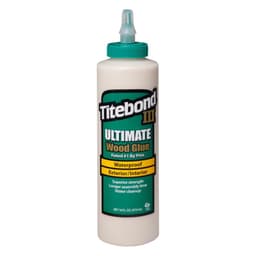
For a small repair that 118 ml will finish, Gorilla Wood Glue is the one. You get a D3 PVA. You do not get a litre, and the extract does not state Type I. When you want Type II on a Titebond bottle, and you expect to use more than 118 ml, Titebond II is the buy, with the volume conflict in the same decision. It prints an indirect-food line. For garden timber, a planter or rain, Titebond III is the one, and the timber still wants a finish. It is the only kept bottle that states Type I. It is not D4.

Colour, food contact, and what not to decide here

Gorilla dries a natural wood colour in the product notes, and one listing field says Clear. Titebond II's dry-colour field is light brown. Titebond III's field says clear. If the glue line will show on pale timber, use the field on the bottle you are buying. Do not rank the printed psi figures.

Common questions

Is Gorilla Wood Glue the same product as Gorilla Glue?
No. Gorilla Wood Glue is the PVA in this comparison, D3 on the amazon.co.uk extract, 118 ml. It cleans up with water and does not foam. Gorilla Glue Original is polyurethane and foams as it cures. Buying the polyurethane because the brand name matches is the mistake this page is trying to prevent. The wood-glue bottle is the one for a close wood joint.
When is Titebond II the better buy than that small Gorilla bottle?
When you want ANSI/HPVA Type II on a Titebond bottle and you expect to use more than 118 ml. It was £10.14 on 15 October 2026, rated 4.8 from 12,200 reviews, and it does not print a BS EN 204 D class. The volume fields say 237 ml and 473 ml. Buy it if you will check the fill, and do not quote a price per litre until one volume is clear. It is the extract that prints indirect food contact.
When is Titebond III the one to buy?
When the joint will see rain, a planter or other wetting beyond sheltered D3, and you will still finish the timber. It was £14.79 for 473 ml, 4.7 from 25,918 reviews, and it is the only kept bottle that states ANSI/HPVA Type I. Type I is not D4. A bare glue line is not a coating. For a small dry repair, it is the dearer bottle without a matching need.
Which of these bottles prints a food-contact line on the amazon.co.uk extract?
Titebond II. The fields in this comparison say indirect food contact on that listing. The Gorilla 118 ml extract does not print it, and the Titebond III extract does not print it either. A review that mentions a chopping board does not add the line to Titebond III. If food contact matters, read the bottle you will use and stay inside what that bottle claims.
What if I need a litre of D3 instead of either brand?
Buy the litre of stated D3 and leave this head-to-head. Everbuild 502 was £8.50 for 1 litre on 15 October 2026, which is a lower price per litre than scaling Gorilla's 118 ml or buying Titebond III's 473 ml. It is D3, not Type I. The buying guide holds that bottle. This page does not score it against Titebond and Gorilla.

Related pages

Sources

Public UK sources used for this comparison. Listing prices, stars, and review counts are from amazon.co.uk extracts dated 15 October 2026.

  1. BSI, BS EN 204:2016 — classification of thermoplastic wood adhesives (retrieved 15 October 2026)
  2. Soudal UK — what D stands for on wood adhesives (retrieved 15 October 2026)
  3. Sika Everbuild 502 wood adhesive data sheet (retrieved 15 October 2026)
  4. Gorilla Glue UK — wood glue (retrieved 15 October 2026)
  5. Gorilla wood glue technical data sheet (retrieved 15 October 2026)
  6. Titebond — wood glue FAQs (retrieved 15 October 2026)
  7. HSE — GB CLP classification (retrieved 15 October 2026)
  8. Consumer Rights Act 2015 (retrieved 15 October 2026)