Independent comparisons. We may earn from shop links. More info

How to use wood glue on a close joint

Updated: October 2026

You already have a PVA or cross-linking wood glue, and the joint has to hold after the clamps come off. This is how to use wood glue on a close joint: bare faces, glue while the bottle's open time still lets you close them, clamp for that bottle's time, then wait for its full cure. The Products Compared editorial team used the maker sheets and the amazon.co.uk fields in the [wood glue comparison](/hub/fillers-adhesives-and-sprays/wood-glue). We did not run a strength test. The minutes below belong to the bottle named next to them. Do not give every brand one shared clamp time.

You already have a PVA or cross-linking wood glue, and the joint has to hold after the clamps come off.

Our top picks

On this page

Make the joint close

These glues need a closed joint. They do not fill a gap. Dry-fit first. A dowel should seat with hand pressure, not rattle. Paint, varnish and sanding dust are a named reason the bond fails, so take the meeting faces back to bare wood and wipe the dust off. A tight fit still fails if you clamp after the open time, because the glue has skinned. If the joint is structural, or the timber is rotten, stop and call a joiner. If you are still choosing a class, use the wood glue buying guide.

Three clocks, and they are not interchangeable

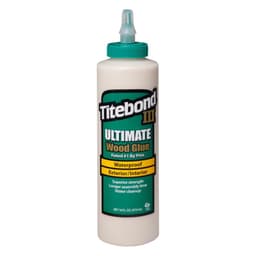
Gorilla's data sheet and the amazon.co.uk listing give an open time of 5 to 10 minutes, a clamp of 20 to 30 minutes and a full cure of 24 hours. That is the PVA, not polyurethane Gorilla Glue. Everbuild 502's Sika sheet puts full strength at 8 hours at 20°C. The listing prints that cure and no clamp minutes. Do not invent a 30-minute clamp because another bottle uses one. LLPT's listing says clamp for 1 to 2 hours and cure for 24 hours. What its waterproof line covers belongs on the exterior wood glue page. Titebond III's bullets give an initial tack of about 30 minutes and a set of about 24 hours. Titebond II describes a strong initial tack and gives no minute figure. The Amazon field that says full cure 15 minutes on Titebond II is not the maker's schedule.

Temperature before the glue goes on

Gorilla's sheet sets a minimum use temperature of 10°C. A cold garage in a British winter is often below that, so bring the timber and the glue indoors before you spread anything. Do not treat 20°C on the Everbuild sheet as the cure temperature for every other brand.

Clean the wet glue and close the bottle

Water-based PVA cleans up with water while it is wet. Wipe the bead before it skins, and keep the cloth off the glue line so you do not starve the joint. Dried PVA on the face will show under a finish. Leaving a cut nozzle open ruins the rest of the bottle. On 151, the bullet says reseal after each use, and many reviewers say you cut the tip and then there is no cap. Put the pin or pull-up seal back on before you walk away.

Where a joiner takes the job

Call a professional for load-bearing timber, rotten exterior joinery, workplace isocyanate or solvent adhesives, or any food-contact job the bottle does not claim. BS EN 15425 is the factory polyurethane standard for load-bearing timber, and a shop bottle does not meet it. The Amazon fields print an FDA indirect-food line on Titebond II only. Repeat only the line on the bottle in your hand. Which bottle to buy is on the best wood glue page.

Common questions

How long do I clamp wood glue?
Use the clamp time on the bottle you are holding. Gorilla Wood Glue's sheet and listing say 20 to 30 minutes, then a 24-hour cure. LLPT's listing says 1 to 2 hours, then 24 hours. Titebond III's bullets say an initial tack of about 30 minutes and a set of about 24 hours. Everbuild 502's listing prints an 8-hour full strength at the sheet's 20°C and does not print clamp minutes. Do not use one brand's figure on another bottle.
What is the difference between open time, clamp time and full cure?
Open time is how long the glue stays workable enough to close the joint. Gorilla's sheet puts that at 5 to 10 minutes. Clamp time is how long pressure has to stay on so the faces cannot move. Full cure is when the joint can take a load: 24 hours on the Gorilla and LLPT listings and on Titebond III, and 8 hours at 20°C on the Everbuild sheet. Unclamping early, or loading the joint at the clamp time, skips a clock.
How do I clean PVA wood glue off the wood?
Wipe it with water while it is wet. Gorilla's listing says a wet cloth, or scrape the glue once it has dried. Everbuild's listing also says water. A dried skin on the face is harder to remove and can show under stain or varnish. Keep the wipe on the squeeze-out, not on the glue line, so you do not pull adhesive out of the joint.
How cold can the room be before the glue dries weak?
Gorilla's sheet sets a minimum use temperature of 10°C. Below a formula's chalk point a PVA can dry weak. If your bottle prints no minimum, treat ordinary room temperature as a rule of thumb, not as a British Standard. BS EN 204 does not set temperature resistance. Warm the timber and the glue before you start if the workshop is near freezing.
When should I stop and call a joiner?
Stop for load-bearing timber, rotten exterior joinery, workplace isocyanate or solvent adhesives, and any food-contact use the bottle does not claim. These are retail non-structural glues. A stair, a rotten sill or a food surface without a printed line is not a clamp-time problem you can solve with a longer cure.

Related pages

Sources

Public UK sources used for this comparison. Listing prices, stars, and review counts are from amazon.co.uk extracts dated 15 October 2026.

  1. BSI, BS EN 204:2016 — classification of thermoplastic wood adhesives (retrieved 15 October 2026)
  2. Soudal UK — what D stands for on wood adhesives (retrieved 15 October 2026)
  3. Sika Everbuild 502 wood adhesive data sheet (retrieved 15 October 2026)
  4. Gorilla Glue UK — wood glue (retrieved 15 October 2026)
  5. Gorilla wood glue technical data sheet (retrieved 15 October 2026)
  6. Titebond — wood glue FAQs (retrieved 15 October 2026)
  7. HSE — GB CLP classification (retrieved 15 October 2026)
  8. Consumer Rights Act 2015 (retrieved 15 October 2026)