Soil blocker vs seed trays: cubes or plastic cells
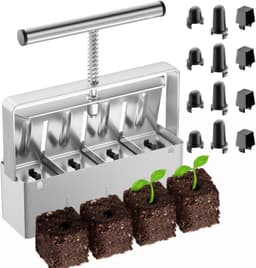
You already own cell trays and you are asking whether a handheld press is worth the wet mix and the extra watering. Soil blocker vs seed trays is a method split, not a brand shoot-out. A blocker replaces the plastic cell with a free-standing compost cube. It does not replace the tray, and it asks more of watering than a module that holds a plug. Prices for the seven tools stay on the [Soil blocker comparison](/hub/fertiliser-soil-and-bark-mulch/soil-blocker). The Products Compared editorial team compared public UK advice with these amazon.co.uk listings. Nobody here ran a yield trial. A qualifying purchase can earn a commission at no extra cost to you.
You already own cell trays and you are asking whether a handheld press is worth the wet mix and the extra watering. Soil blocker vs seed trays is a method split, not a brand shoot-out.
You already own cell trays and you are asking whether a handheld press is worth the wet mix and the extra watering. Soil blocker vs seed trays is a method split, not a brand shoot-out. A blocker replaces the plastic cell with a free-standing compost cube. It does not replace the tray, and it asks more of watering than a module that holds a plug. Prices for the seven tools stay on the Soil blocker comparison. The Products Compared editorial team compared public UK advice with these amazon.co.uk listings. Nobody here ran a yield trial. A qualifying purchase can earn a commission at no extra cost to you.
Our top picks
| Badge | Product | Cells | Block size | Frame | Note | Price | Offer |
|---|---|---|---|---|---|---|---|
| Best overall |  nanovi Nanovi 4-cell 2 inch soil blocker | 4 | 2 inch x 2 inch x 2 inch | Zinc-coated steel | 8.8 | about £30.55 | View offer |
| Best value |  QWORK QWORK 4-cell 2 inch soil blocker | 4 | 2 inch x 2 inch | Galvanised steel | 8.6 | about £19.98 | View offer |
| Alternative |  Lyreh Lyreh 20-cell 3/4 inch soil blocker | 20 | 3/4 in | Stainless steel and plastic | 6.0 | about £28.99 | View offer |


On this page
What actually changes
Roots and transplanting
Time, water and cost
Paper pots and toilet rolls
Common questions
Do I still need a seed tray if I buy a blocker?
Is air pruning better than a module plug?
Which is faster to fill?
What about paper pots or toilet rolls?
Can I keep my old plastic trays and just change the cells?
Which crops stay in modules?
Does a press save money in year one?
Related pages
Sources
Public UK and maker sources from the research digest, used for this page in October 2026. Prices, stars and review counts are from the seven amazon.co.uk listings in this set. A German review line is not a UK sample. Ladbrooke prices are market context from the maker's site. A nationwide shop ban on peat compost has not been enacted.
- RHS, how to garden without plastic (retrieved October 2026)
- RHS, peat-free compost for seeds and cuttings (retrieved October 2026)
- Ladbrooke soil blocker hand tools (retrieved October 2026)
- Garden UK, soil blocking in the UK (retrieved October 2026)
- GOV.UK, General Product Safety Regulations 2005 (retrieved October 2026)
- GOV.UK, product safety advice for businesses (retrieved October 2026)
- Blackberry Lane, soil blocker notes (retrieved October 2026)
- Consumer Rights Act 2015 (retrieved October 2026)