How to use a soil blocker so the cubes do not crumble
You already have a handheld press and the first tray crumbled, stuck in the grid, or washed into slurry under a rose. How to use a soil blocker is a moisture and motion problem, not a brand problem. The mix has to be wetter than potting compost. You charge more than once, scrape the base flush, and water from below. Product cards sit on the [Soil blocker comparison](/hub/fertiliser-soil-and-bark-mulch/soil-blocker). These steps come from UK grower pages and amazon.co.uk review themes. Nobody here ran a germination trial. The cue is pale-grey cube faces, not a calendar. A qualifying Amazon purchase can earn a commission at no extra cost to you.
You already have a handheld press and the first tray crumbled, stuck in the grid, or washed into slurry under a rose. How to use a soil blocker is a moisture and motion problem, not a brand problem.
You already have a handheld press and the first tray crumbled, stuck in the grid, or washed into slurry under a rose. How to use a soil blocker is a moisture and motion problem, not a brand problem. The mix has to be wetter than potting compost. You charge more than once, scrape the base flush, and water from below. Product cards sit on the Soil blocker comparison. These steps come from UK grower pages and amazon.co.uk review themes. Nobody here ran a germination trial. The cue is pale-grey cube faces, not a calendar. A qualifying Amazon purchase can earn a commission at no extra cost to you.
Our top picks
| Badge | Product | Seed pins | Frame | Cells | Note | Price | Offer |
|---|---|---|---|---|---|---|---|
| Best overall |  nanovi Nanovi 4-cell 2 inch soil blocker | 3 sizes | Zinc-coated steel | 4 | 8.8 | about £30.55 | View offer |
| Best value |  QWORK QWORK 4-cell 2 inch soil blocker | Weld-in steel beads | Galvanised steel | 4 | 8.6 | about £19.98 | View offer |
| Alternative |  Transplant Transplant 4-cell 2 inch soil blocker | Fixed hole; larger inserts missing in one review | Galvanised steel | 4 | 8.0 | about £21.00 | View offer |
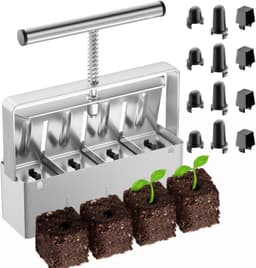


Get the mix wet enough
Charge, scrape, eject
Sow and water
When it still fails
Common questions
How wet should the mix be?
Why do cubes crumble on eject?
How do I get them out of the press?
How do I water without washing edges off?
Do I still need a seed tray?
How soon can I water after making blocks?
Can I start tomatoes in a 20 mm cube?
Related pages
Sources
Public UK and maker sources from the research digest, used for this page in October 2026. Prices, stars and review counts are from the seven amazon.co.uk listings in this set. A German review line is not a UK sample. Ladbrooke prices are market context from the maker's site. A nationwide shop ban on peat compost has not been enacted.
- RHS, how to garden without plastic (retrieved October 2026)
- RHS, peat-free compost for seeds and cuttings (retrieved October 2026)
- Ladbrooke soil blocker hand tools (retrieved October 2026)
- Garden UK, soil blocking in the UK (retrieved October 2026)
- GOV.UK, General Product Safety Regulations 2005 (retrieved October 2026)
- GOV.UK, product safety advice for businesses (retrieved October 2026)
- Blackberry Lane, soil blocker notes (retrieved October 2026)
- Consumer Rights Act 2015 (retrieved October 2026)