Independent comparisons. We may earn from shop links. More info

How to feed rhododendrons: rates, place and timing

Updated: October 2026

You have the pouch or bottle in your hand, but the useful questions are still where, when and how much. Learning how to feed rhododendrons starts with the product's own label, because a 900 g controlled-release granule, a Vitax pellet and a Westland liquid use different rates. The [rhododendron fertiliser comparison](/hub/fertiliser-soil-and-bark-mulch/rhododendron-fertiliser) shows the listed formats. This page keeps their instructions apart. Feed only a plant that needs it, work on moist soil, and stop if the leaves show scorch. A qualifying purchase can earn a commission at no extra cost to you.

You have the pouch or bottle in your hand, but the useful questions are still where, when and how much.

Our top picks

On this page

Find the active root area

Rhododendrons make shallow, fibrous roots. Place feed over the root area rather than against the stem or deep in the planting hole. For an established shrub, that means the outer root zone, with a clear space around the trunk. A concentrated heap in one spot is not an even application. Incorporate dry granules only if the label says so, and avoid deep hoeing. Keep granules off leaves and the crown. Pour diluted liquid onto the compost unless that product gives a foliar method. Never feed a waterlogged pot.

Use spring as the starting point

Early spring is the main feeding point for many dry rhododendron feeds in the UK. Miracle-Gro continuous-release model 121065 is positioned as one application at the start of spring. That schedule belongs to that product. It does not mean every granule or pellet is used only once. Published Vitax directions use March or April and another application around flowering. Those grammes stay with Vitax. Westland's published liquid schedule spans March to September, while other guidance stops general feeding after midsummer. Do not continue when growth has stopped or the plant is stressed. Compare granular vs liquid rhododendron fertiliser before you open a pack.

Keep each rate with its own product

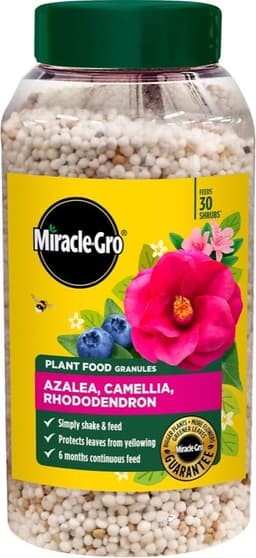
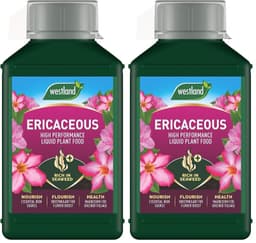
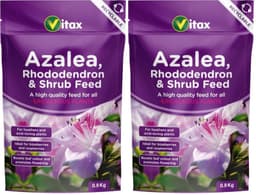
For Miracle-Gro 121065, the published label gives 15–20 g for a new plant, 30–60 g for an established plant and 15–30 g for a plant in a pot. Verify those figures on your current pack. The same label includes a serious eye-damage warning, so follow its handling instructions and keep it away from children and pets. Vitax is commonly directed at 30 g per square metre. A handful means about 30 g for that product only, so weigh it. Westland is published at 50 ml in 4.5 litres every one to two weeks. The listing omitted that ratio, so keep the bottle. Miracle-Gro 121180 is commonly every two weeks, and the twin-pack listing has no mixing ratio. Never borrow the 50 ml figure. B00QXDHOMA also lacks a ratio. Thuja-Vital and sulphate of iron keep their own methods. Iron solution can stain paving.

Follow a short application check

Work on moist compost, measure the rate on the current pack, and spread it over the root area clear of the stem. Note the date so you do not repeat the dose early. B0D2CRD2YK includes granules and liquid. That is a purchase pair, not an instruction to apply both at full rate. B0B1XVSHKZ includes a rose feed. Keep that tub off the rhododendron. The rhododendron fertiliser buying guide explains the declarations.

Stop when leaf tips brown

Brown, dry leaf tips after a heavy dose can indicate fertiliser scorch. Stop feeding. Where drainage is sound, plain water may move excess feed through the compost. Do not leave roots sitting in water. Pale tissue between green veins is a different problem from tip scorch. The rhododendron yellow leaves guide separates high pH, drought and root disease. Fertiliser cannot repair vine-weevil damage or honey fungus.

Common questions

When should I fertilise rhododendrons in the UK?
Spring is the usual starting point. Some dry feeds specify one application, while others allow another around flowering. Liquids may continue during active growth according to their label. Avoid routine winter feeding and do not extend the season merely to use up a bottle.
Should fertiliser go into the planting hole?
Not unless the exact product label expressly says so. Concentrated feed against young roots can cause damage. Rhododendron feeds are generally distributed over the root area after planting, clear of the stem, with only light incorporation where directed.
Can I use a handful as the dose?
Only when the matching label defines it, and a measured amount is still safer. Vitax guidance equates a handful with about 30 g for that product. The same handful is not the correct dose for Miracle-Gro granules, another Vitax formulation or a container plant.
Can I feed again after flowering?
Some products allow or recommend a second application around flowering, while a controlled-release product may be designed for one spring dose. Follow the pack you used first. Do not layer a second complete feed over long-release granules without clear directions.
Can I feed in August or September?
Some liquid labels include late summer or September, but general advice often cautions against encouraging soft growth too late. Follow the current product directions and stop if the plant is not actively growing or is drought-stressed. Dry feeds are usually an early-season job.
What if I applied too much?
Stop feeding immediately. Remove visible excess granules if this can be done without disturbing roots, and use plain water appropriately where drainage is sound. Watch for tip scorch or wilting. For a severe overdose, contact the manufacturer or a horticultural professional with the product name and amount.

Related pages

Sources

Public UK and maker sources from the research digest, used for this page in October 2026. Prices, stars and review counts are from the ten amazon.co.uk listings dated 21 October 2026. A season-long claim is the maker's statement. The 900 g label warns of serious eye damage. No pack here is described as pet-safe.

  1. RHS, rhododendron growing guide (retrieved 21 October 2026)
  2. RHS, rhododendrons on alkaline soil (retrieved 21 October 2026)
  3. RHS, fertilisers (retrieved 21 October 2026)
  4. GOV.UK, manufacturing and marketing fertilisers (retrieved 21 October 2026)
  5. Regulation (EC) No 2003/2003, Article 9 (retrieved 21 October 2026)
  6. Miracle-Gro 121065 pack label (retrieved 21 October 2026)
  7. Vitax azalea, rhododendron and shrub feed pouch label (retrieved 21 October 2026)
  8. Westland ericaceous high performance liquid plant food (retrieved 21 October 2026)