Independent comparisons. We may earn from shop links. More info

How to lay pine bark mulch

Updated: October 2026

You have cleared a border and opened a bag, but the listing says 25 mm while other guidance says twice that or more. Knowing how to lay pine bark mulch starts with that conflict. For useful soil cover, plan on 50–100 mm over moist, weed-free ground, not a token scatter. Keep the material away from stems, allow for settlement and leave the finished surface undisturbed. The [pine bark mulch comparison](/hub/fertiliser-soil-and-bark-mulch/pine-bark-mulch) is where you choose a bag. This guide is the application in beds and borders. A purchase through a link may earn a commission at no extra cost to you.

You have cleared a border and opened a bag, but the listing says 25 mm while other guidance says twice that or more. Knowing how to lay pine bark mulch starts with that conflict.

Our top picks

On this page

How deep should pine bark mulch be?

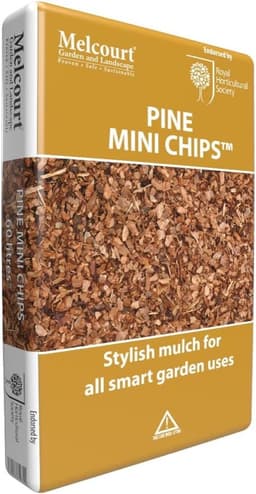
Melcourt gives 50–100 mm for Pine Mini Chips and notes settlement of roughly 5–10%. The RHS advises at least 5 cm, ideally 7.5 cm, for organic mulch generally. For coarser woody material, that guidance reaches 8–12 cm. Use the maker’s range for the named grade and treat the RHS figures as the wider horticultural context. A 25 mm layer can change the colour quickly. It is not equivalent to 50 mm for excluding light or resisting gaps. A few displaced handfuls expose soil. The 25 mm wording on the captured Suttons listing, and on Invigortex B0G361T2TB, should not override the 50–100 mm instructions for Melcourt Pine Mini Chips. Use the lower end on a maintained ornamental bed where the soil is already clean and the bark will not be disturbed. Move towards 75–100 mm for a more substantial layer, particularly with coarser pieces. Avoid burying low plants or changing levels against buildings. Containers need a retaining rim. That method is pine bark mulch for pots.

Prepare the bed before you open the bags

Remove established weeds, including as much perennial root as you practically can. Mulch can make new germination harder. It will not reliably smother bindweed, couch grass or brambles pushing from established roots. Deal with a severe infestation before you buy the final surface. Water dry soil and wait until it is evenly moist, not frozen, waterlogged or squelchy. Bark moderates evaporation after you lay it. It cannot rehydrate a dry root zone once a thick layer is in place. Plant shrubs and perennials first so you do not immediately dig through the new surface. Rake the bed level enough to avoid thin ridges and deep hollows. Remove large debris and obviously diseased woody material. RHS guidance warns against wood associated with honey fungus or Phytophthora. Wear gloves, open dry bags carefully and avoid breathing dust. Tip small piles at intervals, then draw them together, taking care around stems.

Stem gaps, coverage and topping up

Keep a clear ring around woody stems. The RHS suggests about 10 cm, and woody-waste guidance gives 8–10 cm. Aim for a visible hand-width. Do not bank damp bark against a trunk or a crown. Coverage is volume arithmetic, not a trial. A 60-litre bag theoretically covers 1.2 m² at 50 mm and 0.6 m² at 100 mm. A 50-litre bag covers about 1.0 m² at 50 mm or 0.5 m² at 100 mm. Uneven ground, gaps and settlement reduce that. A 3 m by 1 m border is 3 m². At 50 mm it needs 150 litres before allowance, so three 50-litre bags are the mathematical minimum. Buy a little extra for 5–10% settlement. After spreading, check depth with a ruler and fill thin patches. Top up where the layer has genuinely thinned.

What not to do after laying bark

Do not dig surface bark into the soil. Woody material breaking down in the soil can tie up nitrogen near that spot. A surface mulch has much less effect on established shrubs. When you plant later, pull the bark aside and put it back without mixing it through the bed. A temporary white growth on damp chips is the harmless mould Melcourt describes. Break up only that loose patch if the look bothers you. A foul smell, collapsing plants, or wood you suspect of honey fungus or Phytophthora needs a different diagnosis. Do not spread affected chips. An ornamental title is not play surfacing or a fire specification. Get specialist advice for those jobs. Grade checks are in the pine bark mulch buying guide. Named bags are in best pine bark mulch.

Common questions

How deep should pine bark mulch be?
Use 50–100 mm for Melcourt Pine Mini Chips, and stay inside that range for the grade and the site. The RHS advises at least 5 cm, ideally 7.5 cm, for organic mulch generally, and about 8–12 cm for coarser woody material. Allow for 5–10% settlement rather than starting too thin.
Why do some bags say 25 mm?
Some reseller listings print a 25 mm minimum. That is a shallow decorative layer beside maker and RHS guidance. It exposes soil quickly when it is disturbed and blocks less light. Base the calculation on at least 50 mm where the named product instructions support that depth.
How much does a 60-litre bag cover?
Theoretical coverage is 1.2 m² at 50 mm or 0.6 m² at 100 mm. Real coverage is often slightly lower because beds are uneven and bark settles. Measure length by width, then add a modest allowance rather than stretching the last bag.
How far should bark sit from a trunk?
Keep roughly 8–10 cm clear around woody stems and trunks. The gap reduces persistent damp contact and leaves the root collar visible. Do not pile bark into a cone against the plant, even if the surrounding layer is deep.
Can I dig bark into the soil?
Leave mulch on the surface. When planting, pull it aside and replace it afterwards. Incorporating woody bark can affect nitrogen availability locally while it decomposes. Correctly applied surface mulch has much less effect on established shrubs.
Is white mould on bark dangerous?
White fungal growth can be a harmless part of natural bark decomposition, particularly in damp conditions. It is not automatically plant disease. Investigate further if plants decline, the material smells abnormal, or the site contains wood you suspect of honey fungus or Phytophthora.
When should I call a professional?
Get specialist advice for public play surfacing, a formal fire specification, or suspected serious tree and shrub disease. Those cases need product-specific evidence or a diagnosis. Routine mulching of a healthy ornamental bed normally does not, if you follow the bag and basic precautions.

Related pages

Sources

Maker and RHS pages from the research digest, plus the Defra peat announcement and the September 2024 written answer, used for this page in October 2026. Prices, stars and review counts are the captured amazon.co.uk listing figures, not a live re-price. An RHS or FSC line is a listing claim unless the maker page names that pack. No bag here is treated as BS EN 1177 play bark. The bark pH is Melcourt's figure for the bark, not a fertiliser claim.

  1. Melcourt Pine Mini Chips (retrieved October 2026)
  2. Melcourt SylvaBark Pine Mini Mulch (retrieved October 2026)
  3. Melcourt Bark Nuggets (retrieved October 2026)
  4. Melcourt Ornamental Bark (retrieved October 2026)
  5. RHS, woody waste as mulch (retrieved October 2026)
  6. RHS, how to mulch with organic matter (retrieved October 2026)
  7. Defra, horticultural peat announcement, 27 August 2022 (retrieved October 2026)
  8. Defra written answer on the peat ban, 4 September 2024 (retrieved October 2026)