Phalaenopsis fertiliser on a UK kitchen windowsill
The orchid on a UK kitchen sill is usually a Phalaenopsis, a moth orchid in coarse bark. Phalaenopsis fertiliser is a light specialist feed while the plant is growing, a dry crown after watering, and almost no feed in winter. It is not a lawn rate and not a 5 litre mist for one plant. Mixing and vial steps stay on [how to use orchid fertiliser](/hub/fertiliser-soil-and-bark-mulch/orchid-fertiliser/sub/orchid-fertiliser-how-to-use). The ten listings are on the [orchid fertiliser comparison](/hub/fertiliser-soil-and-bark-mulch/orchid-fertiliser). Prices are the amazon.co.uk listings from 19 October 2026. This is not a growing trial. A qualifying purchase can earn a commission at no extra cost to you.
The orchid on a UK kitchen sill is usually a Phalaenopsis, a moth orchid in coarse bark.
The orchid on a UK kitchen sill is usually a Phalaenopsis, a moth orchid in coarse bark. Phalaenopsis fertiliser is a light specialist feed while the plant is growing, a dry crown after watering, and almost no feed in winter. It is not a lawn rate and not a 5 litre mist for one plant. Mixing and vial steps stay on how to use orchid fertiliser. The ten listings are on the orchid fertiliser comparison. Prices are the amazon.co.uk listings from 19 October 2026. This is not a growing trial. A qualifying purchase can earn a commission at no extra cost to you.
Our top picks
| Badge | Product | Form | Dose | Stated analysis | Note | Price | Offer |
|---|---|---|---|---|---|---|---|
| Best overall |  Westland Westland orchid plant feed concentrate, 200 ml | Liquid concentrate | Mixing field 1:5. Squeeze doser | Not stated on the listing | 9.2 | about £7.58 | View offer |
| Alternative |  Growth Technology Orchid Focus Bloom, 100 ml | Liquid concentrate | 5 ml in 2 litres | Higher phosphorus and potassium. No urea stated | 9.0 | about £3.99 | View offer |
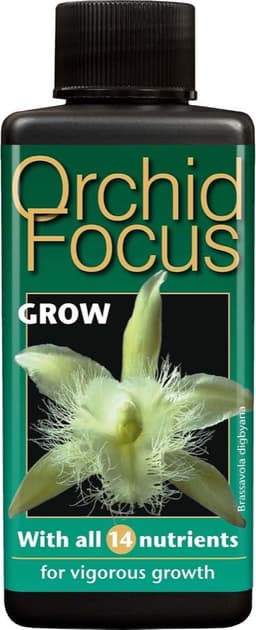
| Best value |  Growth Technology Orchid Focus Grow, 100 ml | Liquid concentrate | 5 ml in 2 litres | High nitrogen. No urea stated | 8.6 | about £3.35 | View offer |


On this page
Why bark holds almost no food
The moth-orchid calendar
Crown, water and ice
What to buy for one moth orchid
Common questions
Does a moth orchid need a specialist feed?
How often should you feed a Phalaenopsis in the growing season?
Should you feed in a UK winter?
Why does bark change the feed job?
Can you leave water in the crown after a feed?
Is Orchid Focus Bloom the moth-orchid bottle?
Should one moth orchid buy a 5 litre mist?
When do you call for help instead of buying more feed?
Related pages
Sources
Public UK and maker sources from the research digest, used for this page in October 2026. Prices, stars and review counts are from the ten amazon.co.uk listings captured on 19 October 2026. A drip duration is a listing claim. A no-urea line is recorded only where the bullets say it. Westland's NPK is from the maker's page, not from the amazon listing. This is not a laboratory test.
- RHS, how to grow Phalaenopsis (retrieved 19 October 2026)
- RHS, fertiliser labels explained (retrieved 19 October 2026)
- RHS, fertilisers: types and uses (retrieved 19 October 2026)
- GOV.UK, manufacturing and marketing fertilisers (retrieved 19 October 2026)
- Fertilisers Regulations 1991, Schedule 2 (retrieved 19 October 2026)
- Westland orchid feed (retrieved 19 October 2026)
- Doff orchid drip feed (retrieved 19 October 2026)
- Growth Technology, Orchid Focus Grow (retrieved 19 October 2026)