Horse manure for vegetables: crops, residues and safe choices
You are ready to spread stable manure over an allotment, with potatoes, beans and carrots planned for spring. Before using horse manure for vegetables, answer two separate questions: is the source likely to let sensitive plants grow normally, and is produce from affected ground considered safe to eat? Hormone weedkiller residues can pass from treated grass, hay or silage through a horse into manure and distort susceptible crops. The UK Health and Safety Executive says a worst-case assessment should not create consumer health concerns, and that the vegetables should be safe to eat. That does not make suspect manure suitable for replanting. This page is the crop decision. Retail products are in the [horse manure comparison](/hub/fertiliser-soil-and-bark-mulch/horse-manure).
You are ready to spread stable manure over an allotment, with potatoes, beans and carrots planned for spring.
You are ready to spread stable manure over an allotment, with potatoes, beans and carrots planned for spring. Before using horse manure for vegetables, answer two separate questions: is the source likely to let sensitive plants grow normally, and is produce from affected ground considered safe to eat? Hormone weedkiller residues can pass from treated grass, hay or silage through a horse into manure and distort susceptible crops. The UK Health and Safety Executive says a worst-case assessment should not create consumer health concerns, and that the vegetables should be safe to eat. That does not make suspect manure suitable for replanting. This page is the crop decision. Retail products are in the horse manure comparison.
Our top picks
| Badge | Product | Stated plants | Manure role | Form | Note | Price | Offer |
|---|---|---|---|---|---|---|---|
| Best overall |  Westland Westland horse-manure rose food, 2 × 3 kg | Roses | Granule enrichment | Granules | 9.2 | about £21.10 | View offer |
| Preis-Tipp |  Topline Topline rose food, 2 × 3 kg | Roses, shrubs, fruit | Granule enrichment | Granules | 9.2 | about £19.99 | View offer |
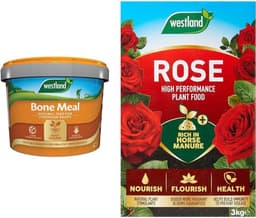
| Alternative |  Westland Westland bone meal and horse-manure rose food bundle | Flowers | 3 kg rose-food part | Not stated | 1.0 | about £27.54 | View offer |


On this page
Ask before the heap reaches potatoes
Distorted growth is not the same as unsafe food
Hungry crops, and why carrots should wait
Try one bed before the whole plot
Common questions
Which vegetables are most sensitive to weedkiller residues in manure?
Are vegetables from affected ground safe to eat?
What does residue damage look like?
Why do carrots fork after manure?
Does well-rotted manure mean it is herbicide-free?
Which crops like trusted horse manure?
What should I do with a suspect shared heap?
Related pages
Sources
Public UK sources from the research digest, used for this page in October 2026. Prices, stars and review counts are from the three amazon.co.uk listings captured on 20 October 2026. None of those tables prints an NPK. A handful rate on a maker page is not an amazon.co.uk line. A missing star line is not a zero-star product. This is not a laboratory test.
- BBC Gardeners' World, horse manure (retrieved 20 October 2026)
- RHS, organic matter: how to use (retrieved 20 October 2026)
- RHS, how to mulch (retrieved 20 October 2026)
- RHS, weedkiller in manure (retrieved 20 October 2026)
- HSE, aminopyralid in manure (retrieved 20 October 2026)
- GOV.UK, storing organic manures in nitrate vulnerable zones (retrieved 20 October 2026)
- Nitrate Pollution Prevention Regulations 2015, regulation 23 (retrieved 20 October 2026)
- Garden Health, Westland rose food (retrieved 20 October 2026)