Independent comparisons. We may earn from shop links. More info

How to use cow manure in a UK garden

Updated: October 2026

The bag is already on the path, or the heap has been dropped by the gate, and you need to know how to use cow manure without scorching the roses or capping the bed in July. Published depths do not match, and a fresh, strawy sack is a different material from a dark, crumbly one. The [cow manure comparison](/hub/fertiliser-soil-and-bark-mulch/cow-manure) is where the amazon.co.uk listings sit. This page is the season, the depth and the planting hole. By the end you should know whether to wait, whether to mulch or dig in, and how far one listed 26 kg bag can go as a rule of thumb.

The bag is already on the path, or the heap has been dropped by the gate, and you need to know how to use cow manure without scorching the roses or capping the bed in July.

Our top picks

On this page

Check the bag before you spread it

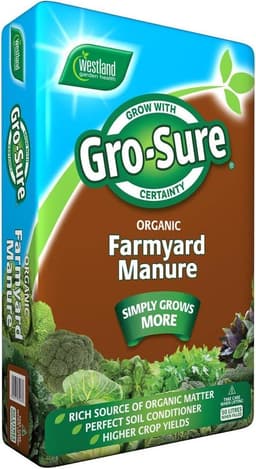
Well-rotted manure is dark, more even, and only modestly earthy. BBC Gardeners' World treats six months as a minimum rot, and a year if the bedding was woody shavings, because fresh dung scorches roots and the wood has not broken down. There is no British Standard number on the Gro-Sure amazon.co.uk listing that certifies that state. If you can see pale sticks and the smell is sharp, stack the bag moist and turn it when you can, until it darkens. Wear gloves and wash afterwards. The BBC guide gives that hygiene line because manure can carry pathogens, and the Westland safety data sheet says to avoid eyes and skin.

When to apply it

On most UK soils the RHS suggests digging organic matter in during March and April, just before growth. Sandy soils are better manured from late winter, because nutrients move through sand more readily. Autumn can suit a bare bed, except on sand. JPR adds a summer warning: from late spring, dig the manure in, because a surface mulch can dry into hard lumps. Fresh manure is a pollution risk if soluble nutrients reach a ditch, so compost it.

Mulch or dig in

The RHS mulch guidance is at least 5 cm of organic matter, kept clear of woody stems. Westland's current farmyard page says a mulch of 3–4 cm, forked into the top 15–20 cm. Those instructions disagree. This page does not average them into 4 cm. Follow the bag you bought. The Gro-Sure amazon.co.uk bullets do not state either depth. If you are following the RHS, the mulch stays off the bark of roses, shrubs and young trees. A single posted bag therefore suits a planting hole and a short border.

Planting holes and pots

Westland's current page gives a planting mix of one part manure to five parts soil. That is a dilution for the hole around a rose or a shrub, not a recipe for a container. Keep the manure in the backfill, away from the stem, and use the soil you dug out as the other five parts. A hole filled with neat manure will sit wet, then shrink, and the roots meet a rich pocket instead of the bed. Manure is not potting compost. Straw, twigs and lumps turn a container uneven, and in the Amazon reviews Gro-Sure buyers who wanted a fine mix for pots said so. That is a container complaint, not a decision about open ground.

How far one bag goes

Use the kilogram figure when you fork manure into a bed, and the litre geometry when you mulch. They answer different questions. A rose bed 2 metres by 1.5 metres is 3 square metres, so at 5 kg per square metre the 26 kg bag covers it with a little left for the hole, and at 10 kg it falls short. If the bed will grow food you eat raw, use the calendar on cow manure on vegetables before you spread.

Common questions

Do I dig manure in or leave it on top?
Dig it in during March and April on most soils, which is the RHS timing, at 5–10 kg per square metre. A mulch is the other method: at least 5 cm if you are following the RHS, or 3–4 cm forked into the top 15–20 cm if you are following Westland's current page. Keep either layer off woody stems. From late spring, JPR suggests digging it in so a summer cap does not dry hard.
How thick should the mulch be?
Use the instruction that belongs to the product you are following, and keep the two numbers apart. The RHS says at least 5 cm of organic matter, clear of stems. Westland's current farmyard page says 3–4 cm. The Gro-Sure amazon.co.uk bullets do not state a depth. Fifty litres at 3 cm covers about 1.7 square metres, and at 5 cm about 1 square metre. Those areas are geometry.
How do I use it when planting a rose or a shrub?
Mix one part manure to five parts of the soil you dug out, which is the ratio on Westland's current page, and keep the mix away from the stem. The hole is not a place for neat manure. If the plant is a rhododendron, azalea or heather, Westland's current page says to keep this conditioner off it. The Amazon bullets do not repeat that line.
What if the bag still smells strong and is full of straw?
Leave it stacked and moist until it darkens and the smell becomes modestly earthy. BBC Gardeners' World treats six months as a minimum, and longer when the bedding is wood. A sharp smell on arrival is unfinished rot, which matches the JPR note and the Gro-Sure reviews that mention raw straw.
How far does one 50 litre bag go?
The listed weight on B00I950W6U is 26 kg. At the RHS rate of 5–10 kg per square metre, dug in, that is roughly 2.6 to 5.2 square metres. As a mulch, 50 litres covers about 1.7 square metres at 3 cm and about 1 square metre at 5 cm. Both are rules of thumb. A 900 litre bulk bag is the quantity that starts to cover several beds, and this Amazon set does not include one.

Related pages

Sources

Public UK and maker sources from the research digest, used for this page in October 2026. Prices, stars and review counts are from the three amazon.co.uk listings captured on 19 October 2026. None of these bags is claimed here as pure cow manure, certified organic or PAS 100. The 6.0 kg nitrogen figure is a farm typical, not a 50 litre bag analysis.

  1. RHS, how to use organic matter (retrieved 19 October 2026)
  2. BBC Gardeners' World, garden manure (retrieved 19 October 2026)
  3. Food Standards Agency, managing farm manures (retrieved 19 October 2026)
  4. GOV.UK, animal by-product categories (retrieved 19 October 2026)
  5. AHDB, using farmyard manure (retrieved 19 October 2026)
  6. RHS, weedkiller in manure (retrieved 19 October 2026)
  7. Westland farmyard manure (retrieved 19 October 2026)
  8. Melcourt SylvaGrow Farmyard (retrieved 19 October 2026)