Independent comparisons. We may earn from shop links. More info

Cow manure on vegetables

Updated: October 2026

The heap looks useful, the brassicas are tired, and the lettuce row is a metre away. Cow manure on vegetables can rebuild a bed, and it can also sit too close to food you will eat raw, or fork a carrot if the ground is still fresh. You need a calendar. The [cow manure comparison](/hub/fertiliser-soil-and-bark-mulch/cow-manure) holds the bagged listings. This page is the food-crop clock: which plants count as ready to eat, how long fresh manure waits, and when a composted bag may go on before you sow. Mulch depth for roses stays on the how-to page.

The heap looks useful, the brassicas are tired, and the lettuce row is a metre away.

Our top picks

On this page

Which vegetables count as ready to eat

The Food Standards Agency guide, Managing Farm Manures for Food Safety, is written for growers of crops likely to be eaten raw. It names E. coli O157, salmonella, listeria and campylobacter. Lettuce, salad leaves, tomatoes, cucumbers, herbs and soft fruit sit in that group when you eat them uncooked. BBC Gardeners' World says to wear gloves and wash afterwards.

Fresh manure and the 12-month gap

Fresh solid manure should not be applied within 12 months of harvesting a ready-to-eat crop. There should also be at least six months between that application and drilling or planting. The same gaps apply to the last time livestock grazed the land. Both clocks run together. A heap spread in April is not cleared for an October lettuce simply because six months have passed, if the harvest would still fall inside 12 months. Do not spread manure onto crops that are already growing when the worry is contamination of ready-to-eat produce. A worked example: fresh manure spread in March 2026 is clear for planting from September 2026, and clear for a raw harvest only from March 2027. A lettuce cut in October 2026 is still inside the harvest gap.

When composted manure can go on before planting

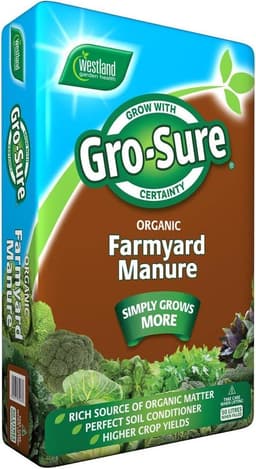
A retail bag is not automatically a finished compost. BBC Gardeners' World says bagged farmyard manure is commonly hot-composted, which is why many weed seeds are killed. The Gro-Sure amazon.co.uk listing does not state a temperature, a turn count or a storage period. You cannot tick the FSA compost box from the star rating. If the seller cannot say the manure was stored or composted, use the fresh-manure gaps. If you sell ready-to-eat crops, take assurance-scheme advice rather than a remembered matrix.

Carrots, peas and cupped leaves

Carrots and parsnips fork on freshly manured ground. If you want straight carrots this season, put them on a bed that had its manure last year, and put this year's bag on the brassica or potato ground. That rotation is about forking and hunger, not about a shorter pathogen wait for a salad. Aminopyralid and clopyralid are a second injury, and they are not a food-poisoning story. Straw bedding is a lower route than hay and silage, because the substance has not had approval for the cereal crops straw comes from. A suspect farm heap can be checked with a pea or bean bioassay, which is the approach Corteva describes. A shop bag still does not prove the herd's feed was clean.

What a retail bag does not guarantee

The animal on the single Gro-Sure bag is unnamed. A discontinued Gro-Sure page is not an organic licence for the sack on amazon.co.uk. An AHDB figure of about 6.0 kg total nitrogen per tonne describes typical cattle farmyard manure, not this 26 kg bag. In the Amazon reviews, people who mention potatoes are reporting use, not a measured crop. Depth and season are on how to use cow manure.

Common questions

Can I put farmyard manure on a vegetable bed this spring?
You can, if the manure has been batch-stored for six months or composted on the FSA terms, and you apply it before you sow. Fresh manure in spring is a poor match for any crop you will harvest raw inside 12 months. March digging suits most soils for soil improvement, and the food clock still overrides that season when the plant will be eaten raw.
How long do I wait after fresh manure before a salad crop?
Leave at least six months before drilling or planting, and do not harvest a ready-to-eat crop within 12 months of the fresh application. Both gaps apply. Manure spread in March is not cleared for a lettuce cut the following October. Keep fresh manure off plants that are already in the ground.
Does composted bagged manure follow the same wait as fresh dung?
The FSA text allows application before planting after six months of batch storage with no fresh additions, or after a managed compost of at least three months that exceeded 55°C for three days and was turned at least twice in the first week. A Gro-Sure bag is often sold as the hot-composted type. The amazon.co.uk listing does not record the temperature or the turns, so a dark, quiet sack is a lower-risk buy and not a completed checklist.
Will manure make carrots fork?
Freshly manured ground forks carrots and parsnips, because the root splits towards the rich spots. BBC Gardeners' World treats soil manured the year before as the better case for those crops. Put this year's bag on hungry crops such as brassicas or potatoes, and keep the carrot row on last year's ground.
Are potatoes and brassicas a safer rotation than lettuce?
They are the usual place for a manured bed if your worry is forked roots and hungry plants. They are not a way around the ready-to-eat rule. If anyone eats the leaves or the fruit uncooked, use the 12-month fresh-manure gap. Gro-Sure reviews that mention potatoes are anecdotes, not a measured yield.
If tomato leaves cup, is the fruit unsafe?
Cupped, fern-like growth can be aminopyralid or clopyralid damage, which the RHS links to manure from animals fed treated hay or silage. The HSE has said the assessed residues were not a consumer-health concern. The crop is what fails. Stop using that batch on peas, beans, potatoes, tomatoes and lettuce.

Related pages

Sources

Public UK and maker sources from the research digest, used for this page in October 2026. Prices, stars and review counts are from the three amazon.co.uk listings captured on 19 October 2026. None of these bags is claimed here as pure cow manure, certified organic or PAS 100. The 6.0 kg nitrogen figure is a farm typical, not a 50 litre bag analysis.

  1. RHS, how to use organic matter (retrieved 19 October 2026)
  2. BBC Gardeners' World, garden manure (retrieved 19 October 2026)
  3. Food Standards Agency, managing farm manures (retrieved 19 October 2026)
  4. GOV.UK, animal by-product categories (retrieved 19 October 2026)
  5. AHDB, using farmyard manure (retrieved 19 October 2026)
  6. RHS, weedkiller in manure (retrieved 19 October 2026)
  7. Westland farmyard manure (retrieved 19 October 2026)
  8. Melcourt SylvaGrow Farmyard (retrieved 19 October 2026)