Independent comparisons. We may earn from shop links. More info

Indoor bonsai fertiliser for a ficus that stays indoors

Updated: October 2026

The ficus was a gift, it lives on a windowsill above a radiator, and the care sheet you half-remember says feed from March to September. That calendar belongs to a tree on a bench in the garden. An indoor bonsai fertiliser question is about a warm-climate tree that is actually growing in the house, how often to feed it when the heating is on, and why a 100 ml mist is not the weekly meal. The packs themselves are in the [bonsai fertiliser comparison](/hub/fertiliser-soil-and-bark-mulch/bonsai-fertiliser). If you use our Amazon links, we may earn a commission at no extra cost to you.

The ficus was a gift, it lives on a windowsill above a radiator, and the care sheet you half-remember says feed from March to September. That calendar belongs to a tree on a bench in the garden.

Our top picks

On this page

Indoor means the species, not the room you prefer

The Federation of British Bonsai Societies uses indoor for warm-climate trees. They will not usually survive a British winter outside. A ficus, and many other tropicals sold as house bonsai, fit that description. A juniper does not. Putting a juniper on a shelf and feeding it will not turn it into an indoor tree. It still needs to live outside, with winter cold, and the feed will not replace that. If the label on the pot says juniper, pine, or another hardy outdoor species, take it off the radiator. According to the manufacturer, azaleas prefer Camellia Focus, which is not in this set. The leaflet also tells you to water before you feed.

How often, including winter

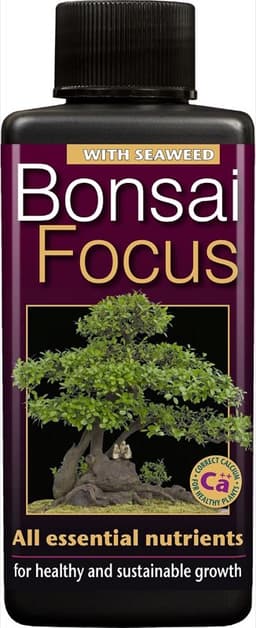
For a ficus that is making new leaves in spring and summer, a low-dose liquid about every two to four weeks is the range UK retailers describe. Miyagi Bonsai, a UK shop, says about every two to four weeks from spring into early autumn for ficus. Those frequencies are the retailer’s care guide. They are not the amazon.co.uk label. According to the manufacturer, use Bonsai Focus every one to two weeks in the growing period, and avoid November to January. The Focus listing says March until August, with occasional winter feeds. A warm room in December does not cancel the pause. If nothing is extending, leave the bottle in the cupboard until growth returns.
Biogold BioGold 900 g

Testsieger

Biogold BioGold 900 g
7.6/10about £34.99

What these listings actually say about indoor use

None of the seven listings answers indoor in the bullets. In the Amazon reviews, Focus buyers mention ficus, and buyers of the 250 ml liquid mention indoor trees, including Chinese elm. That is buyers talking, not the manufacturer’s indoor rate. You cannot claim the listing certified it for a heated flat. Focus prints 5 ml in 1 litre and no NPK. The 250 ml liquid prints 4-6-6, and a scraped field says 1:1, which you should not use. Who those two suit is on best bonsai feed. Pellets are a worse default in a living room: BioGold can smell when the bag opens, and Naruko carries a mould theme. That argument is on liquid vs pellet bonsai fertiliser.

Mist is humidity, not the feed

Central heating dries leaves. The Growth Technology leaflet suggests misting two or three times a week, or a houseplant mist that also feeds. That is a humidity habit. It does not replace watering the compost, and it does not replace 5 ml of concentrate in a litre. The product in this set is UKGROW Bonsai Mist, 100 ml at £5.99, 4.1 from 7 reviews. The bullets do not print an NPK or a dose. Buy it only beside a soil feed. Do not merge it with Bonsai Direct’s Myst, a different 750 ml spray at £14.99. For the ficus, water first, then feed a growing tree at label strength.

Common questions

Can I keep a juniper indoors and just feed it?
No. A juniper is a hardy outdoor tree. FOBBS treats indoor bonsai as warm-climate species that will not usually survive a British winter outside, which is the opposite of a juniper. Feed will not replace winter cold, airflow, and an outdoor bench. A juniper on a windowsill declines because it is in the wrong place. Move the tree outside when you can do that safely, and use the outdoor season on the how-to page.
How often do I feed a ficus in a British winter?
Default to a pause from November to January, which is what Growth Technology prints for indoor use of Bonsai Focus. If the tree is static, Miyagi’s winter guide says skip the feed. If you can see new growth in a bright room, that retailer uses half strength, not the summer rate. A warm radiator is not new growth. Occasional means you can see a reason, not every week because the bottle is open.
The listing asks indoor and does not answer. What then?
Treat the blank as a blank. It is not a quiet yes. Use the species test first: tropical in the house, hardy tree outside. Then use a printed soil dose, Focus at 5 ml per litre or the 250 ml bottle’s cap, and the November pause from the maker’s indoor leaflet for Focus. If your tree is an azalea, the same leaflet points at Camellia Focus, which is outside this comparison.
Is a nourishment mist enough on its own?
No. UKGROW’s 100 ml mist has no NPK and no soil dilution. The star row is 4.1 from 7 reviews, and the two written reviews do not describe a tree. Misting can raise humidity in a dry room, two or three times a week in the maker’s indoor leaflet, on dull days so you do not scorch leaves. The compost still needs water, and a growing ficus still needs a measured feed in the soil.
Should pellets sit on indoor soil?
They can, and a living room is the place they cause the most annoyance. One BioGold reviewer reported a strong smell when the 900 g bag was opened, and another said the pieces look large on a small tree. There is still no cakes-per-pot dose. Naruko reviews describe mould within a day or two. That film on a kitchen tree is a different problem from the same film on a garden bench. For one indoor ficus, a liquid you measure is the calmer default.

Related pages

Sources

Public UK and maker sources from the research digest, used for this page in October 2026. Prices, stars and review counts are from the seven amazon.co.uk listings captured on 19 October 2026. Scores are editorial, not a laboratory test. A missing NPK is a gap, not a zero. The scraped 1:1 field is not the dose for the 250 ml liquid.

  1. RHS, bonsai (retrieved 19 October 2026)
  2. RHS, feeding plants (retrieved 19 October 2026)
  3. Federation of British Bonsai Societies, cultivation (retrieved 19 October 2026)
  4. Federation of British Bonsai Societies, the bonsai year (retrieved 19 October 2026)
  5. Kew, top ten bonsai tips (retrieved 19 October 2026)
  6. Growth Technology, safety data sheets (retrieved 19 October 2026)
  7. Growth Technology, indoor bonsai leaflet (retrieved 19 October 2026)
  8. legislation.gov.uk, retained Regulation (EC) No 2003/2003 Article 9 (retrieved 19 October 2026)
  9. legislation.gov.uk, Fertiliser Regulations 2006 (retrieved 19 October 2026)
  10. ASA ruling, The SEER Centre Trust (retrieved 19 October 2026)