How to fit a privacy screen to a fence
The cloth looked taut in the photo and now it drums every time the side gate opens. Learning how to fit a privacy screen to a fence is mostly the order of the fixings and a fence that was already sound, not a new set of posts. You are covering timber, chain link or a rail you can already lean on. Short ties belong on mesh and thin rails. Timber usually needs a staple, a longer tie, or a batten, and you use every eyelet you were sold. The [privacy fence comparison](/hub/fencing-and-wire/privacy-fence) is the shortlist if you have not chosen the roll. A qualifying purchase can earn a commission at no extra cost to you.
The cloth looked taut in the photo and now it drums every time the side gate opens.
The cloth looked taut in the photo and now it drums every time the side gate opens. Learning how to fit a privacy screen to a fence is mostly the order of the fixings and a fence that was already sound, not a new set of posts. You are covering timber, chain link or a rail you can already lean on. Short ties belong on mesh and thin rails. Timber usually needs a staple, a longer tie, or a batten, and you use every eyelet you were sold. The privacy fence comparison is the shortlist if you have not chosen the roll. A qualifying purchase can earn a commission at no extra cost to you.
Our top picks
| Badge | Product | Fixings | Size | Fabric weight | Note | Price | Offer |
|---|---|---|---|---|---|---|---|
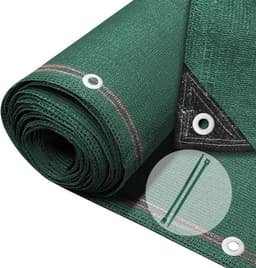
| Best overall |  VOUNOT VOUNOT 1.8 × 10 m privacy netting, 230 g/m² | Grommets and ties, count n/a | 1.8 m × 10 m | 230 g/m² | 9.4 | about £27.54 | View offer |
| Best value |  VOUNOT VOUNOT 1.8 × 10 m privacy netting, 90 g/m² | 50 cable ties and 22 clips | 1.8 m × 10 m | 90 g/m² | 9.2 | about £15.19 | View offer |
 Amazon Basics Amazon Basics privacy screen, 0.91 × 3.05 m | 20 ties at 300 mm | 0.91 m × 3.05 m | 175 GSM | 9.0 | about £13.29 | View offer |


On this page
Check the fence before the roll
Chain link, using the ties
Timber panels, where the included ties run out
Keep it taut, then stop
Common questions
Can I use the cable ties in the box on a wooden panel?
How do I fix privacy netting to chain link?
Should I use every eyelet?
Staples or ties on timber?
Do I leave a gap at the ground?
When should I stop and call a fencer?
Related pages
Sources
Public UK sources from the research digest, plus the amazon.co.uk listings in this set. Page updated October 2026.
- Town and Country Planning (General Permitted Development) (England) Order 2015, Class A (retrieved October 2026)
- Planning Portal: fences, gates and garden walls, planning permission (retrieved October 2026)
- Planning Portal: fences, gates and garden walls, building regulations (retrieved October 2026)
- GOV.WALES: planning permission for fences, gates and garden walls (retrieved October 2026)
- Scottish Government: Circular 1/2024, Class 3E (retrieved October 2026)
- Northern Ireland GPDO 2015, Part 3 Class A (retrieved October 2026)
- Anti-social Behaviour Act 2003, Part 8, high hedges (retrieved October 2026)
- HM Land Registry: boundaries and boundary disputes (retrieved October 2026)