Independent comparisons. We may earn from shop links. More info

Privacy fence buying guide

Updated: October 2026

You are standing at a 1.8 m panel with a tape and a stack of green rolls that look identical in the thumbnails. A privacy fence buying guide has to settle height, length and fabric weight before a star rating means anything, because a cloth that stops at the rail will not hide the panel above it. Read any shade percentage as the seller's claim about light, not as a tested blackout. The figures on this page are the sizes and weights stored from this amazon.co.uk set, not a live re-check and not a lab. The [privacy fence comparison](/hub/fencing-and-wire/privacy-fence) ranks those listings. A qualifying purchase can earn a commission at no extra cost to you.

You are standing at a 1.8 m panel with a tape and a stack of green rolls that look identical in the thumbnails.

Our top picks

On this page

Measure the run before the roll

Covering the back panels is a garden run. Hiding the bins is a different roll. A typical UK panel is about 1.8 m. The matching rolls are 1.8 m by 10 m, about 18 m². A 1 m roll leaves about 80 cm of panel in view. A 2 m by 5 m listing is taller and shorter, and only useful if you may raise the enclosure. About 0.91 m by 3.05 m is bin or gate height. Tape the posts, including returns. A 10 m roll will not stretch over 12 m.

Read grams and the shade percentage together

Printed weights, where stated, are 90, 110, 150, 175 and 230 grams per square metre. If the listing prints no weight, you cannot guess it against a 90 g/m² roll. Shade figures, where printed, are 75%, 85%, 90% or 95%. Each is the seller's light claim. Trade notes on denser shade cloth say you can still see through. UK reviews of the lighter rolls say one layer is see-through in sun, and some buyers double the cloth. The 175 GSM piece is only about 0.91 m high. As a rule of thumb, the 90 g/m² roll is about £0.84 per square metre and the 230 g/m² roll is about £1.53. The heavier roll is the top pick. The lighter twin is the best value.

Fixings and the fence you already have

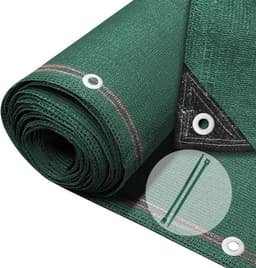
Most listings include cable ties and grommets, clips or holes. Short ties suit chain link. On timber they often miss the wood, so you need a longer tie, a staple into sound timber, or a batten. Do not copy reed and bamboo staple spacing onto a plastic eyelet. The order of tying is on how to fit a privacy screen to a fence. One short screen states 20 cable ties at 300 mm. Several garden rolls state no tie count. Fix the aluminium grommets. If the posts already move, the roll is not the repair.

Height limits if the screen raises the enclosure

If the cloth would stand above the old fence, check the council beside a road, on a listed building, or under an Article 4 direction. England's GPDO 2015 Schedule 2 Part 2 Class A, and the same test in Wales, puts a means of enclosure over 1 metre next to a highway used by vehicles, or over 2 metres elsewhere, outside permitted development. Scotland's Class 3E is 2 metres, or 1 metre if the fence fronts a road or comes forward of the principal or nearest side elevation. A conservation area needs an application, and Scottish flats use Class 7: 1 metre within 20 metres of a road. Northern Ireland is 1 metre beside a vehicular road and 2 metres otherwise. A flush 1.8 m cloth on an existing 1.8 m back panel does not, by itself, raise the enclosure. A 2 m cloth on that panel does. There is no rule that the left-hand fence is yours.

Common questions

What height do I need for a 1.8 m garden panel?
A 1.8 m roll meets a typical UK panel. In this set that is the 1.8 m by 10 m cloth. A 1 m roll leaves a large gap at the top, and a 1.5 m roll still stops short of the arris rail on many panels. A 2 m listing is taller than the panel, so use it only if you may raise the enclosure. Measure your own panel before you treat 1.8 m as exact.
Is a shade percentage the same as privacy?
No. On these listings the percentage is the seller's claim about light or shade, not a tested privacy score. Trade sellers of denser shade netting say the figure is light blockage, and you can still see through the cloth to some degree. A 95% line is not a blackout. Stand on the sunny side of a sample, or read the reviews that mention a second layer, before you treat the number as the view from the path.
Is heavier gsm always more private?
Heavier cloth here is 150, 175 and 230 grams per square metre against 90 and 110. More grams usually means a tighter weave, and reviewers of the 90 g/m² rolls still see through one layer. Grams do not fix height. The 175 GSM piece is only about 0.91 m high. If the listing prints no weight, you cannot assume it is the heavy one.
How long a roll do I need for a run of panels?
Tape the posts, including any return. A 10 m roll covers about 10 m at the stated height. Two panels and a gate are often inside one 10 m roll. A 12 m boundary is not. A listed 2 m by 5 m piece is about half that length. Do not use a title that reviewers say arrived shorter as the length in your sum.
Will a 1 m screen hide a bin or a gate?
A cloth about 0.91 m high and 3.05 m long suits a bin store or a gate, not the panel above the rail. A 1 m by 10 m roll is the long, low strip. Either can take the edge off a view at that height. Neither replaces a panel-height roll, and neither is a blackout if the listing states no shade percentage.
Do I need permission if the cloth sits on an existing fence?
Check when the cloth makes the enclosure taller than it was, or taller than the limit on that boundary. A flush cover on an existing back-garden panel is a different case from a 2 m cloth beside a road. The four nations do not share one number, and a listed building or a planning condition can remove the usual rights. The seller's garden-use line is not consent.

Related pages

Sources

Public UK sources from the research digest, plus the amazon.co.uk listings in this set. Page updated October 2026.

  1. Town and Country Planning (General Permitted Development) (England) Order 2015, Class A (retrieved October 2026)
  2. Planning Portal: fences, gates and garden walls, planning permission (retrieved October 2026)
  3. Planning Portal: fences, gates and garden walls, building regulations (retrieved October 2026)
  4. GOV.WALES: planning permission for fences, gates and garden walls (retrieved October 2026)
  5. Scottish Government: Circular 1/2024, Class 3E (retrieved October 2026)
  6. Northern Ireland GPDO 2015, Part 3 Class A (retrieved October 2026)
  7. Anti-social Behaviour Act 2003, Part 8, high hedges (retrieved October 2026)
  8. HM Land Registry: boundaries and boundary disputes (retrieved October 2026)