Independent comparisons. We may earn from shop links. More info

Leaning fence post repair

Updated: October 2026

One panel has dropped at the corner, and the concrete that was poured years ago is still in the ground. Leaning fence post repair starts with the timber. If the wood you would screw into is soft, a stake has nothing to hold. Peter F. used the amazon.co.uk listings in the [post support comparison](/hub/fencing-and-wire/post-support) and UK repair guides on 19 October 2026. We did not pull a post. A qualifying purchase can earn a commission at no extra cost to you.

One panel has dropped at the corner, and the concrete that was poured years ago is still in the ground. Leaning fence post repair starts with the timber.

Our top picks

On this page

Test the post before you buy a stake

You can straighten a post without removing it only if the timber is solid. Sheridan Fencing say most leaning wooden posts have snapped or rotted at ground level. Pushing the top back and walking away leaves the break where it was. If the footing has shifted and the wood is sound, their repair is to dig the opposite side, lever the post upright and set it with Postcrete. If the wood has failed, they want a spur, not a shove. A spur is worth considering when the damage is at the base, the timber above is solid, and only one or two posts are affected. Replace the post when the rot is higher or the post is split. Sandwich Handyman’s rule of thumb is to replace when the wood is soft more than about 300 mm above the ground.

A repair stake beside concrete, not through it

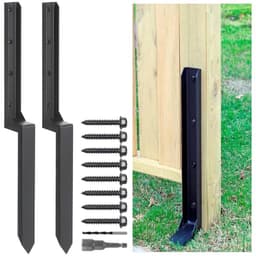
A metal repair stake is driven at the outside edge of the old post, then bolted to sound timber. It does not drill through the concrete bulb. DIY Doctor describes driving at the corner, and a longer offset spur when the bulb is wide. A trade spur sold for 75 mm or 100 mm timber is a different object from the Anmas and Vinclus stakes here. An Anmas offset missed a large concrete bulb. Another stake stopped on concrete about half a metre down. A Vinclus POST-B review says to check the concrete first. If you cannot clear a path for the steel, stop hammering. For stony ground, RSL’s fallback is to dig, screw the spike to the post and backfill with Postcrete. If you are driving any steel, the cable check on how to fit a fence post support still applies.

Cut back to sound timber, then fix

Parkes’ install is to cut the rot back to ground level, drive at the outside edge, and bolt on. Rotten timber left in place, a post you forget to straighten, or a short fixing brings the lean back. A fence post in the ground should be Use Class 4 timber. Do not bury a freshly cut end in wet soil. Straighten the post before you drive. Screwing a stake to a post that is still leaning locks the lean in. A concrete repair spur is the other object when a thin metal stake is the wrong shape. Hartwells list a 1.2 m concrete spur at about £15.30 to about £16.50. It is not an ASIN in this set. Lawsons’ steps include chipping the old concrete to make room, then fixing the spur to the post. It is still not a new post set in a full hole.

What this comparison actually sells for this job

The repair stakes in this amazon.co.uk set are the Anmas Power 2-pack at about £29.99, 4.5 from 130 ratings, the two Vinclus singles at about £19.99 each, and the Vigtayue repair kit at about £28.99. Anmas reviews describe posts held, and also a weld, a storm and a wide concrete bulb. Do not average that into a success rate. Vinclus POST-A and POST-B are separate 85 cm models. The Vigtayue kit prints no post size. Leave the VEVOR 4-pack unless the timber is about 2 inches. Bolt-down shoes and elevated jacks do not drive beside old concrete. AHAQU, the top pick, and Xingwenhao, the best value, are hard-surface feet. They do not belong beside a lawn post. A gate, a row of failed posts, soft timber, a bulb you cannot clear, or a service you have not located is a new post, or a fencer.

Common questions

Can I push a leaning post straight and call it fixed?
You can push it straight only as the start of a repair, and only if the timber is solid. Sheridan Fencing say most leaning wooden posts have already snapped or rotted at ground level. If you let go and it leans again, the footing or the wood has failed. A temporary prop is not a stake, and it is not a concreted post.
How do I tell rot from a loose footing?
Prod the timber at the soil line and about 300 mm above it. Soft wood more than a short way up, using Sandwich Handyman’s threshold as a rule of thumb, is a replace. Solid wood in a footing that has shifted is Sheridan’s lever-and-Postcrete job. A post that is firm above a rotten collar, with the panels still sound, is the spur case Walkers describe, and only when one or two posts are affected.
Will a repair spike fit beside the old concrete?
It fits if there is a clear drive at the outside edge of the post. It does not fit through the bulb. Anmas reviews include an offset that missed a large bulb and a stake that stopped on concrete about half a metre down. If the steel will not pass, stop. Digging out and setting a new post, or using a longer offset or a concrete spur, is the next honest step.
What if the offset is too small?
Stop, rather than bending the stake around the concrete. DIY Doctor point to a longer offset spur when the bulb is wide. The stakes in this set often print no millimetre reach, so you cannot know the offset from the title. A concrete spur, such as the Hartwells 1.2 m spur, is the alternative object. It is not in the twelve listings.
Should I cut the post off at ground level?
Cut the rotten section back to sound timber, which is the Parkes sequence, and treat the fresh end. Do not bury an untreated cut in wet soil. If the sound timber starts more than about 300 mm above the ground, Sandwich Handyman’s threshold says replace the post. A stake screwed into powdery wood will not hold the panel.

Related pages

Sources

Public UK sources listed in the research digest. Prices, stars and review counts are the amazon.co.uk listing lines kept for these twelve ASINs.

  1. Planning Portal — fences, gates and garden walls (retrieved October 2026)
  2. GPDO 2015, Schedule 2, Part 2, Class A (retrieved October 2026)
  3. HM Land Registry — boundaries and boundary disputes (retrieved October 2026)
  4. GOV.UK — party walls and building works (retrieved October 2026)
  5. ENA — Think before you dig (retrieved October 2026)
  6. HSE — excavations and underground services (retrieved October 2026)
  7. Wood Protection Association — Use Class 4 (retrieved October 2026)
  8. Simpson Strong-Tie — elevated post base PPA (retrieved October 2026)