Independent comparisons. We may earn from shop links. More info

How to fit a fence post support

Updated: October 2026

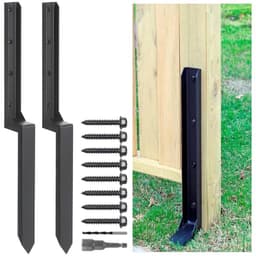
The panel is still on the old post. How to fit a fence post support is two jobs, plus a third if the post stands on concrete. A repair stake screws to timber that is already standing. A drive-in socket takes a new post after the steel is in the ground. A shoe is the concrete job. Peter F. used the amazon.co.uk listings in the [post support comparison](/hub/fencing-and-wire/post-support) on 19 October 2026. We did not install these products. A qualifying purchase can earn a commission at no extra cost to you.

The panel is still on the old post. How to fit a fence post support is two jobs, plus a third if the post stands on concrete. A repair stake screws to timber that is already standing.

Our top picks

On this page

Before you swing the hammer

Locate services before the first blow. LSBUD is a free search that covers work such as replacing a garden fence, and the plans are not a full account of every private cable. The Health and Safety Executive still expects a locator and careful hand digging where you cannot be sure. If you strike a cable in Great Britain, leave the hole and call 105. The safe step is to stop. Lay out a spirit level, eye protection, a driving block or the maker’s dolly, and exterior screws you trust. The block is a square offcut so the steel does not bell. Lawsons tell you to cut that offcut square. RSL’s notes start by clearing turf about 50 mm, then straightening the post. If you do not own the boundary, or you cannot tell a cable scar from a root, the rest of the method waits.

Drive a repair stake or a socket

A repair stake is offered up beside the existing post and driven with a mallet or a sledgehammer onto a block. Check a spirit level on two adjacent faces while the steel is still shallow. DIY Doctor’s rule of thumb is that about 12 mm out at the ground can be about 300 mm out at the top of a tall post. Lawsons suggest starting a socket an eighth of a turn off, to allow for sledgehammer twist. That is their tip, not a British Standard. If the stake twists, as Vinclus POST-A reviews describe, stop. A short stake under a 1.8 m closeboard panel is the moment to put the hammer down. On a socket, stop about 1 cm above the ground, then bolt the new post in. If the ground is stony, dig, screw the spike to the post, and backfill with Postcrete or concrete.

Bolt a shoe or an elevated base to concrete

Mark the post position on the slab before you drill. DIY Doctor’s sequence is mark, drill, then Rawl bolts or a resin stud. The shoe is only as strong as the concrete and the distance from a broken edge. Hold the post, check the level on two faces, and tighten only when it is plumb. The Vigtayue 4x4 shoe has no bottom plate, so it can slide up an existing post and the end grain is not on a pad. Bolt an elevated jack down first, then turn the screw rod. AOOTE reviews describe one-way travel, so set the 100 mm to 150 mm height before you commit. The AHAQU base is the top pick for a light post a frame already holds. Supplied screws on the Xingwenhao bracket, the best value bolt-down listing, are a known weak point. If the heads are soft, use your own exterior fixings.

Stop if the steel or the timber gives up

Stop when the top of a stake crushes, which Anmas reviews describe if you hit the steel itself. Stop when a weld cracks, on Anmas, on Vinclus POST-A, or on a VEVOR spike that broke while it was hammered. Stop when screw heads shear, a POST-B review, or when the included drill bit snaps. Use your own bit. Forcing a broken bit into the post is how the timber splits. Stop when the wood is soft under the screw, when the stake meets stone or the old concrete, or when you still cannot tell concrete from a buried service. A gate post, several failed posts, or a fence people walk under is a fencer’s job. Pull a crooked stake out rather than leaving a lean the panel might hide. Whether a leaning post is even a stake job is leaning fence post repair.

Common questions

Do I hammer the spike itself or a block?
Hammer a driving block or the maker’s dolly, not the rim of the steel. RSL and Lawsons both expect the blows to land on a protected head. Anmas reviews describe a crushed top when the stake is struck directly. A square timber offcut is the usual block. Eye protection stays on, because a glancing blow throws chips.
How often do I use the spirit level?
On two adjacent faces while the steel is still shallow, again before you call the drive finished, and again when the post is screwed or bolted. DIY Doctor’s rule of thumb is that about 12 mm out at the ground can show as about 300 mm at the top. Deep metal is hard to straighten without bending it.
What if the stake twists?
Stop and turn it back while it will still move, or lever it out and start again. Lawsons’ eighth-turn start is their allowance for sledgehammer twist on a socket, not a fix for a stake that has already spiralled. Vinclus POST-A reviews include twist. Bent steel left in the ground does not become plumb when you hang the panel.
What if I hit stone or the old concrete?
Stop driving. A repair stake is meant to pass beside a concrete bulb, not through it. If the ground is stony, RSL’s fallback is to dig, screw the fitting to the post, and backfill with Postcrete or concrete. Forcing the next blows is how welds crack. If you cannot tell stone from a service, leave it and get the ground checked.
How do I bolt a shoe to a slab?
Mark the holes with the shoe in its final position, drill, and fix with masonry anchors or a resin stud sized for that slab, as DIY Doctor outline. Check the post is plumb on two faces before the last tighten. Keep away from a cracked edge and from slabs that sound hollow. The anchors fail when the concrete is thin, whatever the shoe looks like.

Related pages

Sources

Public UK sources listed in the research digest. Prices, stars and review counts are the amazon.co.uk listing lines kept for these twelve ASINs.

  1. Planning Portal — fences, gates and garden walls (retrieved October 2026)
  2. GPDO 2015, Schedule 2, Part 2, Class A (retrieved October 2026)
  3. HM Land Registry — boundaries and boundary disputes (retrieved October 2026)
  4. GOV.UK — party walls and building works (retrieved October 2026)
  5. ENA — Think before you dig (retrieved October 2026)
  6. HSE — excavations and underground services (retrieved October 2026)
  7. Wood Protection Association — Use Class 4 (retrieved October 2026)
  8. Simpson Strong-Tie — elevated post base PPA (retrieved October 2026)