Independent comparisons. We may earn from shop links. More info

How many joules for an electric fence energiser

Updated: October 2026

You have a length in your head, four strands of tape, and a title that says 10 km. How many joules an electric fence energiser needs is a different sum. Stored joules, output joules, and the kilometre claim are three numbers, and only one of them is the energy you should compare. This page sizes the pulse for wire, grass, and stock. It does not rank the [electric fence energiser comparison](/hub/fencing-and-wire/electric-fence-energiser), and it does not choose a plug. When the band is clear, you go back to the listings that actually print that output.

You have a length in your head, four strands of tape, and a title that says 10 km. How many joules an electric fence energiser needs is a different sum.

Our top picks

On this page

Two joule figures, and a kilometre claim

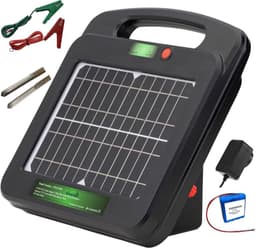
Output joules leave the unit into the fence. Stored joules sit in the capacitor first, and they are the larger number. Compare output with output. The My Animal Command solar unit prints both: 0.25 joule output and 0.55 joule stored. Do not add them. A 10 km, 15 km, or 24 km line is usually clean wire, not July grass or polywire. FenceMate’s 0.5 joule 12 V listing says about 2 km average, or up to 10 km on a clean single wire. The 230 V twin says about 2 km average, or up to 5 km clean. AHDB’s rule of thumb is about one stored joule for 5–6 miles of 2.5 mm high-tensile wire, or about one mile of polywire, at 4,500 V. Compel’s output table is a different start. Do not average them. Supply and earth are on the buying guide.

What changes the load

Wet grass leaks each pulse. Compel moves cattle fencing into the 2–4 joule output band when grass touches the wires. Four tapes on a 1 km paddock are 4 km of conductor. A 0.5 joule unit can hold a garden wire and fail on outdoor netting. Gallagher’s UK line is at least 3.5 kV to keep animals in and 4.5 kV to keep wild animals out. Read the live wire, not the light on the case.

Cattle, horses, and sheep

Voltage is what you measure. Joules are what you buy so that voltage survives the load. AHDB gives about 4,500–5,500 V for untrained cattle, about 3,500–4,500 V once trained, about 5,000 V to train sheep in wool, and about 4,000 V if they are shorn. It does not publish a horse figure in that list. Do not invent one. Compel’s output bands are a rough match only. Under 1 joule is a garden, a short poultry net, or one small clear paddock, which is where the 0.5 joule FenceMate units and the 0.6 joule BA80 sit. One to two joules is a few clear horse paddocks. Two to four is cattle with grass on the wires. Four and up is the start for sheep in wool or heavy growth. Sheep walked through the 0.25 joule solar unit in one review. If the far end is already under the training voltage, more days of training will not fix it.

What to do with a conflicting listing

The AUSTUFF listing B0DRV4BBZW puts 3.5 joule on the title at about £45.99. A reviewer says the manual’s maximum is 2 joules, and the technical field says 2500 milliwatts, which is 2.5 watts, not 3.5 joule. Do not file it in the cattle band until you have read the manual. An unreviewed 4 joule title at 18.6 miles, and a 3 joule listing with six reviews and 24 km, need the same caution. The reviewed units here may simply be too small for sheep in wool. If you buy through a link on this page, we may earn a commission at no extra cost to you.

Common questions

Is stored energy or output energy the number to compare?
Compare output with output when both listings state it. Stored joules are the larger capacitor figure, and AHDB prefers them as a catalogue number. The solar unit that prints 0.25 joule output and 0.55 joule stored is showing both on purpose. Do not merge them into 0.8 joule, and do not match a stored figure on one brand to an output figure on another.
Why does 10 km on the box become a short line in grass?
The long figure assumes a clean conductor. Wet grass leaks each pulse. Polywire has higher resistance than steel, and four tapes multiply the length. FenceMate’s own wording is about 2 km average for a 0.5 joule unit, with 10 km only on a clean single wire. Read the average line if the listing is honest enough to print one.
How many joules for horses on tape?
Compel’s starting band is 1–2 joules output for a few horse paddocks on tape kept clear of growth. Count every tape. A 1 km fence with four lines is 4 km of conductor. The 0.6 joule BA80 is a reviewed 12 V kit for a simpler clear line, not four tapes in a weedy paddock. Measure the far end.
How many joules for sheep in wool?
Compel’s starting point is 4 joules output and up, with heavy growth in the same band. AHDB wants about 5,000 V on the wire to train sheep in wool, or about 4,000 V if they are shorn. A 0.25 joule solar unit is far below that band, and a reviewer said sheep walked through it. This set does not contain a reviewed 4 joule unit.
Does a second live wire need more joules?
It needs more conductor, so it needs more energy if you want the same voltage at the end. Joining several live wires at both ends can lower resistance when the grass stays off them, which is a construction point, not a free doubling of the kilometre claim. Horse & Hound’s four-tape example is the conservative way to count. Do not leave the bottom wire in the grass and hope the extra strand compensates.

Related pages

Sources

Public UK sources from the research digest. Listing prices, stars and review counts are the amazon.co.uk lines used for this comparison, retrieved 19 October 2026.

  1. AHDB — Components of an electric fence (retrieved 19 October 2026)
  2. AHDB — How to set up electric fencing for cattle and sheep (retrieved 19 October 2026)
  3. BSI — BS EN IEC 60335-2-76:2021+A11:2021 (retrieved 19 October 2026)
  4. Voltimum UK — Installation requirements for electric fence energisers (retrieved 19 October 2026)
  5. British Horse Society — Electric fencing (retrieved 19 October 2026)
  6. Cornwall Council — Electric fence guidance for landowners (retrieved 19 October 2026)
  7. Compel — Electric fence energiser (retrieved 19 October 2026)
  8. Rappa — Guide to earthing (retrieved 19 October 2026)