Chicken wire vs aviary wire
You are about to buy a roll because the title says chicken, and the photograph could be a soft hex net or a stiff welded grid. Chicken wire vs aviary wire is that construction choice. Hexagonal netting is twisted. Aviary mesh, as UK shops use the name, is welded into squares. A fox can break the hex. A light weld is still not the heavy panel those shops specify for a fox. The welded rolls on our [Aviary wire](/hub/fencing-and-wire/aviary-wire) comparison were noted on 19 October 2026 by Peter F. This page does not review a chicken-wire ASIN. A qualifying purchase can earn us a commission at no extra cost to you.
You are about to buy a roll because the title says chicken, and the photograph could be a soft hex net or a stiff welded grid. Chicken wire vs aviary wire is that construction choice. Hexagonal netting is twisted.
You are about to buy a roll because the title says chicken, and the photograph could be a soft hex net or a stiff welded grid. Chicken wire vs aviary wire is that construction choice. Hexagonal netting is twisted. Aviary mesh, as UK shops use the name, is welded into squares. A fox can break the hex. A light weld is still not the heavy panel those shops specify for a fox. The welded rolls on our Aviary wire comparison were noted on 19 October 2026 by Peter F. This page does not review a chicken-wire ASIN. A qualifying purchase can earn us a commission at no extra cost to you.
Our top picks
| Badge | Product | Wire diameter | Aperture | Joint | Note | Price | Offer |
|---|---|---|---|---|---|---|---|
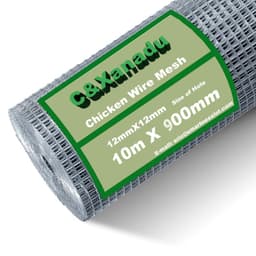
| Best overall |  C&Xanadu C&Xanad 900 mm × 10 m 12 mm aviary mesh | 0.9 mm | 12 mm × 12 mm | Welded square | 6.8 | about £49.90 | View offer |
| Best value |  Muzhira Muzhira 6 m × 300 mm 6.35 mm mesh | 0.6 mm | 6.35 mm | Welded square | 7.8 | about £18.99 | View offer |
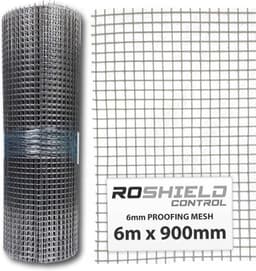
 Roshield Roshield 900 mm × 6 m 6 mm rodent mesh | n/a | 6 mm × 6 mm | Welded square | 8.1 | about £39.99 | View offer |

On this page
Twisted hex or a welded square
What UK pages say a fox can break
Welded is not automatically the heavy sheet
Common questions
What is physically different about the two meshes?
Will chicken wire keep hens in?
Will chicken wire keep a fox out?
Does any welded roll here count as fox mesh?
When is hex still a fair buy?
What gauge do UK fox pages name?
Related pages
Sources
Public UK sources and amazon.co.uk listing lines; retrieved 19 October 2026.
- Animal Welfare Act 2006, section 9 (retrieved 19 October 2026)
- GOV.UK, Bird flu: housing your birds safely (retrieved 19 October 2026)
- British Waterfowl Association, Fencing (retrieved 19 October 2026)
- Mesh Direct, Aviary mesh (retrieved 19 October 2026)
- Mesh Direct, Chicken wire netting (retrieved 19 October 2026)
- The Chicken House Company, Aviary wire mesh guide (retrieved 19 October 2026)
- National Council for Aviculture, Fact sheet 3 (retrieved 19 October 2026)
- Provet, Zinc in birds (retrieved 19 October 2026)