Independent comparisons. We may earn from shop links. More info

Wired vs wireless door intercom

Updated: 22 October 2026

You can either pull a cable to the front door or you cannot, and every listing seems to use the word wireless for a different object. Wired vs wireless door intercom, in this amazon.co.uk set, is a mains monitor on a known core count, or a local radio pair whose open-air metre line is a ceiling. It is not a second buying guide, and it does not settle audio against video as the main fork. Prices are on the [Door intercom comparison](/hub/electronic-surveillance/door-intercom). Products Compared editorial team, 19 October 2026. Not a lab test. A qualifying amazon.co.uk purchase can earn us a commission.

You can either pull a cable to the front door or you cannot, and every listing seems to use the word wireless for a different object.

Our top picks

On this page

Three different wireless things

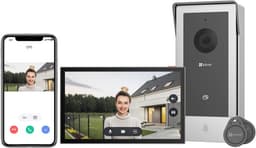
Only one meaning is a cable-free door pair. Wired kits here are the Mercury 2-wire handset, the two TMEZON video kits, and the QingTianTongYun 4-core kit. They fail on the wrong core count. They do not fail because the broadband has dropped. A local radio kit is the Dioche voice pair at £38.29, the Fockety voice pair at £30.79, and the Winnes video bell at £52.99. Dioche and Fockety have no camera and no Wi-Fi. Winnes states no Wi-Fi, no app, and no subscription. That is radio between two boxes you bought together. Wi-Fi plus a cable is the EZVIZ CP5 at £161.49. The indoor monitor joins 2.4 GHz or 5 GHz Wi-Fi so the app can answer. The door station still needs the 2-wire or 4-wire run the listing states. Calling the CP5 wireless because the phone is wireless will send you a kit that still needs a chase. If the app is the feature you want, that trade-off is on best video door phone UK. A fourth meaning is GSM: a SIM panel whose signal can fail when the network changes. It is not in this basket. Do not read a Dioche battery review as a comment on a SIM card.

What the range lines actually mean

Dioche and Fockety both claim about 1,000 m with no obstruction. One Dioche UK review reported a working gate about 50 m from the house, which is one review, not a survey. Fockety's UK notes are about the battery, not a measured range. Winnes states up to 80 m in the open and says walls and doors reduce it. One Winnes review says the two units had to be very close together to work. Do not copy another maker's through-wall metres onto these ASINs. Put the indoor unit where you will leave it, walk the outdoor bell to the gate or the porch, and make a call before any screw goes in. If a Fockety outdoor cell is flat, you have not tested range at all. Brick, foil-backed plasterboard, and a metal door sit between you and the open-air headline.

When the cable is the better bet

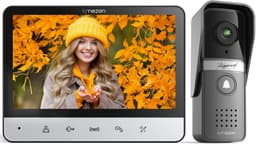
Cable is the better bet when the core count matches and you want the monitor on mains, with no outdoor battery to remember. UK reviews of the TMEZON MZ-V20 treat that as the point: no app and no cell to charge, once the four colours are understood. The cable is not in the box, and a UK review calls the supplied leads about 4 inches. The Mercury handset is the two-wire audio version, with a 1 m UK lead and only two reviews, one of which reports damp on earlier units. A wired indoor station still rings if the router dies. The CP5's phone answer needs the network path that app uses. If you are often out, that path is why you pay £161.49. Radio is the better bet when you cannot drill, the gate is a short walk, and you will accept a battery. The Dioche at £38.29 has the clearer UK file of the two voice radios: 4.2 from 53, IP54 stated, and that 50 m gate note. The Fockety is £30.79 and 3.4 from 35, and UK reviews say charges lasted hours, a day, or about five minutes against an eight-month claim. Do not make the cheaper radio the default. The Winnes is the radio choice when you need a picture and you do not need unlock.

One pair is not a four-wire upgrade

If you only have one pair in the wall, do not upgrade it to a four-wire video kit and call that wired. Go back to the door entry system buying guide and match the cores, or stay on radio. If you have chosen the TMEZON and you are ready to pull four cores, follow the bench test before you chase the wall.

Common questions

Is wireless the same as Wi-Fi?
Not in this set. Winnes, Dioche, and Fockety are local radio pairs. The CP5 uses Wi-Fi on the indoor monitor and still needs a cable to the door. A GSM panel with a SIM is not in this basket.
Will 1,000 m on the listing get through brick?
The 1,000 m line is open air with no obstruction. One Dioche UK review describes a gate about 50 m from the house, not a kilometre through masonry. Do not borrow another brand's through-wall figure.
When is four-core cable the better buy?
When you can run it, you want a mains monitor, and you do not want an outdoor battery. The cable is not in the TMEZON box. Four-core is the wrong buy if the wall only holds one pair, unless you pull a new cable.
What fails when the outdoor battery dies?
The call fails, even if the indoor unit is charged. Fockety UK reviews describe charges lasting hours, a day, or about five minutes, against an eight-month claim. Dioche reviews say the cells run shorter than the six-month line.
What still works if the broadband drops?
A wired monitor that does not use an app still rings in the house. The CP5's away-from-home answer needs the network. The local radio kits never used the broadband, and they still depend on their batteries.

Related pages

Sources

Public UK sources and the amazon.co.uk listings compared on this page. Listings captured 19 October 2026.

  1. BSI, BS EN 62820-1-1:2016+A11:2021 (retrieved 19 October 2026)
  2. Approved Document P (England) (retrieved 19 October 2026)
  3. Tameside Building Control Note 20 (retrieved 19 October 2026)
  4. ICO, home CCTV (retrieved 19 October 2026)
  5. GOV.UK, domestic CCTV (retrieved 19 October 2026)
  6. IEC IP ratings (retrieved 19 October 2026)
  7. Consumer Rights Act 2015, section 9 (retrieved 19 October 2026)
  8. NACD, emergency egress note (retrieved 19 October 2026)