How to install a wireless alarm without a wasted evening
The first night is when a contact falls off or a sensor never joins the hub. You are fitting a Ring or SimpliSafe kit, or checking whether the XNY is a fair afternoon. This is how to install a wireless alarm in the order the UK reviews support: power and account, pair beside the hub, then place, then test. The [alarm system with camera comparison](/hub/electronic-surveillance/alarm-system-with-camera) is the parts list. This page does not rank the kits. If a pad will not hold, screw the part. If the panel still will not join, stop. This page is from Peter F., editor for DIY & tools.
The first night is when a contact falls off or a sensor never joins the hub. You are fitting a Ring or SimpliSafe kit, or checking whether the XNY is a fair afternoon.
The first night is when a contact falls off or a sensor never joins the hub. You are fitting a Ring or SimpliSafe kit, or checking whether the XNY is a fair afternoon. This is how to install a wireless alarm in the order the UK reviews support: power and account, pair beside the hub, then place, then test. The alarm system with camera comparison is the parts list. This page does not rank the kits. If a pad will not hold, screw the part. If the panel still will not join, stop. This page is from Peter F., editor for DIY & tools.
Our top picks
| Badge | Product | Radio | Power note | Fit note from reviews | Note | Price | Offer |
|---|---|---|---|---|---|---|---|
| Best overall |  SimpliSafe SimpliSafe 7-piece camera and alarm | 2.4 GHz, not 5 GHz | 4G and a 24-hour battery stated | Often 20 to 30 minutes | 8.6 | about £184.99 | View offer |
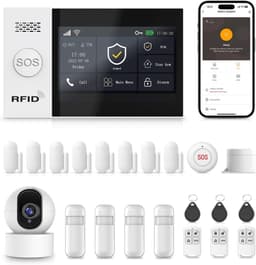
| Alternative |  XNY XNY touchscreen alarm with 1080p camera | 2.4 GHz, SIM if Wi-Fi drops | USB-C lead about 500 mm | Set-up may not finish | 7.6 | about £149.99 | View offer |
| Alternative |  Ring Ring Alarm Pack M with indoor camera | Add each sensor in the app | Check for a BS 1363 plug | Pair before you mount | 7.4 | about £229.99 | View offer |


On this page
Power and account before any sticky pad
Contacts and the magnet gap
Motion sensors, pets and Home mode
Camera, siren and the first test
Common questions
Do you pair the sensor before you stick it?
How close do the magnet and the contact have to be?
Where does the keypad go?
Where does a motion sensor go if you have a dog?
What do you do if the pad will not hold?
What do you check on the plug before you power the hub?
Related pages
Sources
Public sources listed for this comparison, October 2026. Prices, stars and review counts are the amazon.co.uk figures in that set. We did not run a lab test.
- Ask the Police Q75, alarm attendance (retrieved October 2026)
- NSI, intruder alarm systems (retrieved October 2026)
- BIBA, intruder alarms guidance for purchasers (retrieved October 2026)
- NPCC police requirements for security systems, August 2022 (retrieved October 2026)
- ICO, home CCTV systems (retrieved October 2026)
- GOV.UK, domestic CCTV (retrieved October 2026)
- Ring plans, UK (retrieved October 2026)
- SimpliSafe UK service plans, 29 June 2026 (retrieved October 2026)