Independent comparisons. We may earn from shop links. More info

Latching or non-latching RCD

Updated: October 2026

The power returns after a cut and you are at the socket, wondering whether the hedge trimmer can start on its own. A latching or non-latching RCD is that restart rule. It is not a sensitivity score, and it is not a time delay. Non-latching, also called active, opens when the supply is interrupted and stays off until you press reset. Latching, also called passive, keeps the state from before the cut, so a load that was running can run again. An earth-fault trip still needs a person, on either kind. Prices and the latching column are on the [RCD comparison](/hub/electrical-equipment/rcd).

The power returns after a cut and you are at the socket, wondering whether the hedge trimmer can start on its own. A latching or non-latching RCD is that restart rule.

Our top picks

On this page

Two restart rules, not two safety grades

BG's catalogue note and the TLC guide describe the same split. A passive device remembers whether it was on. An active device switches off whenever the supply is interrupted, and you reset it. Masterplug's ARCDKG sheet says that every interruption trips the unit, including when the appliance itself is switched off, so you reset at the socket. The ILRCDNG sheet says the same after the mains is switched. Latching is not a lower safety grade. Both kinds are accepted. The mistake is a cutter that restarts in your hand, or a freezer left off because you used the garden rule on a kitchen socket. This page uses BG and TLC: passive stays closed through a supply loss. If a product page contradicts that, read the listing's own line. Sensitivity is a separate choice, on the RCD buying guide.

A tool you are holding

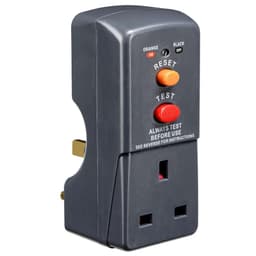
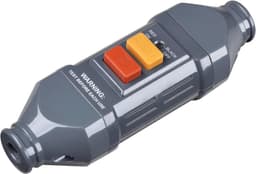
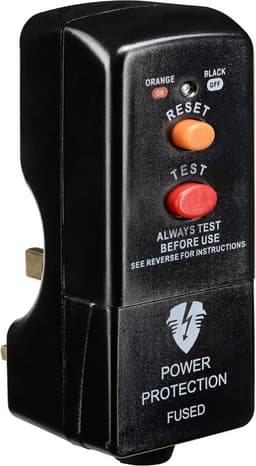
A mower, trimmer, shredder or drill should stay off until you reset it. TLC points active devices at garden equipment and power tools. If a passive adaptor restores power while a tool was left switched on, the cutter can start with the lead still across the lawn. Non-latching removes that path. You walk back, press reset, then press test before you carry on. Three listings state it. The ARCDKG-ZD plug-in states non-latching. The ILRCDNG-MP in-line unit states it. The PRCDKB states it, though reviewers wire that one onto a flex. Reviews on the ARCDKG call a power-cut trip a nuisance for a fish pond. That nuisance is right for a trimmer and wrong for the pond. Which body to buy is on the best RCD page.
Masterplug Masterplug ARCDKG-ZD

Testsieger

Masterplug Masterplug ARCDKG-ZD
8.8/10about £9.94

A pond, a fridge or a freezer

A pond pump, fridge or freezer should come back after a normal power cut. Otherwise the pump is stopped and the stock is lost, or the freezer has been off since the street supply blinked. TLC's usual choice for refrigeration is passive. If nobody will press reset, do not choose a non-latching adaptor from this set. Passive does not ignore an earth fault. After a real trip you still investigate. The memory is only about a supply interruption. The three Masterplug listings that state non-latching belong with the trimmer, not with a timer that switches a pump.

What is not the same thing

Non-latching is not Type S. A time-delayed device waits so another device can trip first. That delay is for selectivity. It is not additional protection for a person on a socket or on outdoor equipment. The Schneider Easy9 EZ9R46291 is instantaneous, which answers the delay question and does not answer latching. The listing does not say whether it holds through a power cut. Do not infer passive or active from instantaneous or from Type A. The Status SRCDORX3 does not state latching either. The EXNICEXI says you press RESET after a trip. That is the routine after the button or a fault. It does not say the adaptor opens on every power cut. Call it a manual reset after a trip, and stop. If the listing is silent, pick a page that states the rule your load needs.

Common questions

Are active and non-latching the same thing?
Yes, in the language used here. Active means the device switches off when the supply is interrupted and must be reset. Non-latching is that rule on the Masterplug listings that state it. Passive and latching are the pair that remembers. A blog that says latching devices trip and then automatically reset is not this definition.
Will a non-latching adaptor come back on after a power cut?
No. It stays off until you press reset. On the ARCDKG sheet that includes switching the appliance off, so you may reset at the socket more often than you expected. After an earth fault you still find the cause first. None of the three non-latching Masterplug listings is the right buy for a load that must restart alone.
Which type is for a hedge trimmer?
Non-latching, so the cutter stays dead until you reset it. That word is on the ARCDKG-ZD, the ILRCDNG-MP and the PRCDKB. The EXNICEXI only states a manual reset after a trip, so it is not confirmed. The Status listing is silent. Test before use. The restart rule does not replace the button.
Which type is for a pond pump or a freezer?
Passive, so a normal cut does not leave the pump or freezer off until someone notices. TLC aims that at refrigeration. An earth fault still stays off. Do not buy the ARCDKG for a pond because it is the cheapest. Reviews already call that power-cut trip a nuisance on a fish pond. That is the active rule on the wrong load.
Is non-latching the same as a time-delayed Type S device?
No. Type S waits so another device can clear first. It is not additional protection for a person. Non-latching is about staying open after the supply disappears. The Schneider RCCB here is instantaneous, so it is not Type S, and the listing still does not state latching. Do not expect two instantaneous 30 mA devices to discriminate.

Related pages

Sources

Public UK sources are listed below. Shelf prices and star lines are the amazon.co.uk figures checked on 19 October 2026.

  1. HSE: work using electrically powered equipment (retrieved 19 October 2026)
  2. HSE: electrical systems on construction sites (retrieved 19 October 2026)
  3. IET Wiring Matters: 30 mA socket-outlet mythbuster (retrieved 19 October 2026)
  4. IET Wiring Matters: RCD testing under Amendment 2 (retrieved 19 October 2026)
  5. IET Wiring Matters: which RCD type (retrieved 19 October 2026)
  6. Electrical Safety First: garden (retrieved 19 October 2026)
  7. GOV.UK: building work, replacements and repairs (retrieved 19 October 2026)
  8. BEAMA guide to the selection and application of RCDs (August 2022) (retrieved 19 October 2026)