Independent comparisons. We may earn from shop links. More info

RCD buying guide

Updated: October 2026

An RCD buying guide starts here. amazon.co.uk is mixing a plug, a unit you splice into a lead, and a breaker for a consumer unit. The Health and Safety Executive is clear that a shock can still be serious or fatal, so the device is a back-up, not a guarantee. Choose the form, then a stated residual current of not more than 30 mA, and treat waveform type as a question only for a device fixed in a board. Prices for the six listings are on the [RCD comparison](/hub/electrical-equipment/rcd).

An RCD buying guide starts here. amazon.co.uk is mixing a plug, a unit you splice into a lead, and a breaker for a consumer unit.

Our top picks

On this page

Plug-in, in-line, or a breaker in the board

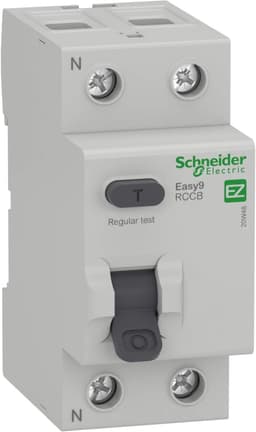
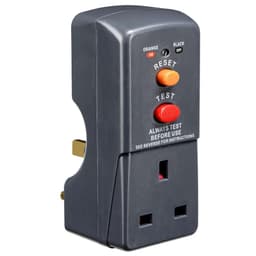
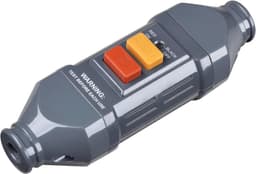
Start with the object you will handle. A plug-in adaptor pushes into a BS 1363 socket and protects only what you plug into it. In this set that is the Masterplug ARCDKG-ZD, the Status SRCDORX3 and the EXNICEXI NB-H3E-13. An in-line unit is wired into a cable. The Masterplug ILRCDNG-MP is sold that way, and reviewers describe the PRCDKB as a plug you wire on, even though its amazon title reads like a socket adaptor. A DIN-rail residual current circuit breaker is a consumer-unit module. The Schneider Easy9 EZ9R46291 is that module. It does not stand in for a 13 A adaptor. A plug-in does not discharge Regulation 411.3.3.

30 mA, and what 100 A is not

For protection of people, HSE says the residual operating current should not be more than 30 mA. Regulation 411.3.3 requires a device not exceeding 30 mA for socket-outlets up to 32 A used by ordinary persons, and for mobile equipment up to 32 A used outdoors. The regulation governs the fixed installation. The same 30 mA ceiling is still the figure to look for on a portable unit. The Schneider listing prints 100 A and 30 mA. The 100 A is the current the RCCB can carry. The 30 mA is the sensitivity. If a listing does not state milliamps, do not fill the gap. A Masterplug sheet for the ARCDKG does state 30 mA and a typical 40 ms. That is the sheet, not the amazon copy. Which gap matters for a tool is on the best RCD page.

Type A only when the device is fixed

Waveform type is a board question. Type A covers pulsating DC and is the practical minimum for new socket and LED circuits under Amendment 2. Only the Schneider Easy9 EZ9R46291 states Type A. Do not relabel the plug-ins. The RCCB is where DIY stops. In England, replacing a consumer unit or adding a circuit is notifiable unless a competent-person scheme certifies it. A plug-in is not that work. The Schneider module is instantaneous, so it is not time-delayed Type S. Lead and lawn conditions are on RCD for garden tools.

What this set can and cannot tell you

These listings illustrate the order. They are not a laboratory ranking. The set cannot give you a home-measured trip time, or a promise that an adaptor prevents a fatal injury. Bulky plugs, lids that will not close, heat and melted pins are reasons to take a unit out of service. If you cannot identify the conductors, do not open an in-line body.

Common questions

Do I still need a plug-in RCD if every circuit has an RCBO?
An RCBO is the installation device. A plug-in is not, and Electrical Safety First says portable devices sit outside the regulations' generic RCD, so one does not discharge Regulation 411.3.3. You may still use a portable on a lead you take outside, tested before use. It protects only what is supplied through it. It will not reliably trip before the board device, because two instantaneous 30 mA devices in series are not selective.
Which listings in this set actually state 30 mA?
The EXNICEXI states 30 mA and IEC 61540. The ILRCDNG-MP states 30 mA and a typical 40 ms trip. The Schneider states 30 mA as sensitivity and 100 A as rated current. The ARCDKG-ZD, the Status SRCDORX3 and the PRCDKB do not print milliamps on the captured amazon pages. A Masterplug sheet for the ARCDKG does state 30 mA. Keep that as a sheet figure. Do not copy it onto the amazon title.
Is a plug-in the same as complying with the 18th Edition?
No. BS 7671 governs the fixed installation. Portable listings here cite BS 7071 or IEC 61540 where they cite anything. Regulation 411.3.3 is met, when it applies, by the device in the installation. In England a new circuit or a replacement consumer unit is notifiable unless a competent-person scheme certifies it. Buying the Schneider module does not provide that certificate.
When do I stop and hire an electrician?
Stop for work inside the consumer unit, for a new circuit, or when you cannot identify the conductors in an in-line unit. Also stop if a unit will not reset with nothing plugged in, if a pin has melted, or if the consumer unit will not reset. HSE says not to use a faulty RCD and not to bypass a trip. A plug-in you can test at a socket is household kit. The Easy9 is not.
Is non-latching a quality grade or a restart rule?
It is a restart rule. A non-latching unit drops out when the supply is interrupted and stays off until you press reset. That suits a tool you are holding, and it does not suit a pond pump, a fridge or a freezer. Latching is not a lower safety grade, and it is not a time-delayed Type S device. Here the ARCDKG-ZD, the ILRCDNG-MP and the PRCDKB state non-latching. The Status and the Schneider do not.

Related pages

Sources

Public UK sources are listed below. Shelf prices and star lines are the amazon.co.uk figures checked on 19 October 2026.

  1. HSE: work using electrically powered equipment (retrieved 19 October 2026)
  2. HSE: electrical systems on construction sites (retrieved 19 October 2026)
  3. IET Wiring Matters: 30 mA socket-outlet mythbuster (retrieved 19 October 2026)
  4. IET Wiring Matters: RCD testing under Amendment 2 (retrieved 19 October 2026)
  5. IET Wiring Matters: which RCD type (retrieved 19 October 2026)
  6. Electrical Safety First: garden (retrieved 19 October 2026)
  7. GOV.UK: building work, replacements and repairs (retrieved 19 October 2026)
  8. BEAMA guide to the selection and application of RCDs (August 2022) (retrieved 19 October 2026)