Independent comparisons. We may earn from shop links. More info

Rotary isolator vs fused spur for one appliance

Updated: October 2026

You are fitting a boiler, a small air conditioner or a heat pump and the manual says isolator, while the search results offer both a white fused spur and a grey rotary box. A rotary isolator vs fused spur is not a style choice. One is a 13 A fused connection unit on a final circuit. The other, in this amazon.co.uk set, is a 16 A rotary with an outdoor claim and, on one listing, no arc extinguishing. This page says when the spur is the device the manual names, and when a rotary is the habit. Prices for the whole set are on the [mains isolation switch comparison](/hub/electrical-equipment/mains-isolation-switch). No lab test.

You are fitting a boiler, a small air conditioner or a heat pump and the manual says isolator, while the search results offer both a white fused spur and a grey rotary box.

Our top picks

BG BG Nexus 852

Best overall

BG BG Nexus 852
9.2/10about £4.76
Tiardey Tiardey CP027688

Rank 3

Tiardey Tiardey CP027688
7.6/10about £11.99
On this page

They are not the same switch

A switched fused connection unit to BS 1363-4 is a 13 A device on a.c. not above 250 V, with a BS 1362 fuse-link in the plate. Double pole means it opens live and neutral. In this set the BG Nexus 852 and 951 are that object, with an LED. A small rotary is a separate enclosure, usually outside, with a handle you can lock. The Tiardey and RiseNova titles are 16 A, not 13 A, and neither listing cites BS 1363-4. The duties diverge as soon as the manual states a fuse, or the current sits above a 13 A fuse-link. A 16 A title does not make the rotary a meter switch. The Knightsbridge CU6300N is a 13 A double-pole plate whose table lists no fuse carrier, so it is not the spur in this comparison.

When the fused spur is the one the manual names

The British Gas 330 installation text is one boiler, not every boiler. It asks for a double-pole switched fused spur, 3 A maximum. If your manual uses the same kind of sentence, the hardware in this set is the BG Nexus 852 at £4.76: double pole, LED, BS 1363 Part 4. You fit the fuse the manual states. A fused spur remains an indoor final-circuit device unless the listing shows a real outdoor rating, which these plates do not.
BG BG Nexus 852

Testsieger

BG BG Nexus 852
9.2/10about £4.76

When a rotary is the usual box

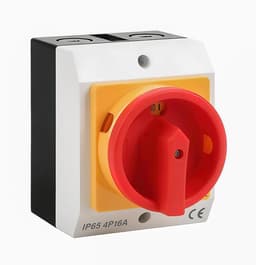
Installers still fit a rotary beside an outdoor unit because the handle can be locked off. A fused spur can still be the electrical choice when the load is within 13 A and the manufacturer allows it. Padlocking the fuse carrier does not lock the neutral. The Tiardey CP027688 is £11.99, titled 16 A and 4-pin, with an IP65 claim. A bullet says there is no arc extinguishing, so you do not open this rotary to stop a running load. Another bullet says up to 100 A, which conflicts with the 16 A title, and two reviews say one unit arrived, not four. The RiseNova at £8.95 has an IP65 claim and no reviews, so it is not evidence.

The choice in one sentence

Use the fused spur when the appliance is a 13 A final-circuit load and the manual states a fuse, and start with the BG 852 unless you need the square plate. Use a rotary only when it is rated for that current, you can lock it, and it is allowed to break that load. Neither 16 A title here is a 100 A meter switch. If the job is the supply at the meter, leave this page and use the buying guide. A permanent-live fan wants the 10 A three-pole plate, not either of these.

Common questions

When is a fused spur the right isolator?
When the appliance is supplied from a final circuit at 13 A or below and the manufacturer asks for a switched fused connection unit, often with a stated fuse such as 3 A. The BG 852 is the double-pole LED plate in this set that cites BS 1363 Part 4. You still label it, keep it accessible, and prove dead before you work. It does not isolate the whole house.
When do people fit a rotary instead?
When the unit is outdoors and the manual or local habit wants a lockable handle beside the plant. A forum discussion of a 10 A air conditioner treats that as habit, and still allows a fused spur if the manufacturer accepts it and the current fits. A rotary in this set has to be judged on its own listing. A 16 A title with no arc extinguishing is a weaker reason than a padlockable switch-disconnector.
Does IP65 on a 16 A box make it a 100 A outdoor switch?
No. IP65 is a dust and water claim. The current on these titles is 16 A. Tiardey's extra line saying up to 100 A conflicts with the title and with the no-arc-extinguishing bullet. A 100 A IP65 rotary from a trade catalogue was about £50 to £67 including VAT, not £8.95 or £11.99.
What does no arc extinguishing change?
You do not use that switch to break a load that is still running. The IET distinguishes a disconnector, which isolates off load, from a switch-disconnector, which can isolate on load. The Tiardey bullet puts the product on the first side of that line, whatever the IP65 claim says. Open it only when the circuit is already off, and still prove dead.
What fuse does a boiler manual often want?
The British Gas 330 text, as one example, wants 3 A maximum in a double-pole switched fused spur, with at least a 3 mm gap, accessible and labelled. Other boilers state their own fuse. A 13 A fuse left in the carrier because it came fitted is not compliance with a 3 A instruction. The gas work is separate from choosing the plate.
Does the LIDER plate change the spur choice?
It can. Reviews say the screwless plastic plate has no earth terminal, and the table says IP00. It is £9.99 against £4.76 for the BG 852, at 3.9 from 49 reviews. Consider it only when you want that front and the earth can land on a metal back box. It is not the default spur, and it is not outdoor.
Can I padlock a spur the way I padlock a rotary?
A rotary handle is built for a padlock. A domestic fused spur usually is not. Padlocking the fuse carrier, where someone has improvised that, does not lock the neutral. The forum note is the warning. If the manual wants a lockable isolator, a spur with no hasp does not meet that sentence, and you look for a device that actually locks both poles you need off.

Related pages

Sources

Public UK sources are listed below. Shelf prices and star lines are the amazon.co.uk figures in the product files. Checked October 2026.

  1. HSE HSR25, Electricity at Work Regulations 1989, regulation 12 (retrieved October 2026)
  2. HSE, work near electricity (retrieved October 2026)
  3. Electrical Safety First, Best Practice Guide 2 issue 4.3 (retrieved October 2026)
  4. IET Wiring Matters, July 2026, Table 537.4 (retrieved October 2026)
  5. IET extractor-fan FAQ (retrieved October 2026)
  6. Approved Document P 2013 (retrieved October 2026)
  7. SI 2012/3119, regulation 12(6A) (retrieved October 2026)
  8. UK Power Networks, a typical domestic supply (retrieved October 2026)