Independent comparisons. We may earn from shop links. More info

Battery cable lug crimper

Updated: October 2026

You are making a copper lead for a leisure battery, a van inverter or a small-boat house bank, and the current is high because the voltage is low. A battery cable lug crimper only helps after you have chosen the cable for that current and for the length of the run, then a lug that matches both the mm² and the stud. Amp-hours on the battery label do not size the cable. This page stays with extra-low-voltage copper leads. It is not a mains joint and not an aluminium method. The eleven tools are listed on the [cable lug crimper comparison](/hub/electrical-equipment/cable-lug-crimper). The order of buying the tool is on the [cable lug crimper buying guide](/hub/electrical-equipment/cable-lug-crimper/sub/cable-lug-crimper-buying-guide).

You are making a copper lead for a leisure battery, a van inverter or a small-boat house bank, and the current is high because the voltage is low.

Our top picks

On this page

Current and length pick the cable

A 1000 W inverter on 12 V draws about 83 A, because current is power divided by volts. 12 Volt Planet uses that sum and suggests 25 mm² as a margin for the cable. Victron’s own table for a 12/2000, as one published example, asks for 70 mm² when the battery cable is under 5 m. That single figure is enough to show the split. 25 mm² sits inside the rotary tools here that state 6–50 mm². 70 mm² does not. If your manual, not a forum rule of thumb, already says 70 mm², a hand tool titled to 50 mm² is the wrong crimper before you argue about brands. Once the mm² is chosen, the lug and the stud have to agree with it.

The lug needs a stud hole as well as a barrel

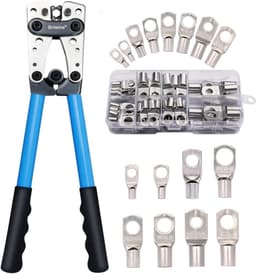
A barrel for 25 mm² on an M8 stud is a different part from a 25 mm² barrel on an M10 stud, and most of the kit bullets in this set never state both. Clearcut Conversions sells a 10 mm² lug with an 8 mm hole at £0.50, which is one retail price for a single lug, not a market average, and it shows the two dimensions you actually need. Brileine at £29.99 claims 60 copper ring terminals. UK reviews call them paper-thin and say the eye tears. Those lugs are a weak link on an inverter lead even when the tool feels heavy. Buy the crimper as a tool and buy lugs that print the mm² and the stud. The stroke, including the tug before you shrink, is on how to crimp a cable lug.

Which tools in this set were used on battery leads

KAIWOLF’s nine UK reviews include a motorhome battery and inverter. It is tool only at £22.99, with six named dies and a ratchet claimed. Dechengbao, also £22.99 and tool only, has the large sample, 4.6 from 669, and UK comments include a campervan conversion, plus a lip if the dies are not square. Its capture does not list the six die sizes. Solder is the habit to drop. BS 7671 expects a soldered joint, where solder is used, to allow for creep and for the temperature under fault. That is a constraint, not a tutorial. A hammer tool can close a lug on a bench and still leave it loose. Mechanism choice is on the hammer crimper vs ratchet page.

Stop before a fixed or oversized run

A leisure lead you can remake in the van doorway is in scope. A run that your inverter manual puts at 70 mm² is not a job for the 6–50 mm² hand tools, even if a hammer title claims 95 mm² and a review has already shown a 50 mm ferrule left loose. The NMAZA hydraulic tool at £67.98 lists dies up to 600 MCM and weighs 5.44 kg. UK reviews still report slack dies and a 70 mm lug that twisted, so a larger tool is not automatically a held cable. Stop when the cable is fixed building wiring, when the joint will be inaccessible, or when the conductor is aluminium. Salt is a reason to buy a lug the seller calls tinned, not a different tool.

Common questions

What tool for a leisure-battery lead?
For copper inside 6–50 mm², the tool-only rotary listings at £22.99 are the ones reviewers actually describe on vans. KAIWOLF’s reviews name a motorhome battery and inverter. Dechengbao’s reviews name a campervan. Both leave you to buy the lug. A kit is a weaker default when UK reviews say the included terminals tear or pull off. Above the stated 50 mm², these hand tools are the wrong size.
Does battery Ah set the cable size?
No. Amp-hours describe storage, not the current in the lead while the inverter is running. A 1000 W load at 12 V is about 83 A whether the bank is modest or large. Size the cable from that current and from the length, then match the lug. A bigger battery can justify thicker cable only when the loads or the run change, not from the Ah figure alone.
Do I need M8 or M10 as well as mm²?
Yes. The barrel follows the cable, and the hole follows the stud on the battery, inverter or fuse holder. A 10 mm² lug with an 8 mm hole is sold as that pair, at £0.50 for one piece at Clearcut Conversions. Kit listings here rarely print both numbers. If the hole is wrong you will drill a palm that was already thin, which is how eyes tear.
Are the copper lugs in the kit good enough for an inverter?
Treat them as unproved. Brileine’s UK reviews call the supplied lugs paper-thin and say the eye tears, including on cable described as a normal car battery lead. Polegas reviews include 16 mm² pulling out of the 16 die. An inverter lead is a bad place to discover that. Buy lugs that state the mm² and the stud, and use the kit terminals only on a joint you can afford to cut off.
Should I crimp or solder a battery lug?
Crimp, then tug, for these extra-low-voltage copper leads. Camper practice and the tool listings point that way, and solder brings creep and fault-temperature duties that BS 7671 already flags for soldered joints. This page is not a soldering method. Heat-shrink goes on after a crimp that has held, not instead of one.

Related pages

Sources

Public sources from the research digest, used for the buyer point of each standard. Shelf prices and star lines are the amazon.co.uk figures in the display file, checked on 22 October 2026.

  1. BSI, BS 7609:1992+A2:2009, uninsulated compression connectors (retrieved 22 October 2026)
  2. Electricity at Work Regulations 1989 (retrieved 22 October 2026)
  3. HSE, work on electrical equipment (retrieved 22 October 2026)
  4. IET Wiring Matters, March 2020, terminal joints (retrieved 22 October 2026)
  5. Power and Cables, Cembre crimping steps (retrieved 22 October 2026)
  6. IEC 61238-1-1:2018, connector type tests (retrieved 22 October 2026)
  7. E-Tech, BS 7609 and BS 7727 (retrieved 22 October 2026)
  8. Eland Cables, crimp and lug testing (retrieved 22 October 2026)