Independent comparisons. We may earn from shop links. More info

Drilling holes in joists UK

Updated: 2026-10-23

You are running a cable or a small pipe across a timber floor, and the shortest route is straight through a joist. Drilling holes in joists UK practice is a position and a diameter first. A neat hole in the wrong third of the span, or through a flange, weakens the floor. The rule below is for solid timber joists, not the chart for an I-joist. The [wood drill bit comparison](/hub/drilling-and-accessories/wood-drill-bit) is the cutters. Products Compared has not surveyed your floor, and a qualifying purchase can earn a commission at no extra cost to you.

You are running a cable or a small pipe across a timber floor, and the shortest route is straight through a joist. Drilling holes in joists UK practice is a position and a diameter first.

Our top picks

On this page

Solid timber joists, and only those

LABC, drawing on Eurocode 5, puts a hole in a solid timber joist on the centre line. Keep it between 0.25 and 0.4 of the span from the support, no wider than 0.25 of the depth, and at least three diameters apart. The table also caps any hole at 65 mm. Notches are a separate limit. That practice is cited to BS EN 1995-1, not to a diagram in Approved Document A. BS 7671, regulation 522.8.14, does not replace the 0.25 figures. NHBC Standards 2024, section 6.4.18, uses a similar zone for joists up to 250 mm deep. Deeper joists go to an engineer.

One example, then the joists this does not cover

On a 3,000 mm span the zone runs from 750 mm to 1,200 mm from the support. A hole 200 mm from the wall plate is outside it. A 150 mm joist allows 37.5 mm. A 100 mm joist allows 25 mm, so a 32 mm spade bit is already too wide. These fractions stop when the joist is not solid timber. James Jones and STEICO both say do not drill the flange. Follow that maker's web chart. Do not drill the timber flanges or the steel webs of a metal-web joist. If you cannot see which joist you have, leave it.
SHALL SHALL 8-piece spade bit set

Testsieger

SHALL SHALL 8-piece spade bit set
8.1/10about £10.99

A bit that can finish the hole

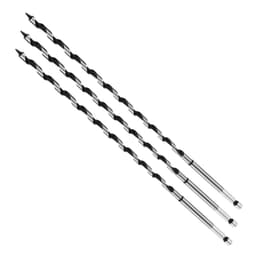
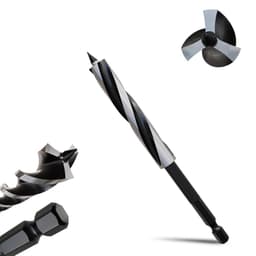
Choose the bit only after the diameter is allowed. A long auger here is 6 mm by 300 mm. That diameter sits inside a quarter of an ordinary joist, and 300 mm reaches further than a 60–120 mm brad bit. It will not bore a 20 mm pipe hole. The other auger is 16 mm by 155 mm, inside the 150 mm example and possibly too short for a deep joist. Use a 32 mm spade only when 32 mm is still within 0.25 of the depth. On a 100 mm joist, it is not. Complaints that cheap spade bits twist are trade chat, not a test of the sets on the buying guide. A hex shank is not an impact rating unless the listing says so.

When the diagram is not enough

The solid-timber picture does not cover a beam, a trimmer or a rafter, a joist deeper than 250 mm under the NHBC wording, or a hole beside a stair, a bath or a heavy partition. Those jobs go to a joiner or a structural engineer. Engineered joists need the manufacturer's chart, not a fraction remembered from a 150 mm joist. If two holes would be closer than three diameters, move one. Stop if you cannot see the services already in the joist. A long bit can meet a cable. If the drill loads up suddenly, reverse out. If you are unsure which rule applies, leave the joist alone.

Common questions

Where along the joist may the hole go?
On a solid timber joist, LABC puts it on the centre line, between 0.25 and 0.4 of the span from the support. On a 3,000 mm span that is 750 mm to 1,200 mm from the wall. A hole next to the support, because the cable is shortest there, is outside that zone. This is not the rule for an I-joist flange.
How big may it be?
No wider than 0.25 of the joist depth, and LABC's table still caps the hole at 65 mm. A 150 mm joist gives 37.5 mm. A 100 mm joist gives 25 mm, so a 32 mm spade bit is already too big. Holes should be at least three diameters apart, centre to centre. Notches use a different limit.
Can I drill near the wall?
Not in the end quarter of a solid joist. The permitted band starts at a quarter of the span, not at the bearing. If the drop to the socket is in that end zone, run the cable along the joist and cross in the middle band, or ask the designer. Do not drill the flange of an engineered joist to dodge the rule.
What if the joist is an I-joist or a metal web?
Do not drill the flange. James Jones and STEICO both say the flange is not a service zone. Use the web chart for that product. Metal-web joists are not a place to drill the timber chords or the steel webs. LABC's 0.25 figures are for solid timber and do not transfer.
Spade bit or auger?
Whichever matches the diameter you are allowed and the thickness you must cross. A 6 mm by 300 mm auger suits a cable through a deep solid joist. A 32 mm spade suits a larger hole only when 32 mm is still within 0.25 of the depth, and about 150 mm of length may not clear a deep joist. Cheap bits that twist are a complaint from site, not a test.
When do I stop and call someone?
When the member is a beam, trimmer or rafter, when it is deeper than 250 mm, when the load is a stair, bath or partition, or when it is engineered and you do not have the hole chart. Also stop if you cannot see existing cables. A clean hole in the wrong place is still the wrong hole.

Related pages

Sources

Public UK sources from the research digest, last checked on 22 October 2026. Shelf prices and star lines are the amazon.co.uk figures on the listings.

  1. HSE: wood dust (retrieved 22 October 2026)
  2. HSE: PUWER overview (retrieved 22 October 2026)
  3. HSE: WD0, wood dust (retrieved 22 October 2026)
  4. HSE: cutting and sanding wood (retrieved 22 October 2026)
  5. LABC: notches and holes in solid timber joists (retrieved 22 October 2026)
  6. NHBC Standards 2024, section 6.4.18 (retrieved 22 October 2026)
  7. GOV.UK: General Product Safety Regulations 2005 (retrieved 22 October 2026)
  8. BSI: BS 328-1:1986 twist drills (retrieved 22 October 2026)